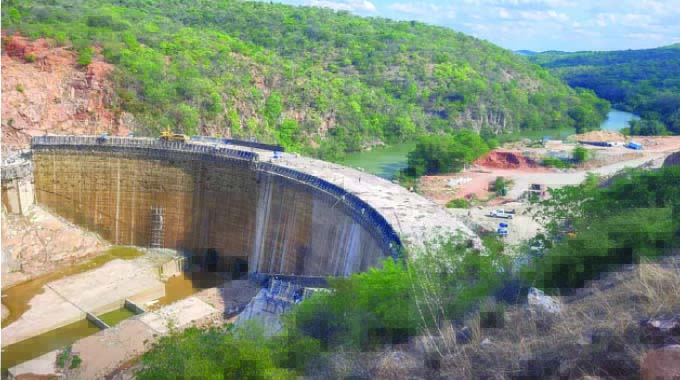
THE Second Republic has invested US$2 billion towards construction of dams and rehabilitation of irrigation infrastructure countrywide since 2019 as the Government shifts towards climate-proofed agriculture to boost national food security and nutrition.
The massive investments in the agriculture sector have enabled the country to shatter records through increased productivity, which is already impacting positively on downstream industries while creating more job opportunities.
With adequate grain reserves for domestic consumption, Zimbabwe is now aiming at exporting excess wheat and maize to the region and beyond as it restores its bread basket status.
Under the Second Republic led by President Mnangagwa, the Government is constructing 12 high-impact dams countrywide including Lake Gwayi-Shangani and Ziminya Dam in Nkayi, Matabeleland North, and Tuli Manyange Dam in Matabeleland South.

President Emmerson Mnangagwa
Others include Kunzvi Dam in Mashonaland East, Marovanyati in Manicaland, Muchekeranwa Dam bordering Manicaland and Mashonaland East provinces, Vungu Dam in Midlands, Silverstroom, Dande, Bindura and Semwa dams in Mashonaland Central.
Matabeleland South has benefited through the rehabilitation of irrigation infrastructure including procurement of equipment at Mtshabezi Dam, Silalabuhwa Dam, Tuli River — Sebasa, and Makwe Dam leading to increased land under irrigation.
In Matabeleland North, the Government has rehabilitated Bubi Lupane Irrigation Scheme, which has transformed livelihoods for villagers.
In an interview on the sidelines of the commissioning of Valley Irrigation Scheme in Kezi, Matobo District in Matabeleland South on Friday, Lands, Agriculture, Fisheries, Water and Rural Development Dr John Basera said the country is reaping the benefits of investing in the agriculture sector.
“We have lined up quite a number of programmes to the effect of climate proofing especially food production sub space so that we still ensure food security with a slant towards food self-sufficiency and food sovereignty,” he said.
“Since 2019, we have invested almost US$2 billion towards dam construction, water harvesting and irrigation development in the country,” said Dr Basera.
“These investments are crucial, especially considering that our country, like many others, is grappling with the adverse effects of climate change, manifesting in the form of droughts, floods, and other extreme weather events.”
He said in terms of cereal production and wheat farming to be specific, the country is now looking to exporting wheat, something that had never been done since the introduction of wheat farming in the 1960s.
“Currently we are sitting on a strategic wheat reserve to the tune of 140 000 metric tonnes and projecting about 430 000 metric tonnes. So, all in and by October we should be having more 500 000 metric tonnes, which is against the national requirement of 360 000 metric tonnes,” he said.
“We can start to prospect and project potential exports of wheat and this will be happening for the first time since the land reform programme and, as well for the first time since the start of the wheat production in the country. The Government, the Second Republic is smashing every record in farming.”
Dr Basera said the agriculture sector has grown by up to 35 percent in the past three years, achieving food self-sufficiency in line with Vision 2030.
He said the Government had to look inward in view of the Covid-19 pandemic and the Russia-Ukrainian conflict, which has strained global supply chains with adverse impacts of import reliant states.
“In fact, it is a major strategic crop in the food security basket. So, as such, two years back we had a plan and our plan was to be wheat and flour sufficient at all cost and at any cost especially because of the Covid-19 realities, which were disrupting the global supply chains for fertilisers, for wheat and so on,” said Dr Basera.
“Also, the geopolitics in eastern Europe taught us to look inward as an economy as Zimbabwe and Africa. We have lined up quite a number of programmes to achieve wheat and flour sufficiency at any cost.”
The Permanent Secretary encouraged farmers to improve their agronomic practices as this can result in reduction of poverty. In order to maximise on productivity, especially on wheat and traditional grains, he said the Government is taking measures to control quelea birds, which threaten crops.
“Quelea birds feast on traditional grains, the moment we suppress the quelea population then we stand a good chance to promote the traditional grains thrust more,” he said,
Meanwhile, over 200 villagers in Kezi, Matobo have benefited from Government’s measures to climate proof the agriculture sector through revitalisation of Valley Irrigation Scheme where they are members. The Government rehabilitated irrigation infrastructure including centre pivots and water pumping systems to ensure the scheme is back on track.
Valley Irrigation Scheme, a brainchild of the Government was established in 1995 but had failed to operate to optimum due to lack of irrigation infrastructure despite sitting on 200-hectares of land.

Tuli-Manyange Dam
The irrigation scheme was supposed to be supported by the Valley Dam but for years the water body was not put to good use as the centre pivot in the area was dysfunctional. This has seen the Government increasing irrigation land from 150 000 hectares in 2020 to 203 000 hectares at the end of June this year with the target being to put 350 000 ha of land under irrigation by 2025.
Dr Basera said the irrigation scheme was rehabilitated with the support from his ministry and the Smallholder Irrigation Revitalization Programme (SIRP).
“The revitalised Valley Irrigation Scheme stands as a tangible testament to the visionary leadership and unwavering commitment of our Government to promote sustainable agricultural practices and overcome the challenges faced by farmers in this region,” he said.
“With the completion of this monumental project, we are opening up a world of opportunities for our farmers to increase their productivity, enhance their livelihoods, and contribute to the economic growth of our nation,” said Dr Basera.
While in the past scheme beneficiaries struggled due inconsistent supply of water, he said the tide has been changed through the investment in viable irrigation infrastructure.
Dr Basera said the scheme will be part of Zimbabwe’s success story that has seen the country achieve food security in cereals in sync with the investments that have been made in the sector.
“These investments are crucial, especially considering that our country, like many others, is grappling with the adverse effects of climate change, manifesting in the form of droughts, floods, and other extreme weather events,” he said.
Dr Basera said the development of the Valley Irrigation Scheme is confirmation that rain-fed farming is no longer sustainable. He said the scheme will also create local employment beyond the district while contributing to economic growth.
“The scheme will create employment opportunities, both directly and indirectly, thus further bolstering the economic prosperity of Matobo District,” said Dr Basera.
Chronicle