Story by Aldridge Dzvene
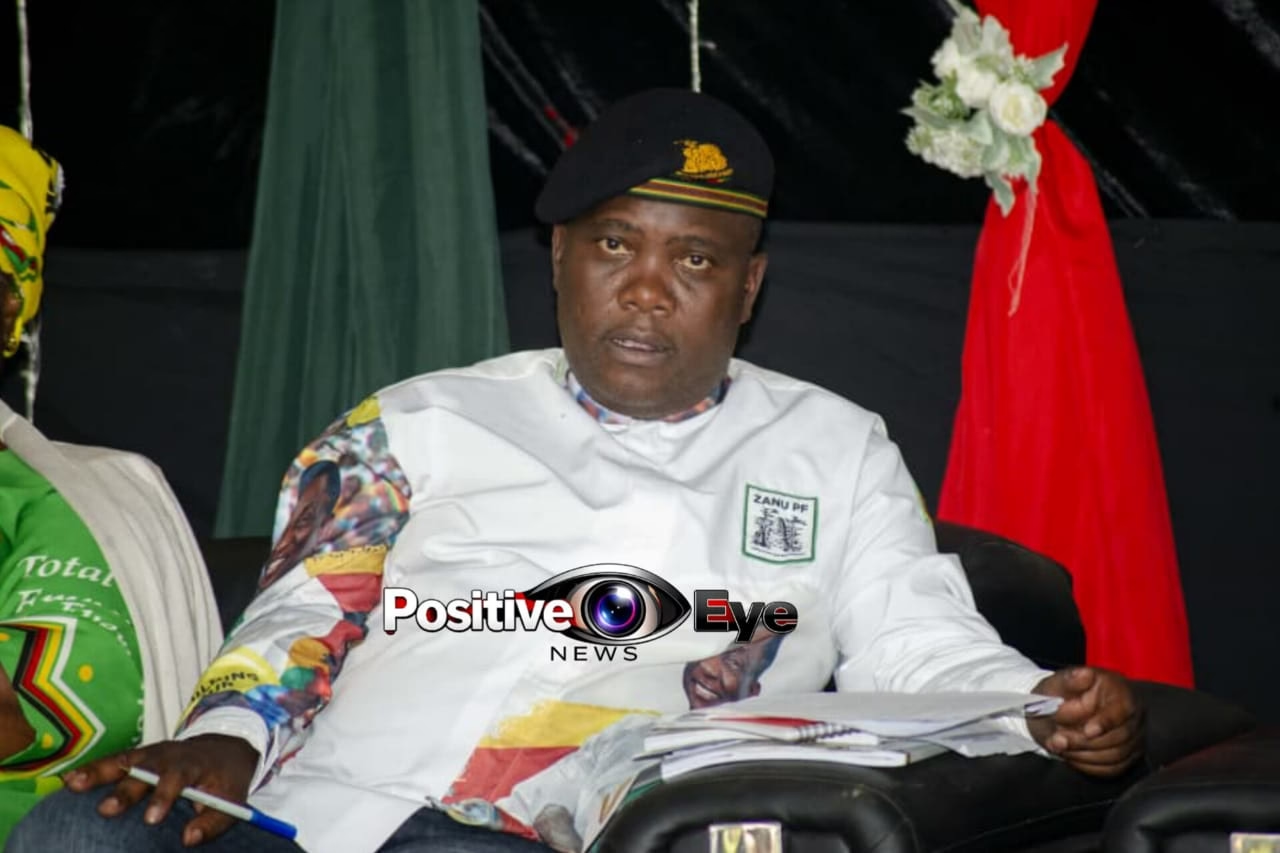
At a conference on terrorism, peace, and international security held in Moscow, ZANU PF Deputy Secretary for Security in the Politburo, Tendai Chirau, delivered a strategically framed address that blended historical memory, ideological continuity, and contemporary geopolitical interpretation into a single coherent narrative of global relations.
The intervention was structured around three interlocking themes: historical injustice, liberation legitimacy, and present-day global power dynamics. Rather than presenting isolated political commentary, the address followed a deliberate sequencing that moved from emotional historical reference points to broader systemic arguments about international order and cooperation.
Opening with appreciation for the hosting platform, Cde Chirau immediately anchored his remarks within a broader commemorative context, referencing Africa Day and the institutional significance of the African Union as a symbol of continental unity and post-colonial political consolidation.
“Allow me to say Happy Africa Day, Viva Africa,” he stated, establishing a tone of continental affirmation before transitioning into historical framing.
A notable feature of the address was the consistent linkage between historical trauma and contemporary global structures. The transatlantic slave trade was presented not only as a historical tragedy but as an early manifestation of systemic external exploitation, described in highly charged terms as a foundational disruption of African societies.
“From the horrors of the transatlantic slave trade to the scars of colonial occupation, Africa has been a battleground for forces that are seeking to dominate rather than cooperate,” he said.
This framing effectively positioned colonial history as the foundation for understanding present-day global inequalities, with particular emphasis on continuity rather than discontinuity between historical and modern systems of influence.
The Zimbabwean liberation experience was then introduced as a case study of resistance, resilience, and eventual political transformation. The narrative highlighted land dispossession, governance exclusion, and identity suppression under colonial rule, but more significantly, it elevated liberation as an outcome of coordinated struggle rather than isolated national effort.
“From that crushing weight, our people found the courage to rise,” he noted, reinforcing a restoration narrative central to post-colonial state identity.
A key structural element in the speech was the deliberate emphasis on regional and international solidarity networks during liberation struggles. The mention of countries such as Tanzania, Zambia, and Mozambique served to reinforce the operational and logistical ecosystem that supported liberation movements in Southern Africa.
Beyond the regional theatre, the address extended into Cold War-era alliances, referencing external actors that provided ideological grounding and material support. This inclusion functioned to situate Zimbabwe’s liberation within a wider global contestation of political systems.
The statement that “it was a shared conviction that terrorism anywhere threatens justice everywhere” introduced a universalising principle, linking disparate geopolitical experiences under a single normative framework of resistance and justice.
The conceptual centrepiece of the intervention was the articulation of neocolonialism as a continuing structural condition rather than a historical phase. The term was deployed expansively, encompassing economic influence, political leverage, and ideological shaping of international systems.
Within this framing, the call for pragmatism and unity functioned as a transition from historical narrative to strategic prescription. The emphasis was not on rhetorical alignment alone, but on coordinated action among states and movements perceived to share similar historical trajectories.
“I implored the delegates to be pragmatic and united in the fight against neocolonialism and all its forms,” he said, reinforcing the need for cohesion over fragmentation.
The selection of Moscow as the platform adds an additional layer of contextual significance. The venue situates the discourse within a broader multipolar dialogue space where alternative interpretations of global governance, sovereignty, and security architecture are increasingly prominent. The presence of multiple ideological currents at such forums typically allows for convergence on themes of non-interference, strategic autonomy, and rebalancing of global power structures.
In aggregate, the address reflects a consistent narrative architecture: historical grievance → liberation legitimacy → solidarity networks → systemic critique → strategic unity. This sequencing is characteristic of messaging designed to reinforce continuity between past struggle and present geopolitical positioning, while simultaneously aligning with broader international conversations around sovereignty and global order reconfiguration.
The overall effect is the presentation of a worldview in which historical experience is not separate from current diplomacy, but rather serves as its interpretive foundation.