By Aldridge Dzvene
The Parliamentary verification visit to Mphoengs Border Post has revealed a facility whose importance extends well beyond the routine processing of travellers.
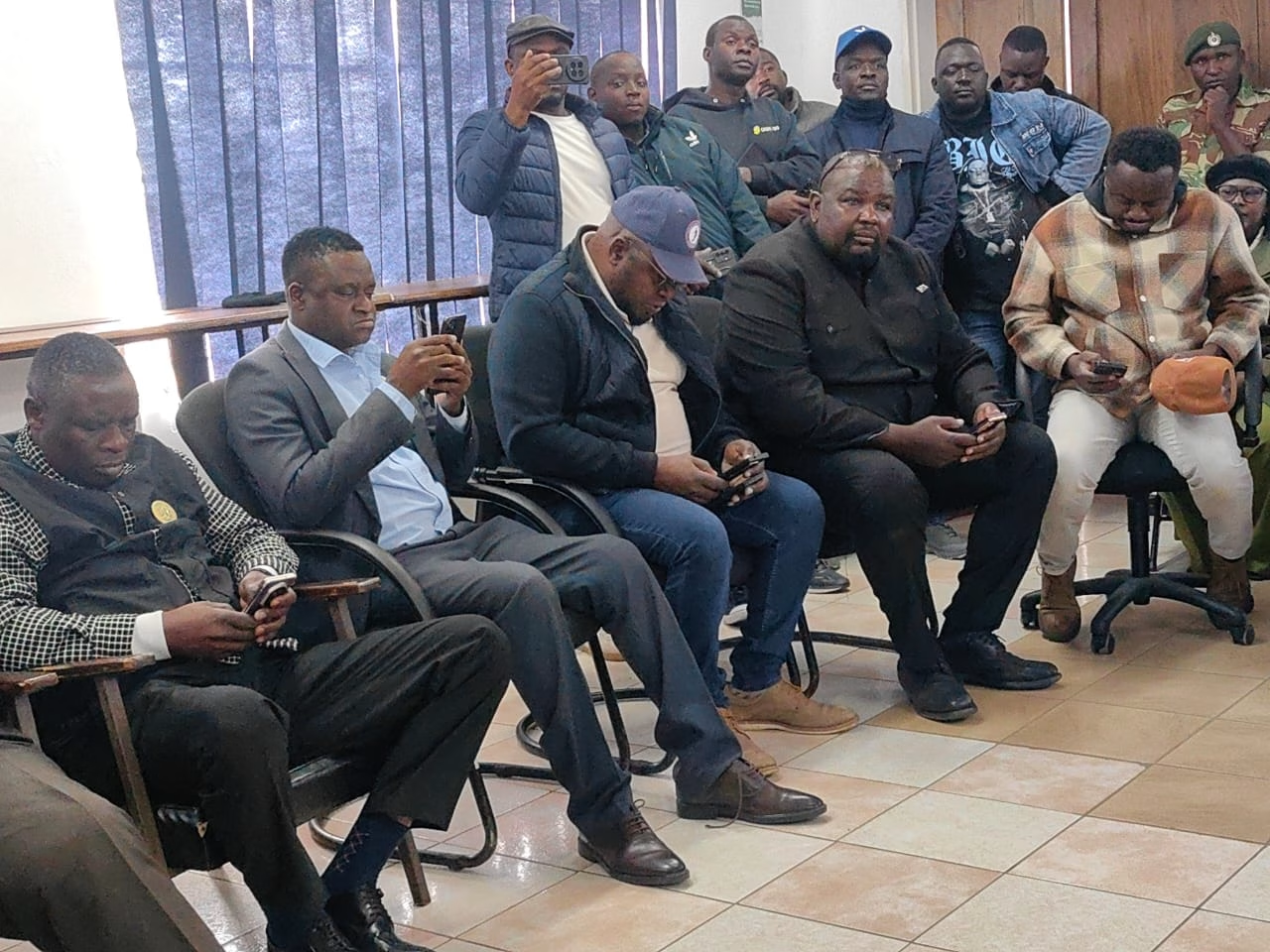
Situated along the Zimbabwe-Botswana boundary, Mphoengs has become an important link for communities on both sides of the border and, increasingly, part of Zimbabwe’s response to regional population movements. The Joint Portfolio Committee on Defence, Home Affairs and Security Services and the Thematic Committee on Peace and Security visited the border post as part of their assessment of Reception and Transit Centres for Zimbabweans returning from South Africa and people travelling through Zimbabwe towards Malawi.
Their observations point to a border post that has acquired a degree of institutional maturity, but which may still be operating below its full potential.
The infrastructure is one of its clearest strengths. The bridge connecting Zimbabwe and Botswana, upgraded customs facilities and improvements at the border have created a more functional crossing for people using the facility. Immigration officials also reported strong working relations with their Botswana counterparts, an important advantage in an environment where the management of cross-border movement depends as much on cooperation between neighbouring authorities as it does on physical infrastructure.
That relationship became particularly important during periods of unrest in South Africa. According to officials, Botswana adopted a practical approach towards Zimbabweans fleeing the attacks, facilitating their return home rather than simply detaining them. The provision of a dedicated vehicle to expedite their movement illustrates how effective coordination between neighbouring countries can prevent temporary displacement from becoming a more complicated humanitarian and administrative problem.
Such cooperation should not be taken for granted. Border communities routinely live with the consequences of decisions made by governments several kilometres away. When authorities coordinate effectively, movement can be managed with less disruption to families and communities. When they do not, the burden is usually felt first by ordinary travellers.
The views of residents around Mphoengs are therefore equally important to the Parliamentary findings.
Communities in areas such as Ingwizi and Kezi welcomed the border post because its location reduces the time and cost of travelling to access the crossing. That observation points to one of the less discussed functions of border infrastructure: distance itself has an economic cost.
For a trader, farmer, transport operator or ordinary household, every additional kilometre can mean higher fuel costs, longer journeys and greater expenditure of time. A nearby crossing can therefore have value even before a single additional truck passes through it.
It is against this background that the community’s call for commercial vehicles to be processed at Mphoengs deserves serious consideration.
The current limitation to private vehicles means that the border is providing connectivity without fully participating in the commercial activity that such connectivity could generate. If commercial traffic were eventually accommodated, Mphoengs could become considerably more important to the surrounding economy, particularly by shortening routes for legitimate businesses and producers that currently rely on other crossings.
But that transition would need to be carefully planned.
Commercial traffic brings substantially different requirements from private travel. Customs would have to handle cargo documentation and inspections; appropriate facilities would be required for trucks; roads and holding areas would need to withstand increased traffic; and agencies responsible for agricultural, veterinary and other regulatory controls would need sufficient capacity.
The question, therefore, is not simply whether Mphoengs should handle commercial vehicles. It is whether the volume and character of potential trade justify the additional investment required to make the facility a properly functioning commercial crossing.
That is a question government can answer through evidence.
A feasibility assessment could establish the likely traffic volumes, commodities, economic benefits, infrastructure requirements and operating costs. It could also determine what categories of commercial vehicles or goods could initially be accommodated without creating unnecessary congestion at the crossing.
Such an approach would allow Mphoengs to develop according to the needs of the communities and businesses it actually serves rather than attempting to replicate the functions of larger border posts.
There is also a regional dimension.
Zimbabwe’s geographical position gives it an important role in connecting Southern African markets. Efficient border crossings are consequently not only national administrative assets; they form part of the region’s wider transport and trading network. The more efficiently legitimate movement is handled between neighbouring countries, the greater the potential for border communities to participate in that regional economy.
Mphoengs is well placed to benefit from this because of its proximity to communities that already use the crossing and its direct connection to Botswana.
The Parliamentary visit also highlights the value of viewing border infrastructure as a long-term public investment. A bridge, customs facility or immigration hall should not be assessed only by whether it is functional on the day of inspection. Its real value lies in what it enables over the next decade.
For Mphoengs, that could include greater passenger movement, carefully regulated commercial activity, improved local services and stronger cooperation between Zimbabwean and Botswana authorities.
However, expansion must be accompanied by adequate controls. As traffic increases, so does the importance of effective customs enforcement, traveller identification, cargo inspection and inter-agency information sharing. The objective should be to ensure that increased legitimate activity does not create avoidable gaps that can be exploited by criminals.
This is particularly relevant because border communities often know the crossing and surrounding terrain better than anyone else. Their experiences should form part of government planning. Residents have already identified the practical benefit of Mphoengs; they can also provide valuable information about transport patterns, trading activity and the difficulties that currently limit use of the facility.
Parliament’s role is important here because its oversight can turn such observations into policy questions.
Rather than simply recording that residents want commercial vehicles processed at Mphoengs, the relevant authorities should establish what would be required to make that possible, what the likely benefits would be and what risks would need to be managed.
That would give the community’s request a practical route from consultation to policy.
The broader lesson from Mphoengs is that successful border management is ultimately about understanding the movement of people, goods and economic activity across a particular geographical space. Every border has its own character. A system that works at Beitbridge or Plumtree cannot automatically be transplanted to Mphoengs.
Mphoengs appears to have developed a distinct role: a relatively accessible crossing serving communities that value proximity, supported by good infrastructure and constructive relations between the two countries.
Its next phase should build on those strengths.
The priority should be to determine whether the border can safely and economically accommodate a greater range of legitimate activity, particularly commercial traffic, while preserving the efficiency that residents already value.
For Zimbabwe, that would turn the Parliamentary visit into something more useful than an inspection.
It would provide an opportunity to ask a fundamental policy question: what should Mphoengs become over the next five to ten years?
If the answer is a more capable community and commercial gateway, then planning should begin now.
The infrastructure is already there. The relationship with Botswana is working. The communities have identified the demand.
What remains is for government to determine the scale of the opportunity—and build accordingly.