By Aldridge Dzvene
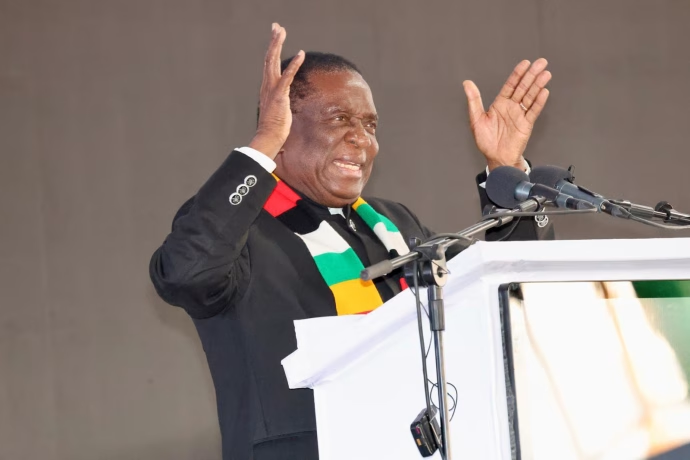
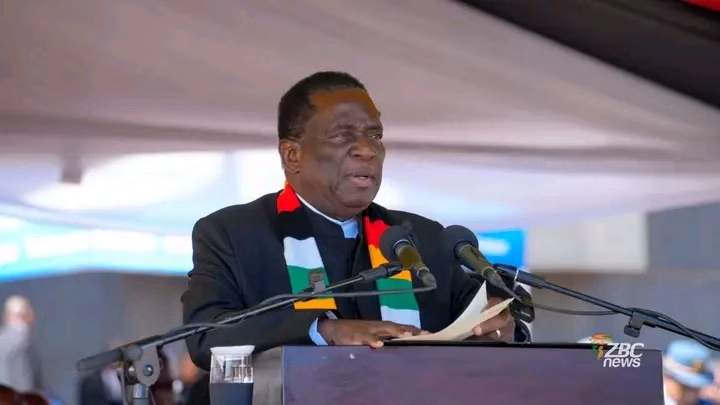
HARARE – The burial of National Hero Cde Edward Raradza has presented Zimbabwe with a question deeper than remembrance: what happens to a nation when the generation that sacrificed for its freedom is gradually replaced by generations that did not experience the cost of obtaining it? Addressing mourners at the National Heroes’ Acre, President Dr Emmerson Dambudzo Mnangagwa placed Raradza’s life within that wider national question, describing him as a nationalist, agricultural visionary, miner, industrialist and spiritual leader whose contribution extended across politics, production, business and community development.
The significance of that description lies in the breadth of Raradza’s service. He was not remembered simply for occupying political positions. His record after Independence reflected the transition from political liberation to economic participation, as he served the Party, entered Parliament, worked with farmers, produced commercially, invested in mining and established industrial capacity. That trajectory provides a useful lens through which to understand patriotism in contemporary Zimbabwe, because the meaning of national service changed after 1980. During the liberation struggle, patriotism demanded personal sacrifice against a system that denied the majority political and economic rights. Raradza experienced that reality directly through political activism, persecution and detention. After Independence, however, the challenge became how to make the country work, requiring citizens prepared to convert political freedom into productive capacity, functioning institutions, employment and economic resilience.
Raradza’s agricultural record illustrates that transition. He did not merely advocate for farmers; he became a farmer, achieved national recognition in tobacco, cotton and livestock production, participated in the mobilisation of farmers and helped expand access to agricultural machinery and inputs. His experience reinforces a strategic reality that remains relevant to Zimbabwe, political sovereignty becomes vulnerable when a country lacks productive capacity and depends excessively on external sources for food, capital, technology, energy or industrial inputs. Economic independence therefore cannot remain an abstract political objective. It has to be built through citizens and institutions capable of producing, investing and creating value.
His mining activities take that argument further. Through Zambezi Gas, Raradza entered a sector historically associated with substantial external capital and demonstrated that Zimbabweans could establish and operate a large-scale mining enterprise. The company supplied coal to national electricity generation, exported regionally and created direct and indirect employment. The strategic significance is not simply that a Zimbabwean owned a mining company. It is that ownership was connected to productive capability, employment, energy security and industrial participation. The question for Zimbabwe is therefore not only who owns its resources, but who possesses the capital, technical knowledge, managerial competence and industrial capacity to transform those resources into national economic power.
That context gives greater weight to the President’s call for more industrialists in the mould of Raradza, alongside value addition, beneficiation, local industries and greater participation in global value chains. The implication is that patriotism must increasingly be measured by contribution rather than declaration. A farmer who raises production strengthens food security; an industrialist who creates employment strengthens economic resilience; a professional who develops local expertise reduces dependence on external capacity; and a young Zimbabwean who builds an enterprise expands the productive base. Patriotism, in this sense, becomes an economic and social responsibility rather than merely a political sentiment.
Raradza’s political and community record reinforces the same principle. As a Member of Parliament for Muzarabani South, he was associated with grassroots development projects and agricultural initiatives benefiting small-scale farmers, including women’s cooperatives. His later service as a Bishop adds another dimension, with the President describing the relationship between Church and State as an important component of national development and emphasising patriotism, integrity, discipline, honesty and love of country. These qualities are not merely moral abstractions in a development context. They contribute to social trust, institutional stability and the discipline required to sustain long-term national programmes.
There is also a generational lesson embedded in the President’s tribute. Those who participated in the liberation struggle understood the cost of failure because they lived under colonial rule. Younger Zimbabweans inherited the outcome without necessarily experiencing the sacrifice that produced it. The danger is that inherited freedom can eventually be treated as an entitlement rather than a responsibility. Raradza’s life challenges that tendency by showing that the defence of Independence did not end at the battlefield or with the raising of the national flag. It continued through productive agriculture, industrial investment, community development, political service and the strengthening of national institutions.
The National Heroes’ Acre therefore carries a significance beyond commemoration. It preserves the memory of sacrifice, but the real test of that memory is whether subsequent generations reproduce the values that made sacrifice meaningful. Raradza’s legacy, as presented by the President, is one of loyalty, persistence, hard work, production, enterprise, service and national responsibility. His story consequently reframes the question of patriotism for a country now confronting the demands of industrialisation, economic transformation and generational renewal.
The liberation generation secured the political space in which Zimbabwe exists today. The present generation has the responsibility to make that space productive, resilient and capable of supporting future generations. That is perhaps the strongest lesson from Raradza’s life: national sacrifice is not honoured simply by remembering those who made it. It is honoured by continuing the work they began.
For Zimbabwe, the enduring tribute to Cde Edward Raradza may therefore be found not only at the Heroes’ Acre, but in productive farms, functioning industries, successful Zimbabwean enterprises, skilled citizens, stronger communities and young people who understand that inheriting a country also means accepting responsibility for building it.