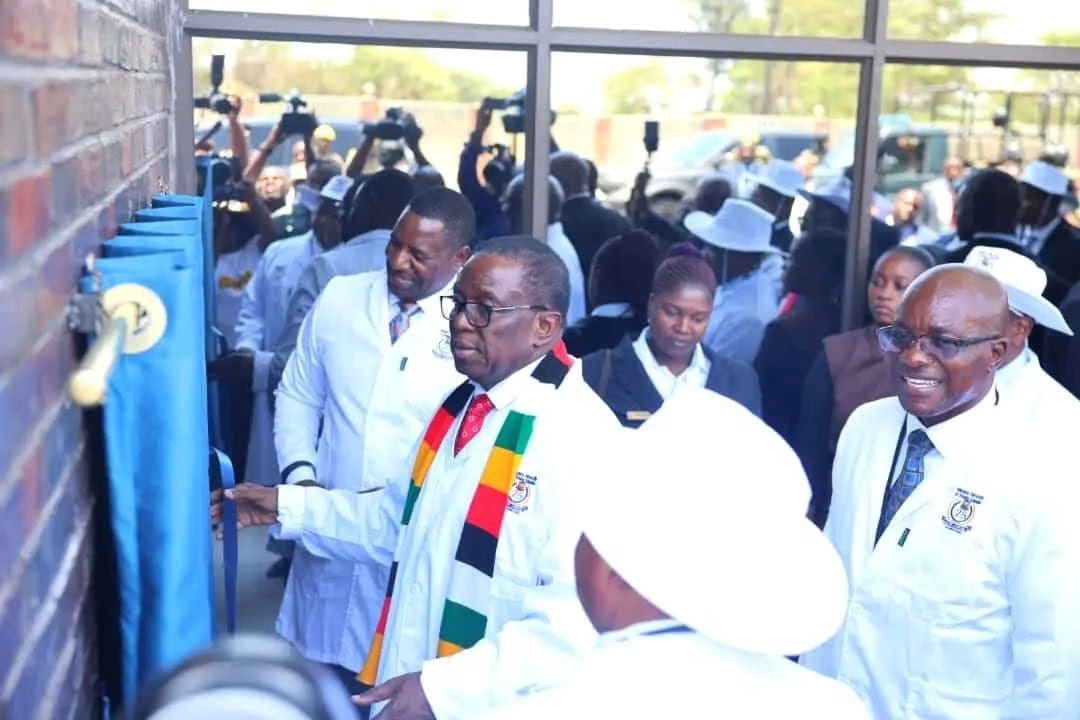
President and Chancellor of Bindura University of Science Education, Cde Dr Emmerson Dambudzo Mnangagwa, yesterday led the institution’s 25th graduation ceremony and commissioned a series of strategic infrastructure and industrial projects, highlighting the Second Republic’s drive to reposition tertiary institutions as engines of skills development, innovation and production.
A total of 2,371 graduands were capped under the theme, “Shaping and Creating the Future: Building Zimbabwe,” while the President’s visit brought into focus a broader transformation taking place at the university, where academic training is increasingly being connected to manufacturing, enterprise and commercial activity.
The commissioning of the new university entrance, shopping mall, optometry clinic and BUSE Industrial Park demonstrates an expanding institutional model in which higher education infrastructure is expected to support economic activity beyond the conventional classroom and lecture theatre.
The Industrial Park provides the clearest expression of that shift. At its centre is the Palpo Technologies Assembly Plant, which will assemble laptops, cellphones and tablets, creating a direct link between university-based skills and domestic technology production.
Strategically, the significance of the plant extends beyond the assembly of electronic devices. It creates a platform for technology transfer, skills development, local production and import substitution, while providing opportunities for students and graduates to connect research and technical knowledge with commercial production. This is the practical meaning of the Education 5.0 thrust, where the value of higher education is increasingly measured not only by qualifications produced, but by innovations, enterprises and solutions emerging from institutions.
For Mashonaland Central, the developments add another layer to the province’s economic infrastructure. A university with graduates, research capacity, manufacturing facilities and commercial services can become an anchor for surrounding businesses, suppliers and technology-driven enterprises, potentially strengthening local value chains and creating employment beyond the university itself.
The graduation component remains equally significant. With 53 percent of the graduands being female and 47 percent male, BUSE continues to expand the skilled human-capital base required to support Zimbabwe’s transformation. The challenge now is to ensure that increasing numbers of graduates move beyond qualification into productive economic participation, entrepreneurship, research, industry and public service.
This is where the industrialisation component of the BUSE model becomes important. Zimbabwe’s development ambitions require a closer relationship between universities and the productive economy, particularly as the country seeks to increase domestic manufacturing, beneficiation, technological capability and value addition. The Industrial Park therefore represents an attempt to narrow the traditional gap between what institutions teach and what the economy produces.
The broader strategic question is whether such university-based industrial platforms can be scaled and connected to markets, finance, research networks and private-sector investment. If successfully integrated, institutions such as BUSE can become regional innovation centres capable of producing both skilled people and commercially useful solutions for industry.
President Mnangagwa was welcomed to Mashonaland Central by Minister of State for Provincial Affairs and Devolution, Cde Christopher Magomo, and BUSE Vice Chancellor, Professor E. Mwenje. Also in attendance were Minister of Home Affairs and Cultural Heritage, Hon. Dr Kazembe Kazembe; Minister of Information and Broadcasting Services, Dr S. Zhemu; ZANU PF leadership, senior Government officials, university authorities, graduates and their families, among other dignitaries.
The significance of the day therefore extends beyond the graduation of 2,371 students. It reflects an attempt to bring together human capital, infrastructure, technology and production within one institutional ecosystem.
For the Second Republic, that convergence is central to the wider development equation. A university that produces graduates but leaves their knowledge disconnected from production has limited economic reach. A university that can train, innovate, manufacture, commercialise and feed skilled people into the economy becomes part of the country’s industrial infrastructure.
The transformation at BUSE consequently offers Mashonaland Central a potential new economic node while providing a practical demonstration of how Education 5.0 can move from policy language into physical infrastructure and productive activity.
The ultimate measure, however, will be what these facilities produce, the enterprises they stimulate, the technologies they develop, the jobs they create and the number of graduates who successfully convert knowledge into economic value. That is where the deeper test of Zimbabwe’s education-to-industrialisation strategy will lie as the country pursues an empowered, prosperous and industrialised economy by 2030.