By Aldridge Dzvene
HARARE — Zimbabwe has formally placed the legacy of the Munhumutapa within the country’s national calendar, creating a new public holiday that goes beyond the ordinary designation of a non-working day and opens a broader conversation about history, identity, heritage and the meaning of Zimbabwean statehood.
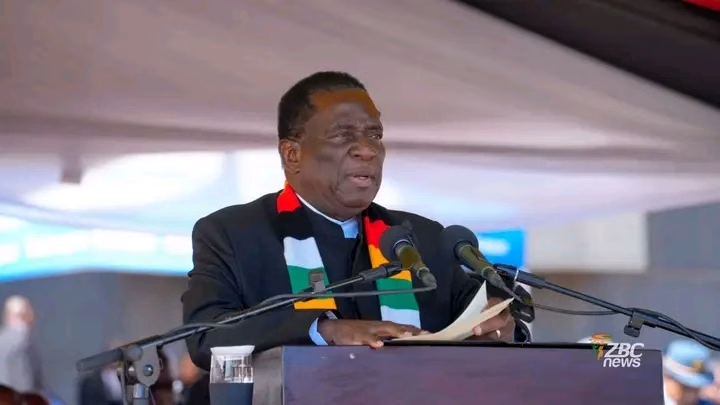
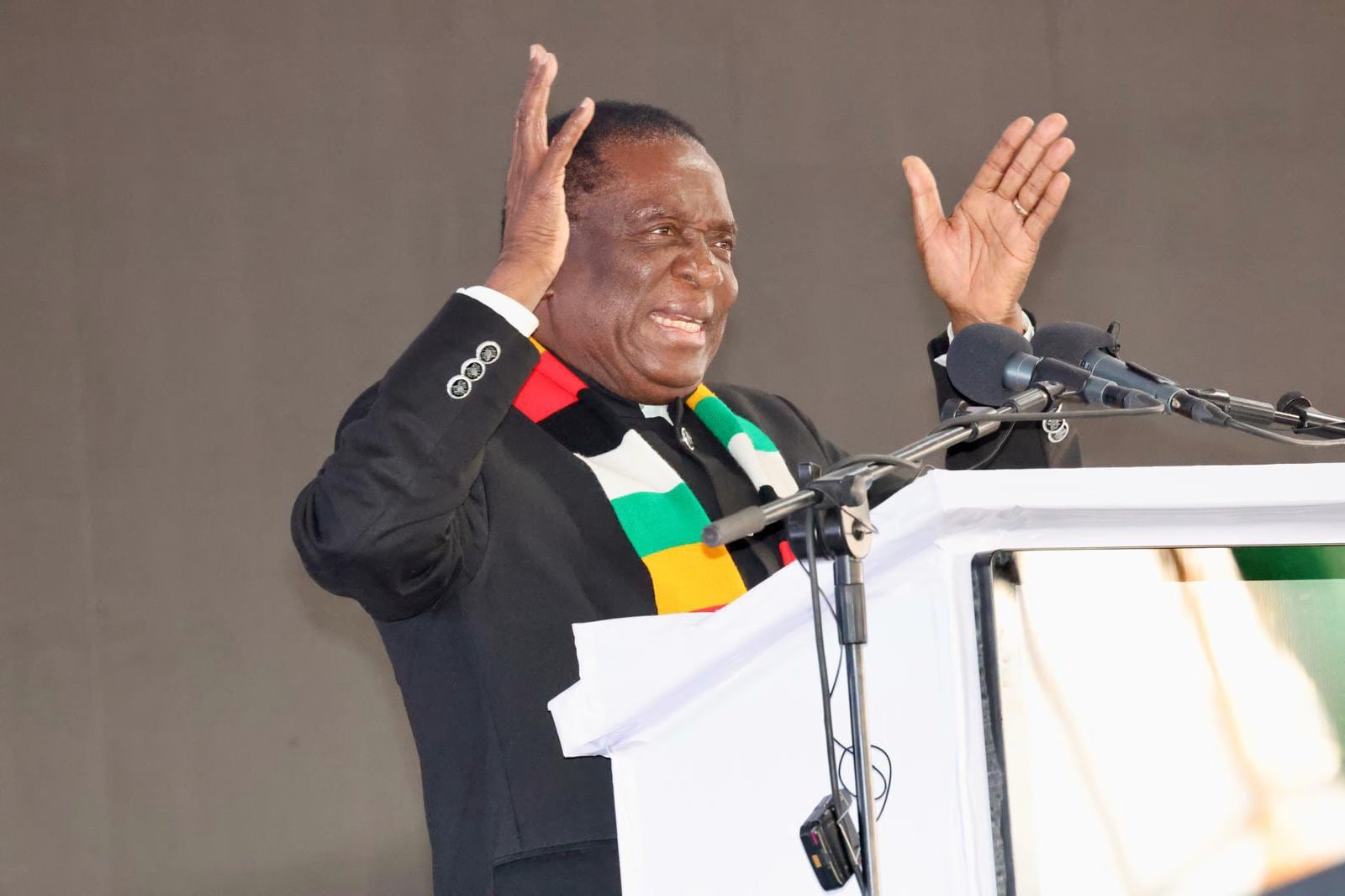
In a proclamation through Statutory Instrument 148 of 2026, issued under Section 2(2) of the Public Holidays and Prohibition of Business Act [Chapter 10:21], His Excellency Dr Emmerson Dambudzo Mnangagwa, President and First Secretary of ZANU PF, declared 15 September every year a public holiday to be known as Munhumutapa Day.
“It is hereby declared that the 15th of September every year henceforth, shall be a public holiday to be known as Munhumutapa Day,” the proclamation states.
The legal instrument gives permanent statutory recognition to a day whose significance lies principally in Zimbabwe’s pre-colonial political and economic history.
The Munhumutapa, also known as Mutapa, was not merely a traditional royal institution. Historical evidence associates the Mutapa state with extensive political authority, agriculture, mining, cattle production and long-distance commerce, with gold and ivory forming important components of its external trade. Its commercial networks connected the interior with trading systems extending towards the Indian Ocean.
That history gives the new holiday a potentially deeper national-development meaning.
Zimbabwe’s contemporary economic strategy places considerable emphasis on agriculture, mining, beneficiation, infrastructure, industrialisation, trade and the mobilisation of domestic resources. Many of these sectors have historical precedents in the societies that existed long before colonial rule.
The Mutapa state, for example, participated in regional and international trading networks and derived wealth from agricultural production, livestock, mining and commerce. Its experience demonstrates that the territory that constitutes modern Zimbabwe was connected to wider economic systems long before the arrival of European colonial powers.
Munhumutapa Day therefore provides an opportunity to shift the national historical narrative from one centred almost exclusively on colonialism and the liberation struggle towards a longer continuum of African state formation, economic organisation, technological capability and international engagement.
This does not diminish the importance of the liberation struggle. Rather, it adds another historical layer to the national story.
The significance is particularly important in the context of Zimbabwe’s ongoing drive to strengthen indigenous knowledge, cultural confidence and national identity.
For decades, much of Africa’s history was interpreted through colonial frameworks which frequently portrayed pre-colonial African societies as politically fragmented and economically disconnected from the wider world. The archaeological and historical record tells a more complicated story.
Great Zimbabwe, for instance, was an important centre of production and trade, with commercial networks extending towards the Indian Ocean. The emergence of the Mutapa state represented another major phase in the political and economic development of societies in the region.
The new holiday consequently presents Zimbabwe with an opportunity to make heritage part of national development rather than treating history as something confined to museums and academic texts.
A properly institutionalised Munhumutapa Day could become a platform for schools, universities, museums, traditional leaders, researchers, tourism operators and cultural institutions to examine the country’s pre-colonial systems of governance, production, architecture, trade and diplomacy.
There is also an economic dimension.
Zimbabwe’s tourism sector already markets Great Zimbabwe and other heritage sites as important components of the country’s destination offering. A national day centred on the Munhumutapa legacy could potentially stimulate heritage tourism, cultural festivals, academic conferences, exhibitions, traditional performances and domestic travel.
That opportunity, however, will depend on how the day is developed.
If Munhumutapa Day becomes merely another entry on the public-holiday calendar, its historical value could quickly be reduced to ceremonial speeches and political symbolism.
Its greater value would emerge if it becomes an annual national platform for historical research, heritage conservation, cultural education and economic activity.
Universities could use the period to showcase archaeological and historical research. Museums could curate exhibitions around Great Zimbabwe, Mutapa and subsequent African states. Schools could organise history programmes. Tourism authorities could develop heritage routes linking major archaeological and cultural sites. Traditional leaders could participate in documenting oral histories and indigenous knowledge systems.
Such an approach would turn the holiday from a commemorative date into an instrument of historical education and cultural economy.
There is also an important question of historical scholarship.
The history of the Mutapa state is complex, with oral traditions, archaeological evidence and Portuguese documentary accounts sometimes presenting different interpretations of its origins, expansion and succession. Scholars have debated the relationship between Great Zimbabwe and the emergence of the Mutapa state, as well as the precise chronology of early rulers.
That complexity should not weaken the case for commemorating the heritage. Instead, it makes rigorous scholarship even more important.
A mature national heritage policy should allow Zimbabweans to celebrate their history while continuing to investigate it critically.
This is where Munhumutapa Day could acquire significance beyond the politics surrounding its creation.
National identity is strongest when citizens understand that the country’s story did not begin with colonial occupation, nor did it end with independence in 1980. Zimbabwe’s modern state sits within a much longer historical continuum of African societies that developed systems of authority, production, commerce, diplomacy and culture.
The creation of Munhumutapa Day consequently creates a new question for the country: what should Zimbabwe do with its history?
The answer should be more ambitious than commemoration.
Zimbabwe can use the day to connect historical achievement with contemporary development, demonstrating to younger generations that the country’s capacity for production, trade, innovation and organisation has deep indigenous roots.
In that sense, the most important legacy of Munhumutapa Day may not be the holiday itself, but the national conversation it creates.
A country that knows where its institutions, industries, communities and cultural traditions came from is better positioned to define where it wants to go.
As Zimbabwe pursues Vision 2030 and seeks to strengthen domestic production, beneficiation, investment and international trade, Munhumutapa Day offers an opportunity to place that modern transformation within a much longer Zimbabwean story, one that reaches from the stone walls of Great Zimbabwe and the trading networks of the Munhumutapa state to the infrastructure, industries and economic ambitions of the present Republic.
The challenge now is to ensure that the history being commemorated is researched, taught, preserved and translated into tangible cultural and economic value.
That is where a public holiday can become more than a day off.
It can become a day on which Zimbabwe remembers that its history contains not only memories of conquest and resistance, but also a record of statecraft, production, commerce, innovation and engagement with the wider world.