HARARE — Zimbabwe is heading into the 2026/2027 summer rainfall season under a heightened risk of below-normal rainfall, with Government warning of prolonged dry spells, erratic rainfall and warmer-than-normal temperatures as a very strong El Niño phenomenon increasingly shapes the country’s climate outlook.
The warning, presented to Cabinet by the Minister of Environment, Climate and Wildlife, Hon. Evelyn Ndlovu, places preparedness at the centre of Zimbabwe’s approach to the coming agricultural and water season, with Ministries, Departments, Agencies and other stakeholders being urged to strengthen contingency measures before the full effects of the anticipated dry conditions emerge.
The National Climate Outlook covers the period from October 2026 to March 2027 and follows the consensus regional outlook produced at the 33rd Southern African Regional Climate Outlook Forum held in Swakopmund, Namibia, from 25 to 28 August 2026.
At the centre of the forecast is El Niño, a climate phenomenon associated with changes in atmospheric and oceanic conditions that can significantly alter rainfall patterns across Southern Africa.
For Zimbabwe, the immediate concern is the increased probability of a below-normal rainfall season.
The October to December 2026 period is expected to carry an increased likelihood of below-normal rainfall across the country. However, the outlook also stresses that rainfall will not be uniform, meaning that some areas could still receive meaningful rainfall even within an overall dry season.
This geographical variation is particularly important for Zimbabwe because national rainfall averages can conceal substantial differences between districts.
Some districts in Matabeleland South and Masvingo, for example, have a chance of receiving near-normal rainfall in December, despite the broader expectation of drier-than-normal conditions.
The second part of the season, covering January to March 2027, presents a similarly mixed but challenging picture.
Northern and eastern parts of the country face an increased likelihood of below-normal to normal rainfall, while the southern and western areas are expected to experience normal to below-normal rainfall. The forecast suggests that cumulative rainfall in these areas could remain broadly comparable with long-term averages, although this does not necessarily mean rainfall will be evenly distributed throughout the season.
That distinction could prove critical for agriculture.
A season can record rainfall totals close to normal while still producing poor agricultural outcomes if the rain arrives too late, falls in short intense episodes or is interrupted by prolonged dry spells during critical stages of crop development.
The national outlook is therefore warning not simply of less rain, but of greater uncertainty in when and where that rain will arrive.
The expected erratic distribution of rainfall, combined with frequent and potentially extended dry spells, creates a risk that farmers and communities could face periods of moisture stress even when rainfall occurs elsewhere in the country.
This places a premium on early planning.
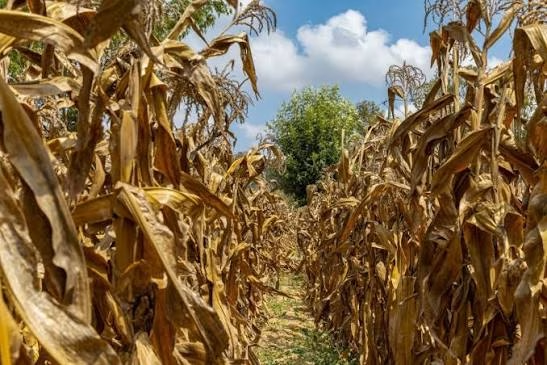
For Zimbabwe’s agricultural sector, water availability is one of the most important determinants of productivity. A prolonged dry spell can affect crop establishment, livestock condition, pasture availability and the reliability of household water sources.
The impact can extend beyond agriculture into food prices, rural incomes, energy generation, water supply and overall economic activity.
This is why Government’s emphasis on water harvesting and conservation is particularly significant.
Rather than waiting for rainfall shortages to become a crisis, the forecast provides an opportunity to strengthen water management ahead of and during the season. Water harvesting infrastructure, dam management, conservation measures and efficient utilisation of available water resources can help communities and productive sectors build greater resilience against rainfall shocks.
The outlook also has implications for livestock-producing areas, where reduced pasture and water availability can place additional pressure on farmers.
The southern and western parts of Zimbabwe, already characterised by relatively drier climatic conditions, will require particular attention if below-normal rainfall combines with extended periods of high temperatures.
At national level, the forecast reinforces the importance of contingency planning across Government.
A rainfall season is not only an agricultural event. Its performance influences multiple parts of the economy, including food security, rural livelihoods, water supply, electricity generation and disaster preparedness.
Early warning therefore provides an opportunity to coordinate interventions before vulnerabilities become emergencies.
The most important message from the outlook is that the forecast should not be interpreted as a certainty that every part of Zimbabwe will experience drought conditions throughout the season.
Climate outlooks describe probabilities rather than guaranteeing weather outcomes for individual communities.
The reference to local variations is therefore important. Conditions can change during the season, and district-level rainfall can differ significantly from the national picture.
This makes regular updates from the Meteorological Services Department particularly important.
As the season progresses, more localised forecasts can help farmers, businesses, local authorities and communities make decisions around planting, water management and other activities that depend heavily on weather conditions.
For farmers, the forecast could encourage greater attention to moisture conservation, water harvesting, appropriate crop choices and flexible planting decisions where conditions permit.
For Government, the challenge is broader, ensuring that early warning information is converted into early action.
Zimbabwe’s experience with variable rainfall has repeatedly demonstrated that the economic cost of responding to a crisis can be substantially greater than the cost of preparing for one.
The 2026/2027 outlook therefore provides a planning window.
With the possibility of a very strong El Niño and an increased likelihood of below-normal rainfall, the priority is to strengthen resilience before prolonged dry spells begin to place pressure on households, agriculture and water systems.
The forecast is ultimately less about predicting a difficult season than about determining how prepared Zimbabwe will be if that season materialises.
If water conservation, contingency planning, climate information dissemination and agricultural preparedness are intensified early, the country can reduce the impact of rainfall shocks.
The coming six months will consequently test not only Zimbabwe’s climate resilience, but also the effectiveness of its ability to turn scientific early-warning information into practical action on the ground.