By Aldridge Dzvene
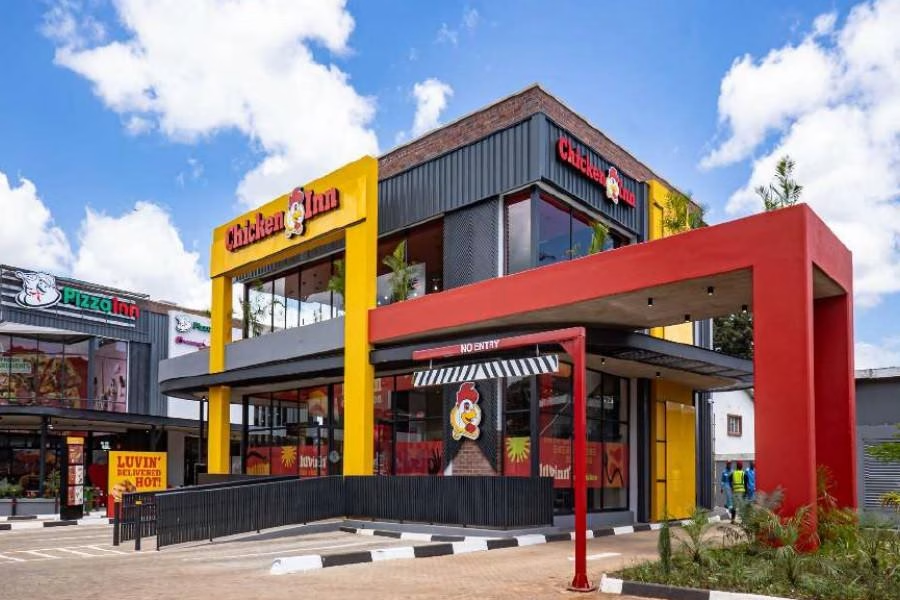
HARARE — Simbisa Brands’ recognition by the Zimbabwe Revenue Authority (ZIMRA) is more than an award for tax compliance. It highlights the growing importance of large formal businesses in expanding Zimbabwe’s domestic revenue base as the country seeks to finance more of its development from economic activity generated at home.
The Victoria Falls Stock Exchange-listed quick-service restaurant group was honoured among leading revenue contributors during ZIMRA’s Silver Jubilee celebrations, marking 25 years of the authority’s work in revenue mobilisation and service delivery.
The recognition comes at a time when the relationship between business growth and national revenue has become increasingly important. As Government places greater emphasis on domestic resource mobilisation, the expansion of companies operating within the formal economy provides a wider base from which revenue can be collected.
Simbisa’s numbers demonstrate the scale of that economic activity.
Between January and June 2025, the company contributed close to US$1 million in Fast-Food Tax to ZIMRA, according to its 2025 annual report. Simbisa said it absorbed the full impact of the tax during the period rather than transferring the entire cost to consumers, despite the pressure this placed on margins.
The contribution is significant because it came alongside continued expansion and strong financial performance, rather than being driven simply by higher prices.
For the six months ended December 2025, Simbisa recorded revenue of US$182.8 million, up 16 percent year-on-year. Operating profit increased 27 percent to US$31.9 million, while profit before tax rose 76 percent to US$20.4 million.
The figures point to a business that is expanding its commercial footprint while remaining an important contributor to the formal economy.
By March 2026, Simbisa had 342 trading counters in Zimbabwe, following the addition of eight net outlets over the preceding 12 months. Zimbabwe revenue had risen 26 percent year-on-year to US$61.9 million, while customer volumes increased 12 percent to 12.6 million.
The wider group operated 751 counters across its markets by the same period, with group revenue for the third quarter rising 23 percent year-on-year to US$85.3 million.
But the significance of this growth extends beyond Simbisa’s financial statements.
A growing formal business creates layers of economic activity around it. Its outlets require employees, suppliers, transport services, property, utilities, technology, logistics and locally sourced inputs. The more the business expands, the greater the number of transactions taking place within the formal economy.
That activity creates opportunities for Government to capture revenue through different channels while also supporting employment and domestic supply chains.
This makes taxpayer compliance an important part of the development equation.
For Government, a stronger formal sector means a broader and potentially more predictable domestic revenue base. For businesses, sustained growth depends on an operating environment in which infrastructure, consumer demand, taxation, energy and regulation allow investment to generate returns.
The relationship is therefore not simply about how much tax a company pays. It is also about whether the economy is producing enough productive activity to continuously enlarge the pool from which public revenue can be generated.
Simbisa’s performance also shows that businesses are increasingly responding to economic pressures through investment and operational changes.
In Zimbabwe, the company says it is pursuing supply-chain optimisation, cost controls and solarisation as it deals with higher fuel costs, energy pressures and the impact of the Fast-Food Tax. Its delivery volumes increased 83 percent year-on-year in the third quarter, demonstrating how changing consumer behaviour and digital channels are creating new avenues for business growth.
This is important for the wider economy because the next phase of Zimbabwe’s growth will depend not only on attracting new investment, but also on enabling existing formal enterprises to scale.
Companies that expand their operations, employ more people, procure from local suppliers and remain compliant with tax obligations can play a greater role in reducing the pressure on public finances and strengthening the productive base of the economy.
For ZIMRA, the next challenge is to ensure that revenue mobilisation keeps pace with an economy that is becoming increasingly sophisticated and technology-driven.
The authority’s 25-year milestone comes as revenue administration globally is moving towards greater use of digital systems, data analytics and intelligence-led compliance. For Zimbabwe, such systems can improve efficiency while making it easier for compliant businesses to interact with the tax authority and harder for economic activity to remain outside the formal tax net.
The objective should ultimately be a virtuous cycle, stronger businesses generate more economic activity, wider economic activity produces more revenue, and stronger domestic revenue capacity gives Government greater room to invest in the infrastructure and services required to support further growth.
Simbisa’s ZIMRA recognition therefore provides a useful measure of that relationship.
Its contribution to the fiscus, combined with continued investment and expansion, demonstrates how the growth of individual formal enterprises can become part of a much larger national development story.
As Zimbabwe moves forward, the measure of a successful formal economy will increasingly be found not only in the size of individual companies, but in how effectively business growth translates into jobs, investment, domestic supply chains and sustainable revenue for national development.