By Aldridge Dzvene
Zimbabwe’s digital transformation is beginning to move beyond the question of who is connected to a more consequential question, what the country is doing with that connectivity.
The latest figures from the Postal and Telecommunications Regulatory Authority of Zimbabwe (POTRAZ) suggest that the country’s telecommunications sector is entering a new phase, characterised by rapidly rising data consumption, expanding broadband infrastructure, accelerating investment and a gradual decline of traditional voice-based communication.
For a country pursuing Vision 2030 and seeking to build a more productive, technology-enabled economy, this transition is significant.
Active Internet and data subscriptions increased by 5 percent during the first quarter of 2026 to 13.92 million, pushing Internet penetration from 84.55 percent to 87.39 percent. Broadband penetration also rose to 85.83 percent.
Mobile subscriptions reached 17.28 million, taking mobile penetration to 108.53 percent.
But subscription numbers only tell part of the story.
The more revealing indicator is the amount of data moving through Zimbabwe’s networks.
Mobile Internet and data traffic increased by 11.85 percent quarter-on-quarter to 179.33 petabytes and was 57.28 percent higher than in the first quarter of 2025. Fixed Internet and data traffic rose even more sharply, increasing 29.39 percent to 621 petabytes.
This is the clearest evidence yet of a changing communications economy.
Zimbabwe is not merely adding more Internet users. Existing users are consuming substantially more digital content and services, creating growing demand for network capacity, fibre, mobile broadband, cloud services, digital platforms and other elements of the digital economy.
The transformation is also visible in what Zimbabweans are no longer using as heavily.
Mobile voice traffic declined by 8.38 percent to 4.64 billion minutes during the quarter, while SMS traffic fell 8.89 percent to 2.52 billion messages.
The decline reflects seasonal consumption patterns, but POTRAZ also identifies a broader structural shift towards Over-The-Top services that provide voice, video and messaging through Internet connectivity.
The telephone call is therefore increasingly becoming a function of the Internet rather than the primary product of the telecommunications network.
That distinction matters for economic planning.
As communication, commerce, entertainment, financial services and other activities migrate onto digital platforms, telecommunications infrastructure increasingly assumes the same strategic importance as other national infrastructure.
Zimbabwe’s own broadband strategy recognises this. The National Broadband Plan identifies broadband as an enabler of investment, innovation, competition and economic activity, with universal and reliable broadband forming part of the country’s 2030 development ambitions.
The latest investment figures suggest that the infrastructure side of that ambition is gaining momentum.
Mobile network operators increased capital expenditure by 152 percent during the quarter, from ZWG1.08 billion to ZWG2.73 billion.
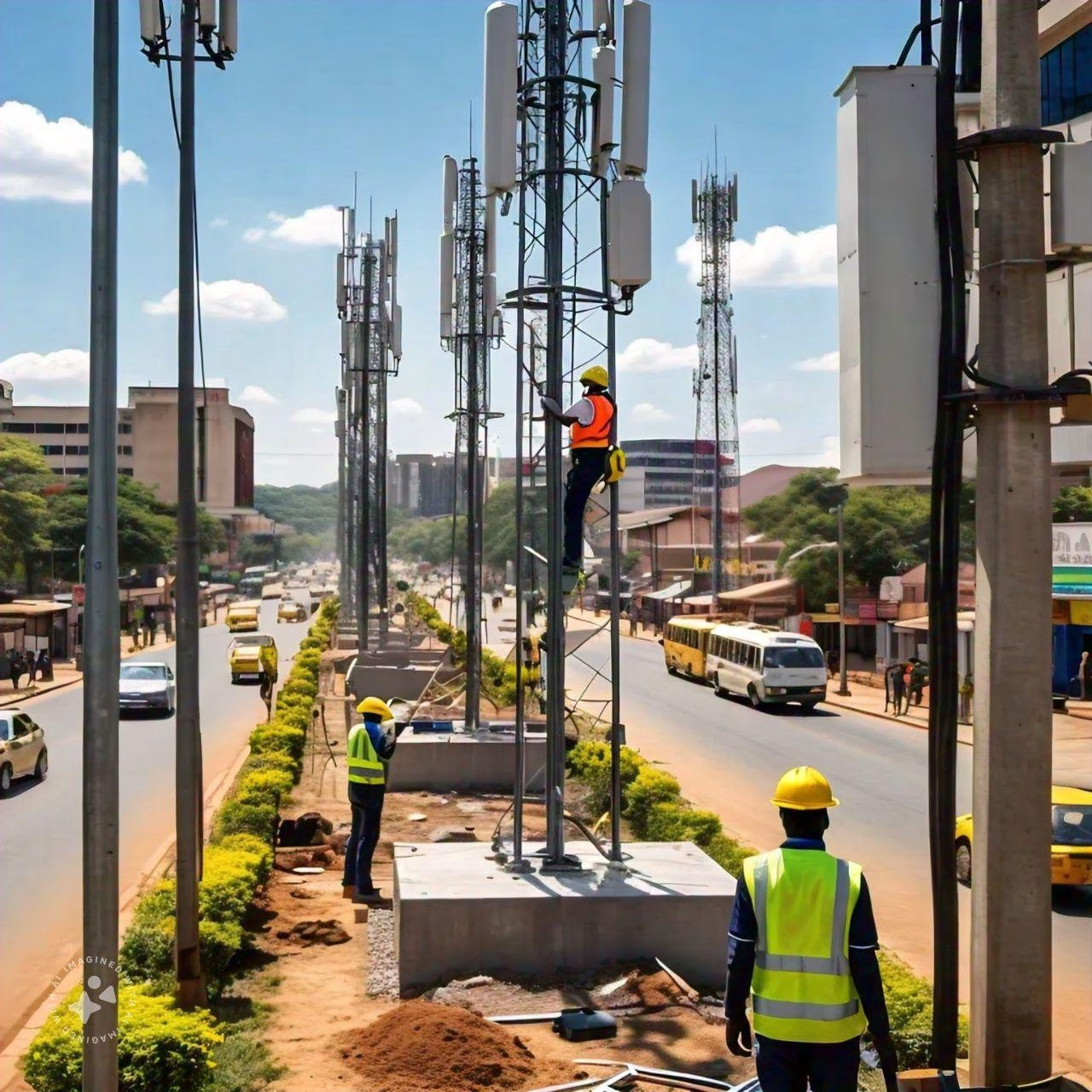
The investment translated into additional infrastructure across the country, including 161 LTE base stations and 13 additional 5G base stations, taking the national 5G total to 379.
The country’s fibre backbone also expanded by 33.83 percent to more than 19,200 kilometres.
These developments matter because the digital economy cannot grow on applications alone. Every online transaction, video call, digital payment, cloud service, artificial intelligence application or e-commerce transaction ultimately depends on physical infrastructure capable of carrying the traffic.
The infrastructure being built today is therefore becoming part of the productive base of tomorrow’s economy.
There is another important shift taking place in the fixed Internet market.
Fixed Internet and data traffic reached 621 petabytes during the quarter, with Liquid Intelligent Technologies accounting for 55.21 percent of the market. Fixed Wireless Access subscriptions also rose to 243,155, representing 58.65 percent of fixed broadband subscriptions.
Satellite connectivity is adding another dimension to the market, with POTRAZ recording a 28.98 percent increase in VSAT subscriptions.
The result is a telecommunications landscape that is becoming considerably more competitive and technologically diverse.
Fibre, LTE, fixed wireless and satellite technologies are increasingly competing to solve the same fundamental problem, how to deliver faster and more reliable connectivity to households, businesses and institutions.
For consumers, that competition has the potential to improve choice and service quality.
For the economy, however, its significance is much larger.
A more competitive broadband market can reduce the barriers faced by businesses that depend on connectivity, particularly small enterprises operating through digital marketplaces, online payment systems, social media commerce and cloud-based tools.
It can also make it easier for institutions such as schools, hospitals and public agencies to integrate digital systems into their operations.
This is consistent with Zimbabwe’s wider digital development framework, which identifies universal access, digital literacy, e-commerce, digital governance and connectivity as important components of the country’s transformation agenda.
The challenge now is to ensure that infrastructure expansion translates into broader economic participation.
The headline penetration figures can easily create the impression that the digital divide is close to being solved. They do not tell the entire story.
POTRAZ estimates that 5G population coverage in urban communities stood at 18.94 percent, while rural communities remain considerably more dependent on earlier generations of network technology.
This creates a second phase of the digital development challenge.
The first phase was getting people connected.
The second is ensuring that connectivity is fast enough, affordable enough and geographically distributed enough to enable people to participate meaningfully in the digital economy.
That distinction will become increasingly important as Zimbabwe moves deeper into technologies such as artificial intelligence, cloud computing, digital finance and data-driven business.
Connectivity that only permits basic messaging is fundamentally different from connectivity capable of supporting high-value economic activity.
The opportunity, therefore, lies not merely in increasing Internet penetration from 87 percent towards 100 percent, but in increasing the economic value generated from every connection.
This is where telecommunications policy intersects with industrial development.
A well-connected economy can support remote work, digital entrepreneurship, online education, telemedicine, e-commerce, digital financial services and technology-enabled agriculture. It can also allow Zimbabwean businesses to reach markets beyond the country’s physical borders.
The Smart Zimbabwe 2030 framework similarly envisages a digital economy in which ICT adoption facilitates commercial transactions, professional interaction, competitiveness and wealth creation.
The POTRAZ figures indicate that the underlying infrastructure for that ambition is expanding.
But infrastructure alone will not create the desired transformation.
The next policy challenge is to ensure that growing connectivity is matched by digital skills, affordable devices, reliable electricity, cybersecurity, local digital content and an enabling environment for technology businesses.
There is also a commercial challenge for operators.
Despite increased investment and rising data consumption, MNO revenue declined by 2.36 percent to ZWG7.55 billion during the quarter, while average revenue per user fell by 5.20 percent to ZWG437.02.
This exposes one of the central contradictions of the digital transition.
People are using more data, but greater usage does not automatically translate into proportionately greater revenue for network operators.
Operators must therefore invest heavily in capacity while simultaneously finding sustainable ways to monetise the expanding digital ecosystem without making connectivity prohibitively expensive.
For Zimbabwe, that balance will be critical.
Affordable connectivity encourages adoption. Greater adoption creates demand. Demand justifies infrastructure investment. Infrastructure then creates the foundation for new businesses and services.
That cycle can become an important component of economic transformation if it is supported by sound policy and investment.
The first quarter figures consequently represent more than another quarterly telecommunications performance report.
They provide a snapshot of an economy undergoing a quiet but important structural change.
Voice is declining.
Data is expanding.
Fibre networks are growing.
5G infrastructure is being deployed.
Fixed wireless and satellite connectivity are reshaping the broadband market.
And billions of dollars in local-currency investment are being directed towards the infrastructure required to support this transition.
The development question now is what Zimbabwe will build on top of that infrastructure.
The country’s stated ambition is to become an upper-middle-income economy by 2030, with ICT and digitalisation serving as important enablers of that transformation. The Ministry of ICT itself describes its objective as building a connected, innovative and secure digital future, while national broadband policy targets universal and reliable broadband access by 2030.
The POTRAZ numbers suggest that Zimbabwe is moving closer to the connectivity foundation required for that ambition.
The next measure of success, however, should increasingly be jobs created, businesses enabled, productivity improved, services delivered and wealth generated through the digital economy.
Zimbabwe is no longer simply building a telecommunications network.
It is building an economic infrastructure.
The task now is to ensure that the infrastructure becomes productive infrastructure, connecting not only people to the Internet, but businesses to markets, farmers to information, students to knowledge, innovators to capital and Zimbabwean products to the wider world.