HARARE — Zimbabwe’s land reform programme is beginning to assume a significance far beyond the issuance of title deeds, with the formalisation of agricultural land increasingly becoming part of a wider state architecture for economic visibility, productive control, capital formation and rural transformation.
This is the less obvious dimension of the current land-tenure drive.
The country is not simply attempting to give beneficiaries documents proving their relationship with land. It is progressively creating a system through which land, its occupants, its boundaries, its productive potential and its economic value can be identified, recorded and incorporated into a more coherent national economic system.
That distinction is fundamental.
Land has always been one of Zimbabwe’s most politically consequential assets. It was at the centre of the liberation struggle, the redistribution programme and the reconstruction of the post-colonial agricultural economy. But for much of the period following land redistribution, the economic relationship between the new landholder and the formal financial system remained incomplete.
The State could redistribute land without necessarily having a sufficiently comprehensive system for measuring the economic activity taking place on it.
That is precisely the structural gap the current tenure reforms begin to address.
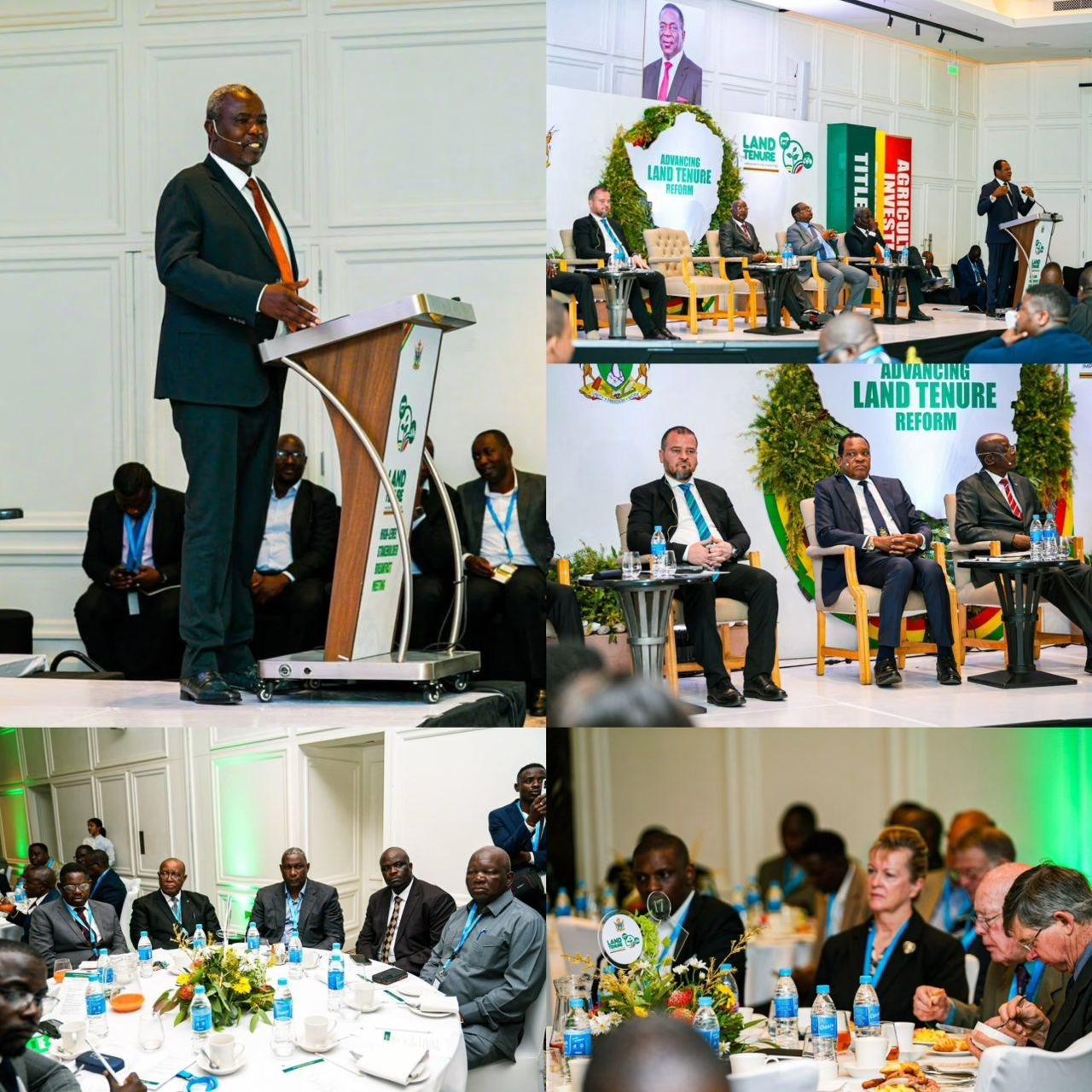
Chairman of the Land Tenure Implementation Committee, Dr Kuda Tagwirei, has framed secure tenure as a mechanism through which land can become bankable, attract investment, improve access to finance and increase agricultural productivity.
The significance of that position lies not simply in the reference to collateral or credit.
It is about bringing a historically fragmented productive asset into an identifiable economic framework.
The surveying of approximately 4.2 million hectares, the mapping of beneficiaries and the implementation of the Presidential Title Deeds Programme represent, in that sense, an exercise in building economic visibility around land. Recent reporting indicates that 27,045 plots had been surveyed and 10,231 mapped to beneficiaries, with further agreements of sale already being concluded.
That process creates something much larger than a register.
It creates a national information base.
Once land is accurately surveyed, boundaries are known. Once beneficiaries are mapped, occupation becomes attributable. Once tenure is formalised, the productive asset becomes easier to incorporate into agricultural planning, investment decisions, financial assessment and infrastructure development.
This is why digitisation becomes strategically important.
A modern economy depends heavily on the quality of information available to the institutions that plan and finance it. The more accurately the State understands the location, ownership or tenure status and productive characteristics of agricultural land, the more effectively it can plan irrigation, roads, electricity, agricultural services, mechanisation, extension programmes and rural infrastructure.
The land register consequently becomes more than an administrative database.
It becomes part of the country’s economic infrastructure.
This is an important evolution in the land reform story.
The first major objective of Zimbabwe’s post-independence land struggle was redistribution. The subsequent challenge was productivity. The emerging challenge is increasingly about integration: integrating redistributed land into the financial, agricultural, infrastructural and productive systems of the national economy.
That is where the economic transformation argument becomes much deeper.
A piece of agricultural land can exist physically without fully existing economically.
It can produce food while remaining outside formal financial structures. It can be occupied without its productive potential being properly measured. It can have significant underlying value without that value being visible within conventional economic systems.
Formal tenure begins to close that gap.
Professor Mthuli Ncube, the Minister of Finance, Economic Development and Investment Promotion, has put a monetary dimension to the issue, arguing that Zimbabwe’s agricultural land contains significant economic value that is not fully captured in conventional economic accounting. Recent reporting has placed the estimated hidden value at around US$20 billion.
The strategic implication is considerable.
Zimbabwe is effectively attempting to move from an economy in which land is predominantly understood as a physical resource to one in which land can increasingly function as an identifiable component of the country’s productive capital base.
That does not mean every farmer suddenly becomes eligible for unlimited borrowing, nor does a title deed automatically create wealth.
The transformation is more structural.
A formalised landholding can provide greater certainty around long-term investment. That certainty can encourage expenditure on irrigation, fencing, orchards, livestock infrastructure, mechanisation and soil improvement. Financial institutions can operate with better information about the underlying asset and the farmer’s tenure position. Agricultural investors can work within a more clearly defined land administration environment.
The consequence is a gradual conversion of land security into investment confidence.
And investment confidence is one of the missing bridges between redistribution and transformation.
This also explains why the current programme should not be viewed in isolation from Zimbabwe’s wider agricultural modernisation agenda.
Mechanisation without secure and clearly identifiable land arrangements creates one set of limitations. Finance without reliable land information creates another. Irrigation without long-term certainty over productive use creates another. Market access without sufficient production creates another.
Tenure reform begins to connect these otherwise separate interventions.
The strategic architecture therefore looks less like a title-deed programme and more like an interconnected economic system:
land identification, tenure security, financial visibility, investment, productive infrastructure, agricultural output, value addition and household wealth.
The importance of the system is that each component strengthens the next.
A farmer with secure tenure has a stronger incentive to invest over a longer horizon. Greater investment can raise productivity. Higher productivity can generate larger and more predictable incomes. Predictable incomes strengthen the farmer’s participation in formal markets. Expanding formal agricultural activity strengthens agro-processing and related industries.
The transformation consequently travels beyond the farm gate.
It reaches transporters, equipment suppliers, fertiliser companies, processors, banks, insurance providers, wholesalers, retailers and ultimately consumers.
This is where the rural economy becomes strategically important to national economic transformation.
Zimbabwe’s agricultural land is not merely a collection of individual farms. It represents a distributed national productive base.
Formalising that base gives the State greater capacity to understand where productive assets are located, how they are being utilised and where infrastructure and investment can generate the greatest economic returns.
That has implications for national planning that are easy to overlook.
A modern State cannot effectively plan what it cannot adequately measure.
Land surveying and beneficiary mapping therefore have a significance beyond cadastral administration. They improve the information available for resource allocation.
The development of irrigation infrastructure, for example, becomes more strategically manageable when the State possesses increasingly reliable information on land parcels, beneficiaries and agricultural potential.
The same applies to roads, electricity, dams, agricultural extension, mechanisation programmes and rural industrialisation.
The land administration system consequently becomes a planning instrument.
This is particularly significant for a country pursuing economic sovereignty.
Zimbabwe’s experience has repeatedly demonstrated the vulnerability created when critical productive capacity is disconnected from domestic capital, infrastructure and institutional systems.
A stronger land administration framework provides an opportunity to rebuild the agricultural economy around a more visible and measurable productive base.
It also strengthens the country’s capacity to convert agricultural production into industrial activity.
The ultimate strategic objective is therefore not simply a farmer owning a plot.
It is the creation of a productive rural economy in which land supports agriculture, agriculture supports processing, processing supports industry, industry supports employment and the resulting economic activity strengthens household incomes.
That is the deeper economic logic behind secure tenure.
There is another dimension that deserves attention: rural stability.
Land reform fundamentally altered Zimbabwe’s social and economic geography. Millions of livelihoods are directly or indirectly connected to agricultural land. The long-term consolidation of tenure arrangements therefore has implications for confidence, investment behaviour and the stability of rural communities.
A system in which beneficiaries possess clearer and more secure tenure arrangements creates a stronger foundation for generational economic planning.
The land can increasingly become an asset around which households organise production, investment and inheritance rather than merely a place of occupation.
That changes the economic psychology of rural Zimbabwe.
A farmer begins to think beyond the current season.
The investment horizon lengthens.
Permanent infrastructure becomes more rational.
Agricultural production becomes more commercially oriented.
The land begins to acquire an intergenerational economic function.
This is ultimately where the present phase of Zimbabwe’s land reform could become historically significant.
The first generation of land reform changed the distribution of land.
The emerging phase seeks to change the economic function of that land.
That is a substantially different proposition.
It means the success of land reform can no longer be assessed only through the number of beneficiaries, hectares redistributed or title deeds issued. Those are important indicators of administrative progress, but they do not fully capture economic transformation.
The more consequential indicators will be the increase in agricultural investment, productivity, access to finance, irrigation coverage, mechanisation, value addition, rural employment and household incomes that follow.
In this sense, the title deed is not the product.
It is the institutional gateway.
The real product is a more productive rural economy.
And this is why the current land-tenure programme should be understood as part of the broader architecture of the Second Republic’s economic transformation agenda.
Zimbabwe is gradually attempting to resolve a problem that has existed since the most dramatic phases of land redistribution: how to ensure that political ownership of a strategic resource is matched by economic functionality.
The answer emerging from the tenure programme is not simply documentation.
It is economic formalisation.
The State is progressively establishing the records, identities, boundaries and tenure arrangements necessary to make agricultural land more visible to the systems that drive modern economic activity.
In that sense, the most important transformation may not be visible on the day a farmer receives a title deed.
It will become visible years later in the irrigation scheme financed, the machinery purchased, the crop harvested, the processing plant supplied, the rural business established and the household income generated.
That is the deeper strategic meaning of Zimbabwe’s current land reform trajectory.
The country is moving from the historic politics of land redistribution towards the economics of land utilisation.
And in that transition, land is being repositioned from being principally a symbol of liberation and ownership into something equally consequential: a foundation of productive national capital.