Story by Godfrey M Bonda
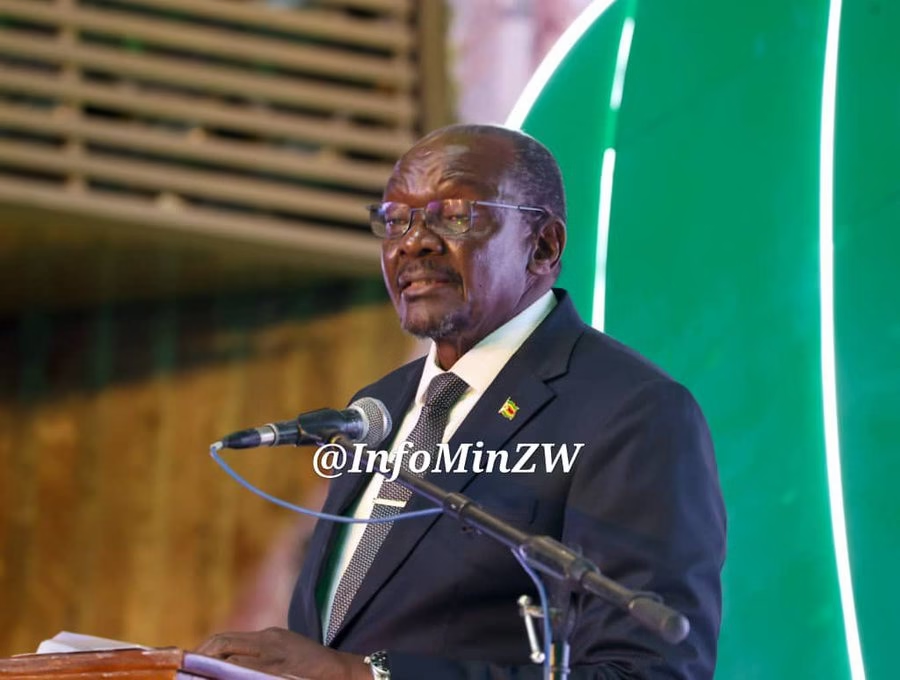
HARARE — Vice President Dr Colonel (Rtd) Kembo Mohadi has called for stronger social and economic support for persons with albinism, urging Government, business and communities to ensure that they are fully integrated into Zimbabwe’s development agenda.
Speaking at the Albinism 4 ED Empowerment Programme held at ZANU PF Headquarters in Harare, Vice President Mohadi said resources must be mobilised to strengthen social welfare programmes for persons with albinism and ensure that no citizen is left behind in the country’s development trajectory.
“We must mobilise resources to cater for the social welfare of people with albinism,” Vice President Mohadi said.
He emphasised that persons with albinism have an equal right to participate in Government and national affairs, noting that every citizen has a role to play as Zimbabwe advances towards Vision 2030 and the National Development Strategy 2 (NDS2).
Vice President Mohadi said discrimination against persons with albinism remains a challenge that must be confronted through education and public awareness.
“Albinism is a genetic condition and unfortunately discrimination continues to emerge. You must confront such issues through educational awareness,” he said.
He called for a society that recognises people based on their talents, capabilities and contribution rather than physical characteristics.
“We must build a society of people based on their talent and capabilities,” he said.
The Vice President further stressed the importance of ensuring access to education, vocational training, healthcare and social protection for persons with albinism, particularly children who require additional support to succeed in school and later in life.
He also challenged the business community to go beyond conventional charitable donations by creating meaningful economic opportunities for persons with albinism.
“I particularly wish to challenge business communities that their donations go beyond donations,” Vice President Mohadi said, calling for employment opportunities to also be created within business supply chains.
He said Government remained committed to ensuring that persons with disabilities participate meaningfully in national development.
Minister of State for Harare Metropolitan Province, Senator Charles Tawengwa, welcomed participants to the empowerment programme and reaffirmed the Second Republic’s commitment to inclusive development.
He said persons with albinism must be empowered socially, economically and politically so that they can fully participate in national development.
The Minister reiterated the Government’s guiding principle of leaving no one and no place behind, while calling for unity as the country pursues its development objectives.
Meanwhile, ZANU PF Harare Provincial Chairman, Senator Masimirembwa, said persons with albinism had demonstrated patriotism and were contributing to the strengthening of party structures.
The Minister of Youth, Sport, Arts and Recreation, Cde Machakaire, outlined several empowerment opportunities available to young people, including the Youth Empowerment Fund, which targets young people below the age of 35.
He encouraged young people with albinism to approach Ministry of Youth offices and submit applications for support.
He also highlighted opportunities available through vocational training centres, which offer accredited training in various skills, urging persons with albinism to take advantage of the programmes.
“We want you to be active participants in the duties of the Government,” Minister Machakaire said.
He added that EmpowerBank had been directed to simplify access to financial services for persons with albinism, creating opportunities for young people to pursue entrepreneurship and other income-generating activities.
National Chairman of Albinism 4 ED, Cde Blessing Chikuhwa, commended President Emmerson Dambudzo Mnangagwa and the Second Republic for what he described as significant developments taking place across Zimbabwe.
He cited infrastructure developments, including the Trabablus Interchange and the construction of the new Parliament building, as examples of the country’s development trajectory.
Cde Chikuhwa called for sustainable economic support for persons with albinism so that they can become active participants in the pursuit of Vision 2030.
The empowerment programme also received support from other ZANU PF affiliates, including Boyz DzaMudhara, Fathers 4 ED and Health Ambassadors 4 ED, who joined the programme in solidarity with Albinism 4 ED.
The engagement placed inclusion at the centre of the development agenda, highlighting the need to move beyond awareness towards practical interventions in education, employment, skills development, healthcare, social protection and access to finance for persons with albinism.