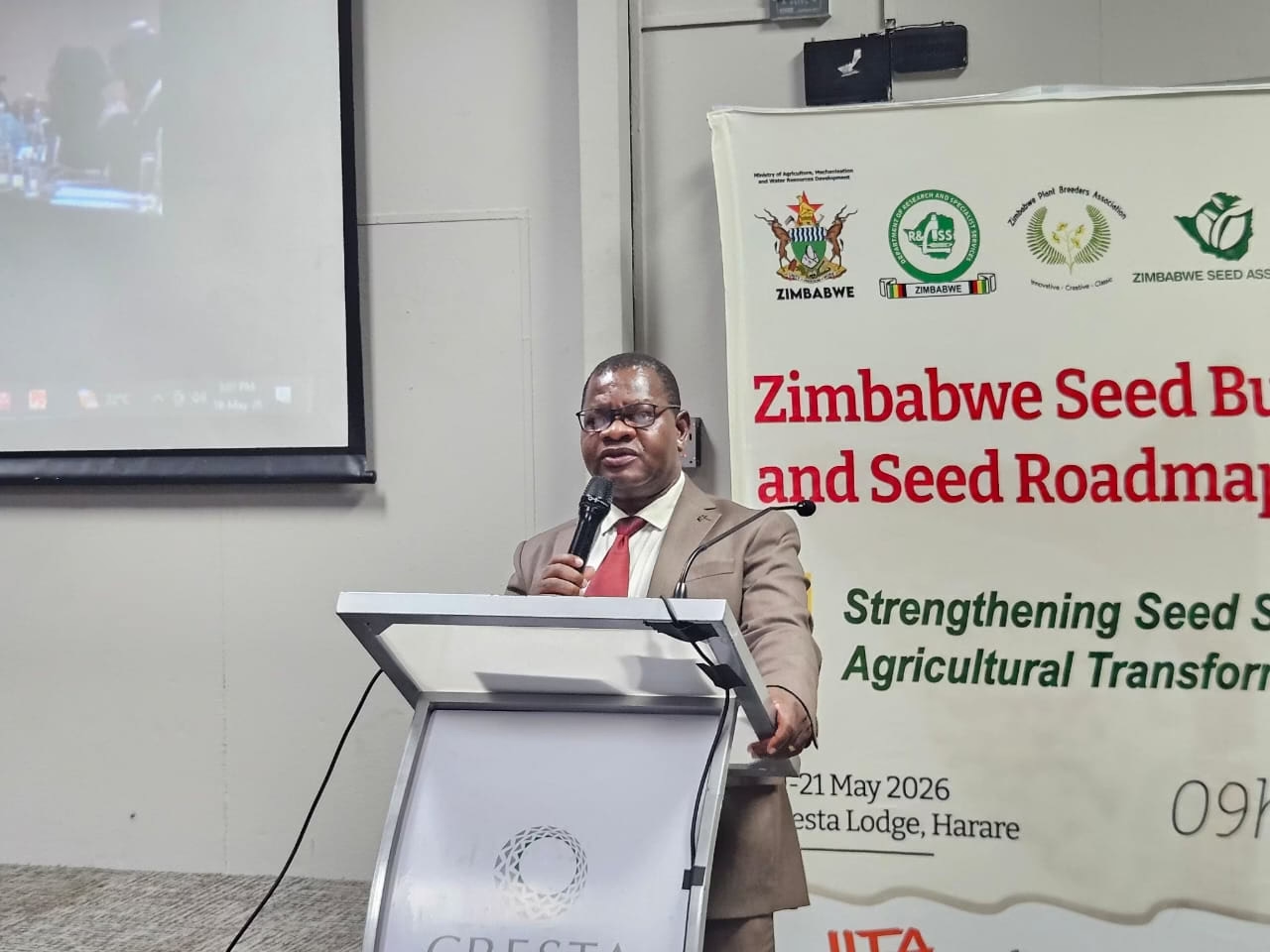
Harare, Zimbabwe’s push toward building a US$15.8 billion agricultural economy by 2030 is increasingly being anchored on the strength of its seed systems, with climate smart, drought tolerant, and pest resistant seed varieties emerging as critical instruments in safeguarding food security, boosting productivity, and strengthening resilience against climate shocks.
Addressing delegates at the Zimbabwe Seed Business Summit in Harare, Professor Doctor Obert Jiri emphasized that improved seed systems now occupy a strategic position within Zimbabwe’s agricultural transformation agenda under Vision 2030 and the National Development Strategy framework.
Professor Doctor Obert Jiri noted that Zimbabwe’s agricultural sector has expanded significantly in recent years, growing from approximately US$5.2 billion to US$10.3 billion during the implementation period of NDS1. He further highlighted the remarkable rise in wheat production, which increased from 175 000 tonnes in 2020 to more than 645 000 tonnes by 2025, a transformation largely attributed to innovation, mechanisation, irrigation expansion, and the strengthening of seed systems.
Analytically, the focus on seed systems reflects a growing recognition that agricultural productivity begins long before harvesting, marketing, or processing. The quality, adaptability, and resilience of seed varieties determine not only crop yields, but also national food security outcomes, farmer incomes, export competitiveness, and climate resilience.
As climate variability continues affecting rainfall patterns across Southern Africa, countries are increasingly prioritising drought resistant and climate adaptive seed technologies capable of sustaining productivity under unpredictable environmental conditions. Zimbabwe’s emphasis on climate smart agriculture therefore reflects both an economic necessity and a strategic adaptation response to climate change pressures affecting regional agriculture.
The expansion of pest resistant seed varieties is equally significant within the broader context of protecting agricultural investments and minimising production losses. Crop pests and diseases continue posing substantial threats to food systems across Africa, often undermining yields and increasing production costs for farmers. By promoting improved seed genetics, Zimbabwe aims to strengthen productivity while reducing vulnerability within the agricultural sector.
The sharp increase in wheat output over the past five years also signals the growing effectiveness of Zimbabwe’s import substitution strategy within agriculture. Wheat has historically been one of the country’s major import dependent commodities, placing pressure on foreign currency reserves. The expansion in local production therefore carries wider macroeconomic implications tied to food sovereignty, foreign currency conservation, and industrial stability within the milling and baking sectors.
Importantly, the transformation of seed systems also has implications for rural industrialisation and agricultural commercialisation. Modern seed systems stimulate broader value chains involving research institutions, seed breeders, irrigation development, agro processing industries, logistics networks, and export markets. Agriculture increasingly functions not merely as subsistence activity, but as an integrated economic ecosystem capable of driving employment creation, industrial growth, and rural economic expansion.
Professor Doctor Obert Jiri’s remarks further highlighted the role of innovation and scientific research within Zimbabwe’s agricultural modernisation drive. The increasing collaboration between Government institutions, agricultural researchers, seed companies, and farmers reflects a transition toward knowledge based agriculture where productivity is increasingly linked to science, technology, and data driven farming practices.
From a policy perspective, the country’s agricultural growth trajectory under NDS1 illustrates how strategic interventions in irrigation, mechanisation, financing, and input systems can significantly alter production outcomes. The progress in wheat production has particularly become symbolic of Zimbabwe’s broader ambition to transform itself from a food insecure nation into a self sufficient and export competitive agricultural economy.
However, analysts note that sustaining long term agricultural growth will require continued investment in irrigation infrastructure, research and development, extension services, rural financing, and market access systems. Strong seed systems alone, while critical, must operate within a wider ecosystem of agricultural support mechanisms to fully unlock national productivity potential.
The Zimbabwe Seed Business Summit therefore emerged as more than an industry gathering, it reflected the growing strategic importance of agricultural science, innovation, and resilience within Zimbabwe’s broader developmental agenda.
As Zimbabwe advances toward its target of a US$15.8 billion agricultural economy by 2030, the strengthening of seed systems is increasingly being viewed not simply as an agricultural intervention, but as a national economic strategy central to food security, industrial growth, climate adaptation, and sustainable development.