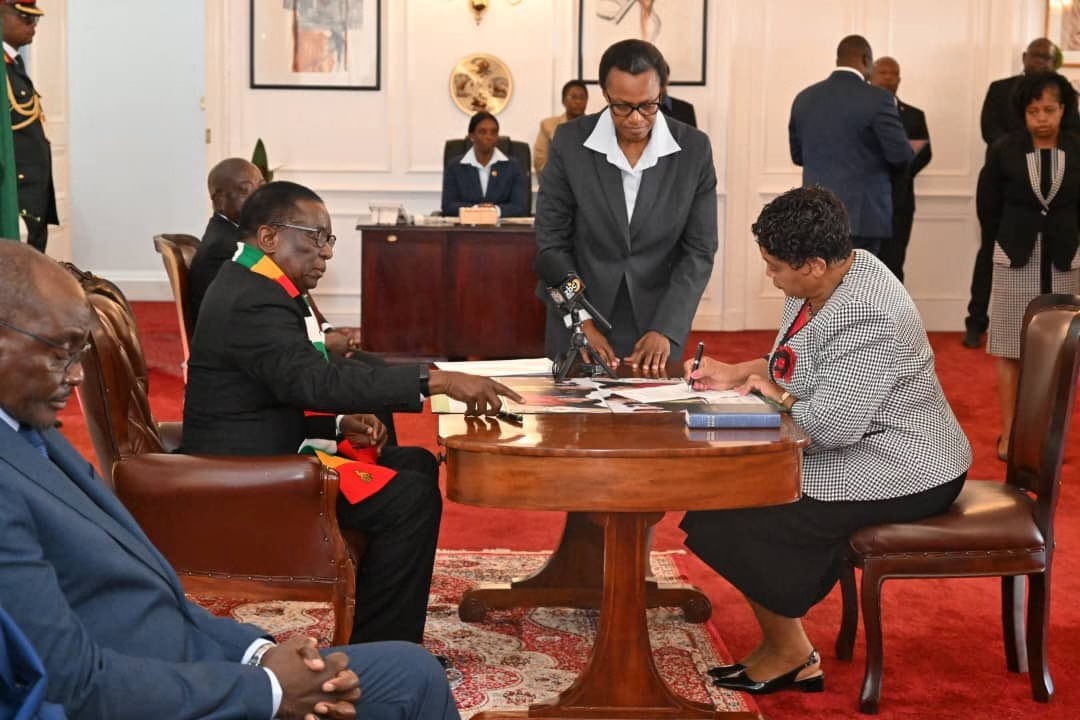
Harare, The swearing in ceremony presided over by President Emmerson Mnangagwa marked more than a constitutional process of appointing senior public officials, it reflected Zimbabwe’s broader institutional continuity agenda, governance consolidation, and the evolving role of women within key national leadership structures.
At the ceremony, Chief Justice Elizabeth Chiedza Gwaunza officially took oath as Chief Justice of Zimbabwe, becoming one of the most prominent women to occupy the country’s highest judicial office. Deputy Chief Justice Paddington Garwe was also sworn in, alongside Honourable Tsitsi Zhou, Health Service Commission Deputy Chairperson Dr Rugare Abigail Kangwende, Health Service Commission member Colonel Retired Dr Lioba Tendai Gunduza, Health Service Commission member Mr Enerst Takafa Manyau, and Auditor General Mrs Vimbai Chikwenhere.
Analytically, the appointments illustrate Government’s emphasis on strengthening institutional functionality across critical sectors including justice administration, public health governance, land administration, and financial oversight. The simultaneous swearing in of officials from different sectors demonstrated an integrated governance approach where institutional effectiveness is increasingly viewed as central to the attainment of Vision 2030 and the National Development Strategy 2.
However, the elevation of Chief Justice Gwaunza carried particular symbolic and socio political significance. Her remarks following the ceremony introduced a deeply personal narrative rooted in Zimbabwe’s historical gender inequalities, especially surrounding access to education for the girl child. Reflecting on growing up during a period when many girls were denied educational opportunities due to social and economic barriers, the Chief Justice’s story became a broader reflection of Zimbabwe’s gradual transformation in expanding women’s participation within leadership and professional sectors.
Chief Justice Gwaunza acknowledged the role played by her father in supporting her education and ensuring that she pursued studies up to tertiary level, highlighting the importance of family support structures in shaping women’s advancement within traditionally male dominated professions such as law and judicial administration.
From a governance perspective, her appointment also reflects continuity within the judiciary itself. Having served as Deputy Chief Justice since 2018, Chief Justice Gwaunza enters office with extensive institutional experience and a deep understanding of the country’s legal and constitutional framework. Her elevation therefore represents both transition and continuity, ensuring stability within the judicial sector while maintaining institutional memory.
Responding to recurring public claims surrounding judicial independence, Chief Justice Gwaunza strongly defended professional integrity within the judiciary, emphasizing that judges must remain guided by conscience, professionalism, and fidelity to the law rather than public sentiment or political pressure.
Her remarks were significant within the broader discourse surrounding the independence of state institutions in modern democracies. Analytically, judicial legitimacy increasingly depends not only on constitutional guarantees, but also on public confidence in institutional impartiality and professional conduct. By stressing professionalism and independence, the Chief Justice sought to reinforce confidence in the judiciary’s role as a constitutional guardian within Zimbabwe’s governance architecture.
The appointment also comes at a time when Zimbabwe continues pursuing institutional modernisation and public sector reforms under NDS2. The judiciary remains central to broader national objectives linked to investment confidence, constitutionalism, dispute resolution, and rule based governance. Efficient and credible judicial systems are increasingly recognised as critical pillars in economic development, investor assurance, and social stability.
Equally important was the appointment of Auditor General Mrs Vimbai Chikwenhere, a position central to accountability, public finance oversight, and transparency within Government institutions. The Health Service Commission appointments similarly reflect ongoing efforts to strengthen governance and operational capacity within the health sector, particularly as Zimbabwe continues modernising healthcare delivery systems.
The swearing in ceremony therefore represented more than a formal constitutional occasion. It reflected Zimbabwe’s broader effort to consolidate institutions, strengthen governance systems, and reinforce continuity within strategic sectors of national administration.
For many observers, Chief Justice Gwaunza’s rise to the country’s highest judicial office also stands as a powerful symbol of perseverance, institutional service, and the changing trajectory of women’s leadership within Zimbabwean society. Her journey from a generation where girls struggled for educational access to leading the judiciary embodies a wider national story of transformation, resilience, and evolving opportunity