By Aldridge Dzvene
HARARE, Zimbabwe’s ambition to move from resource extraction towards value-added production is increasingly tied to a wider regional question, whether African economies can convert their collective market, investment potential and industrial capabilities into an integrated production system that keeps more economic value within the continent.
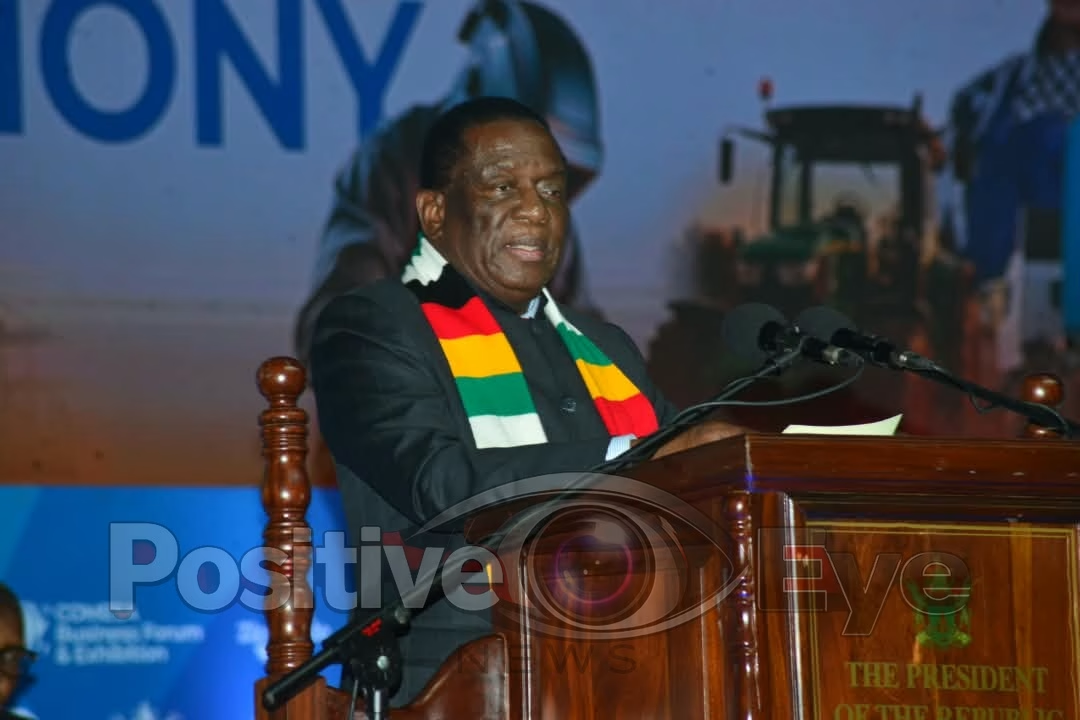
This challenge took centre stage yesterday when His Excellency Dr Emmerson Dambudzo Mnangagwa, President and First Secretary of ZANU PF, officially opened the 19th Common Market for Eastern and Southern Africa (COMESA) Business Forum at the Harare International Conference Centre, calling on member states to strengthen cross-border investment, dismantle barriers to regional commerce and build production networks capable of expanding trade, employment and economic opportunity.
His Excellency Dr Emmerson Dambudzo Mnangagwa, President and First Secretary of ZANU PF, placed particular emphasis on the need to connect investments across national boundaries, arguing that individual countries must increasingly develop complementary productive capabilities rather than pursue economic projects in isolation.
“Investments in our respective jurisdictions should not be developed as isolated national projects. They must connect our economies through mutually beneficial cross-border investments and regional value chains,” His Excellency Dr Emmerson Dambudzo Mnangagwa, President and First Secretary of ZANU PF, said.
The intervention elevated the business forum beyond a conventional investment promotion gathering, placing the relationship between national industrialisation strategies and regional economic integration at the centre of discussions ahead of the 25th COMESA Summit of Heads of State and Government, scheduled for Harare on 22 October.
The underlying economic proposition is consequential. African countries can possess substantial mineral reserves, agricultural resources, infrastructure and consumer markets without necessarily developing the industrial relationships required to turn those advantages into competitive manufactured products. The missing link is often the coordination of investment, technology, production, finance and distribution across national economies.
For COMESA, which encompasses a market of more than 600 million people and an economy estimated at approximately US$1 trillion, the opportunity is not simply to increase the volume of goods crossing borders. It is to expand the region’s capacity to manufacture, process, supply and consume products generated within its own economic space.
His Excellency Dr Emmerson Dambudzo Mnangagwa, President and First Secretary of ZANU PF, therefore challenged business leaders, investors and entrepreneurs to identify practical ways of increasing production, processing and trade within the bloc, with particular attention to agriculture, critical minerals, energy resources, industrialisation and human capital development.
The significance of this approach lies in its potential to change how investment opportunities are conceived. Rather than treating each country as a separate destination competing independently for capital, regional value chains create opportunities for investments in different jurisdictions to reinforce one another.
A mineral-processing project, for example, becomes more strategically valuable when it can supply regional manufacturers. Agricultural production gains greater economic significance when connected to food processing, packaging, cold-chain logistics and established distribution networks. Similarly, investments in energy infrastructure can support manufacturing capacity that serves consumers and businesses across several countries.
Such relationships can widen markets, support economies of scale and improve the commercial viability of industrial projects. They can also enable smaller economies and enterprises to participate in production networks without having to establish every stage of a manufacturing process independently.
However, these benefits are not automatic. They require reliable infrastructure, compatible standards, predictable regulations, accessible financing and efficient border procedures. Without these conditions, regional investment may remain fragmented, with businesses continuing to face high transaction costs despite the existence of formal trade agreements.
This is the implementation challenge confronting COMESA as it seeks to translate its common-market framework into a more productive regional economy.
His Excellency Dr Emmerson Dambudzo Mnangagwa, President and First Secretary of ZANU PF, acknowledged the scale of the problem, observing that intra-COMESA trade and investment remain significantly low relative to the bloc’s economic potential.
Rather than treating this gap solely as a weakness, His Excellency Dr Emmerson Dambudzo Mnangagwa, President and First Secretary of ZANU PF, presented it as an opportunity to establish stronger commercial networks, expand production and develop investment partnerships that operate across national boundaries.
The distinction matters because regional integration is ultimately measured by economic activity rather than institutional declarations. Its success depends on whether businesses can identify suppliers in neighbouring countries, secure investment for productive projects, access customers across the region and move goods through borders without excessive delays and costs.
The address also connected this regional ambition to the industrialisation agenda pursued by Zimbabwe, particularly the emphasis on beneficiation and value addition.
For decades, many African economies have depended heavily on exporting primary commodities while importing a substantial proportion of the manufactured goods consumed by their populations. This arrangement can generate export earnings, but it also limits opportunities to develop domestic manufacturing capabilities, industrial skills, technology and higher-value employment.
His Excellency Dr Emmerson Dambudzo Mnangagwa, President and First Secretary of ZANU PF, urged the private sector to move beyond the export of raw commodities towards value addition, beneficiation and manufacturing, identifying agro-processing, leather, cotton-to-clothing production, pharmaceuticals, battery materials and clean-energy technologies as areas with potential for industrial expansion.
His Excellency Dr Emmerson Dambudzo Mnangagwa, President and First Secretary of ZANU PF, cited Zimbabwe’s December 2022 decision to restrict exports of unprocessed lithium ore as an example of efforts to retain more value from natural resources and accelerate industrial development.
The broader significance is that beneficiation cannot be considered exclusively a national undertaking. Processing facilities require markets, specialised inputs, technology, energy and capital. A regional market can help provide the scale necessary to support investments that might struggle to remain competitive if dependent on domestic demand alone.
Zimbabwe’s mineral resources could therefore be linked to regional manufacturing opportunities, while agricultural output could supply processing industries and finished products could be distributed through markets across COMESA.
The same principle applies to battery materials and clean-energy technologies, where the potential gains extend beyond mineral extraction to chemical processing, component manufacturing, technical skills and the development of associated industrial services.
Yet the transition from resource extraction to manufacturing demands more than policy restrictions on raw exports. It requires sustained investment in electricity, transport, industrial infrastructure, technology, skilled labour and market development. The test is whether policies designed to encourage beneficiation result in competitive production capacity and commercially sustainable industries.
Regional cooperation can help address part of that challenge by widening the available market and enabling complementary investments. But the necessary financing, infrastructure and regulatory conditions must be established if these opportunities are to move beyond policy ambition.
The emphasis on investment also carries implications for Zimbabwe’s private sector. Access to a regional market is valuable only when businesses possess the productive capacity, quality standards, pricing competitiveness and distribution systems required to supply it.
This means the industrialisation agenda must be accompanied by efforts to strengthen manufacturing productivity, improve access to finance, develop technical skills and help businesses identify reliable regional buyers.
The potential gains extend to agriculture, where increased production can be linked to agro-processing, food manufacturing, storage, packaging and regional distribution. Such connections can create additional markets for farmers while supporting enterprises that provide inputs and services along the value chain.
For young people and women, the development of connected industries could create opportunities in manufacturing, logistics, technology, business services and entrepreneurship. However, the extent of these benefits will depend on whether expanding investment translates into accessible employment, enterprise participation and skills development.
The forum’s theme, “One Market, One Future: Advancing Inclusive Industrialisation, Investment and Regional Integration in COMESA”, consequently raises an important question about the distribution of economic gains. A larger regional market must not only facilitate business expansion but also widen participation in productive economic activity.
His Excellency Dr Emmerson Dambudzo Mnangagwa, President and First Secretary of ZANU PF, challenged delegates to ensure that the discussions produce practical recommendations capable of informing decisions at the forthcoming summit, placing responsibility on both governments and the private sector to move from dialogue towards implementation.
The private sector’s role is particularly important because governments can negotiate agreements and establish regulatory frameworks, but businesses ultimately determine whether investment opportunities become operational factories, processing facilities, distribution networks and commercial partnerships.
At the same time, enterprises cannot independently overcome every barrier to regional trade. Customs procedures, regulatory inconsistencies, non-tariff barriers, payment constraints and infrastructure deficiencies often require coordinated action by governments and regional institutions.
The relationship between these responsibilities was captured in the welcome remarks delivered by ZimTrade chief executive officer Mr Allan T. Majuru, who argued that the region’s institutions had advanced faster than the practical integration of its markets.
“Our institutions have often run ahead of our markets. We have built the courts, the banks, the regulators and the payment systems. The question for this Forum is why our trucks, our invoices and our payments do not yet move as freely as our treaties do,” Mr Majuru said.
The observation identifies one of the central contradictions in regional integration: formal arrangements may recognise the principle of free movement and trade, while businesses continue to encounter practical obstacles that undermine the commercial value of those commitments.
A manufacturer cannot operate efficiently across several countries if essential inputs are delayed at borders. An exporter cannot reliably expand into new markets if payment arrangements are cumbersome or unpredictable. An investor cannot confidently establish a regional production network if regulatory requirements and operating costs vary significantly between jurisdictions.
Reducing these constraints is therefore not merely an administrative exercise. It is part of the industrialisation process itself, because production depends on the timely movement of inputs, finance, technology and finished goods.
Mr Majuru also highlighted the scale of the regional market, pointing to COMESA’s population of more than 640 million people and its estimated US$1 trillion economy as evidence of the commercial opportunities available to businesses operating within the bloc.
His argument that even a modest increase in cross-border purchases could substantially expand regional trade underlined the importance of developing stronger commercial relationships between neighbouring economies.
However, a large population does not automatically translate into effective demand for locally manufactured goods. Businesses must still meet consumer needs, maintain quality, offer competitive prices and establish dependable supply arrangements. The challenge is to connect the region’s potential purchasing power with enterprises capable of supplying that demand.
Mr Majuru further argued that the region’s transport capabilities should be matched with commercial opportunities, suggesting that stronger connections between producers, buyers, investors and distributors could help unlock existing capacity.
The point reinforces the need for business matchmaking and investment facilitation alongside infrastructure development. Roads, airports and transport systems provide the physical foundation for commerce, but their economic value depends on the productive activities and trade relationships they support.
The exhibition accompanying the business forum, running from 19 to 21 October, provides a practical setting for businesses from Zimbabwe and across the region to showcase products, explore partnerships and identify opportunities for commercial expansion.
The programme also follows the COMESA Green Industries Connect, which examined opportunities in the circular economy, electronics and electronic waste, leather, plastics and packaging. These sectors offer scope for developing new production capabilities while addressing resource efficiency, waste management and industrial sustainability.
Their inclusion broadens the industrialisation debate beyond traditional commodities. It highlights opportunities to build businesses around processing, recycling, materials recovery, manufacturing and the development of products that serve regional demand.
For Zimbabwe, the immediate opportunity is to use its hosting role to strengthen commercial connections between domestic producers and regional markets. The country’s agricultural, mining, manufacturing and service sectors could benefit from investment partnerships that expand production and open additional export channels.
But the lasting value of the gathering will depend on whether discussions translate into bankable projects, measurable trade growth, productive investment and sustainable commercial relationships.
The recommendations emerging from the forum are expected to inform the 25th COMESA Summit, providing an opportunity for governments to consider the policy measures needed to improve regional commerce and strengthen industrial cooperation.
This makes implementation the defining test of the meeting. Progress must eventually be visible in stronger intra-regional trade, more competitive manufacturing, reduced border delays, increased cross-border investment and wider participation by enterprises in regional value chains.
His Excellency Dr Emmerson Dambudzo Mnangagwa, President and First Secretary of ZANU PF, has placed the challenge before the region: to connect national investments, expand production and make the common market work more effectively for businesses and citizens.
The ultimate measure of success will not be the number of delegates attending the forum or the volume of investment opportunities discussed, but the extent to which those engagements generate new productive capacity, stronger regional supply chains, employment and improved economic opportunities.
For COMESA, the transition from a market defined by its size to one distinguished by its productive strength will require sustained cooperation between governments, investors and businesses.
The opening address in Harare brought that task into focus, placing regional industrialisation and connected investment at the centre of the debate over how the bloc can turn its collective economic potential into tangible development outcomes.