By Aldridge Dzvene
The significance of the INSTAK Munhumutapa Public Lecture lies beyond the recovery of a historical name. At a deeper level, the discussion opens a question about how Zimbabwe understands the relationship between political authority, economic power, natural resources, production, trade and national identity.
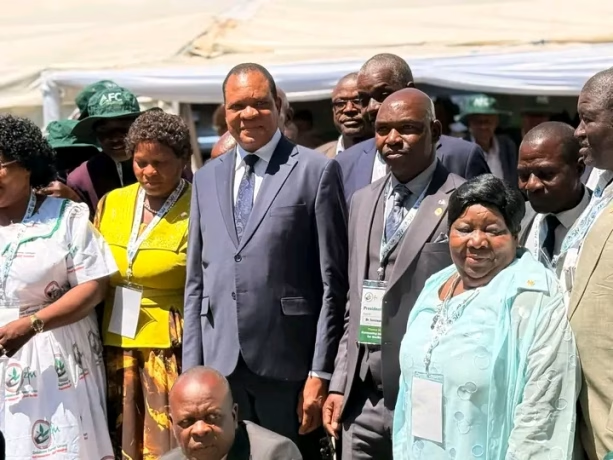
Held at Heritage Village in Harare, the lecture brought together intellectuals, university students, senior political figures and members of the public to examine the Mutapa civilisation and its contemporary relevance. Experts from the National Museums and Monuments of Zimbabwe and the Herbert Chitepo School of Ideology presented papers on the civilisation, while INSTAK used the platform to place the historical state within a modern conversation about Zimbabwe’s development trajectory.
This is where the Munhumutapa question becomes considerably more important than a celebration of the past.
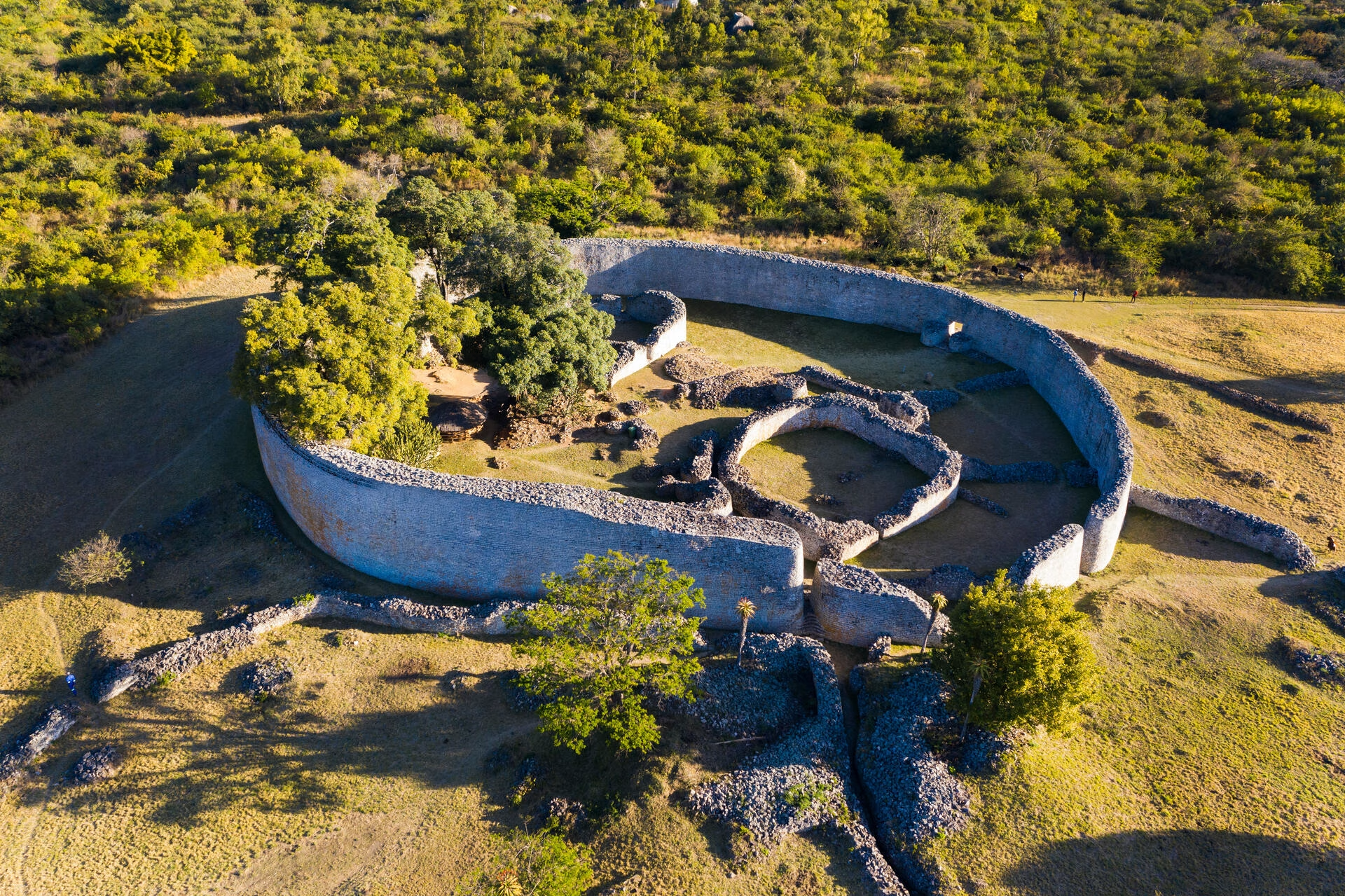
The Mutapa State was not simply an ancient royal household or a collection of settlements around a powerful ruler. It was a political and economic system in which authority, production, tribute, resource access and external commerce were connected. Historical accounts describe a state in which subordinate rulers provided tribute according to what their territories produced, while foreign traders were subject to tolls and duties. The ruling establishment also exercised considerable influence over valuable commodities and the trading relationships through which gold, ivory and other products moved towards the Indian Ocean.
In other words, political power had an economic foundation.
That distinction is critical when interpreting Munhumutapa in the context of contemporary Zimbabwe. The useful comparison is therefore not that the modern Republic is literally the Mutapa State reborn. The two belong to completely different political, constitutional and international systems. The useful comparison is that both historical and contemporary Zimbabwe can be examined through the question of who organises productive capacity, who controls resources, who determines economic relationships and how national wealth is converted into wider social and political outcomes.
The Mutapa system demonstrates that political authority in pre-colonial Zimbabwe was inseparable from the ability to organise land, agriculture, mining, livestock, labour, tribute and commerce. The state derived strength from productive communities and from its position within regional and international trading networks. Gold and ivory were particularly important commodities, while agriculture and livestock provided the productive base necessary to sustain communities and political authority.
This makes the contemporary discussion about Zimbabwe’s minerals, agriculture and industrialisation more than an economic policy debate. It becomes part of a much longer historical question about the organisation of national productive capacity.
That is the deeper intellectual value of the Munhumutapa discussion.
Modern Zimbabwe possesses a sovereign state, a constitutional government, formal institutions, a central bank, taxation systems, industrial policy, universities, financial institutions, modern infrastructure and participation in global markets. The Mutapa State operated through completely different institutions. Yet the underlying developmental question remains recognisable: how does a society turn the resources within its territory into organised national capability?
This is precisely why the discussion of natural resources at the INSTAK lecture carries contemporary significance. Ambassador Kwame Muzawazi, Chief Executive Officer of the Institute of African Knowledge, argued that studying the Mutapa State offers lessons about economic independence, control of natural resources and the ability to establish self-determined international trading relationships.
That argument moves the discussion from heritage into political economy.
A mineral deposit by itself does not constitute national development. Agricultural land by itself does not create prosperity. A strategic geographical position does not automatically generate economic power. The historical Mutapa example suggests that the decisive issue is the organisation of these assets within a wider system of production, authority and exchange.
For contemporary Zimbabwe, this translates into a very modern set of questions.
Can lithium be processed beyond the export of raw minerals? Can gold contribute to a broader industrial ecosystem? Can agricultural production feed domestic manufacturing and export industries? Can infrastructure connect producers to markets? Can energy availability support industrial production? Can financial institutions mobilise capital towards productive sectors? Can young Zimbabweans acquire the technical skills required by those industries?
These are modern questions, but they sit within an old African developmental logic: resources become national power when a society develops the institutions and productive capacity to organise them.
The history of the Mutapa State also demonstrates the importance of trade. Its economic life was connected to the wider Indian Ocean commercial system, with goods moving between the interior and coastal trading centres. Historical accounts record the movement of gold, ivory and other commodities outward, while imported goods entered the interior through these networks.
That provides another useful bridge to modern Zimbabwe.
A landlocked country cannot treat international trade as an external matter. Its ports, roads, railways, airports, border posts, financial systems and diplomatic relationships all become components of its economic architecture. The modern equivalent of an ancient trading route is therefore not simply a road or border crossing. It is the entire infrastructure through which Zimbabwe connects production to regional and global markets.
This is where the contemporary phrase “Zimbabwe is open for business” acquires an interesting historical dimension.
ZANU PF Politburo Deputy Secretary for Security, Cde Tendai Chirau, speaking at the INSTAK lecture, said President Emmerson Mnangagwa had never described himself as “Munhumutapa”, but argued that comparisons had emerged among Zimbabweans observing the emphasis on building a developed and prosperous country. He linked the contemporary “Zimbabwe is open for business” position with the historical Mutapa state’s engagement in commerce, and connected the philosophy “nyika inovakwa nevene vayo” with the productive activities associated with the historical state, including agriculture and mining.
Analytically, the significance of that argument is not whether the two systems should be treated as identical. They should not. Its significance is that contemporary political language about national ownership, production and economic participation is being interpreted through an older historical vocabulary.
That is a powerful form of political communication because historical memory can provide concepts through which a society explains its present.
This also explains why Munhumutapa Day and the work being undertaken by INSTAK matter beyond ceremonial commemoration. The institute has created a platform where history is being debated as an intellectual resource for understanding contemporary Zimbabwe. Its intervention is particularly relevant because it brings together heritage, political thought, economic history, education and national development rather than treating history as something confined to textbooks and monuments. The September 2026 lecture itself brought intellectuals, students, political figures and members of the public into that conversation.
The challenge now is to take that conversation further.
If Munhumutapa is presented only as an impressive civilisation that existed centuries ago, its contemporary value will remain largely symbolic. Its greater value emerges when the historical record generates questions about today’s institutions, industries and capabilities.
What does economic sovereignty mean in an era of multinational capital?
What does control of natural resources mean when mineral extraction increasingly depends on foreign technology and investment?
What does national ownership mean when production requires partnerships with international companies?
What does “open for business” mean if the country exports commodities but imports much of the technology, machinery and finished products required by its economy?
And perhaps most importantly, how does economic growth translate into opportunities for the young population that will inherit the country?
These questions give Munhumutapa contemporary relevance without romanticising the past.
The historical record itself contains warnings. The Mutapa political economy was not immune to internal competition or external pressure. Changes in trading patterns, Portuguese intervention and the growing participation of other actors in the gold economy weakened aspects of the political and economic order over time. Some historical accounts specifically connect changes in control over gold trading and productive activity with changes in political power.
That provides perhaps the most important lesson of all.
Economic power is not permanent merely because a country possesses resources. It depends upon institutions, productive capacity, control of economic channels, adaptability and the ability to manage relationships with external powers.
Seen from this perspective, the Mutapa story becomes a historical case study in state power.
Its relevance to modern Zimbabwe is therefore not found in crowns, royal titles or attempts to reproduce a medieval political structure. It lies in understanding that sovereignty has always had an economic dimension. A state may possess political independence, but the practical strength of that independence is affected by what it can produce, what it controls, what it trades, what it owns, what it imports, what it exports and how effectively it converts national resources into broad-based capability.
That is why the INSTAK initiative deserves attention as an intellectual intervention rather than merely a commemorative programme.
By bringing Munhumutapa into public discussion, the institute has opened space for Zimbabweans to examine the country’s past through the requirements of the present. The most productive outcome would be a generation of students, researchers, entrepreneurs, policymakers and citizens who understand that heritage is not only about remembering where Zimbabwe came from. It can also be used to interrogate where the country is going.
The historical Munhumutapa state organised political authority around economic production and trade. Modern Zimbabwe operates through a constitutional republic and a completely different institutional architecture, but it faces the same fundamental developmental challenge in a modern form: converting territory, resources, human capital, infrastructure and international relationships into sustained national productive capacity.
That is the point at which Munhumutapa stops being history alone and becomes a framework for asking difficult questions about the present.
The real measure of the new Munhumutapa conversation will therefore not be how often the ancient state is celebrated, but how deeply its history is studied, researched, taught and translated into contemporary thinking about production, resource governance, industrialisation, trade, innovation and national capability.
The past cannot be reproduced.
But it can be interrogated.
And in that interrogation lies the real reason Munhumutapa matters.