GWERU — When Agriculture, Mechanisation and Water Resources Development Minister Hon. Dr. Anxious Jongwe Masuka told farmers that agriculture must be treated as a business, the statement went beyond the traditional question of how much maize, wheat, tobacco or horticultural produce Zimbabwe can grow.
It points to a more fundamental question confronting the country’s agricultural economy, how Zimbabwe moves from simply producing commodities to building an integrated agro-industrial system in which production, finance, markets, processing, logistics and exports reinforce one another.
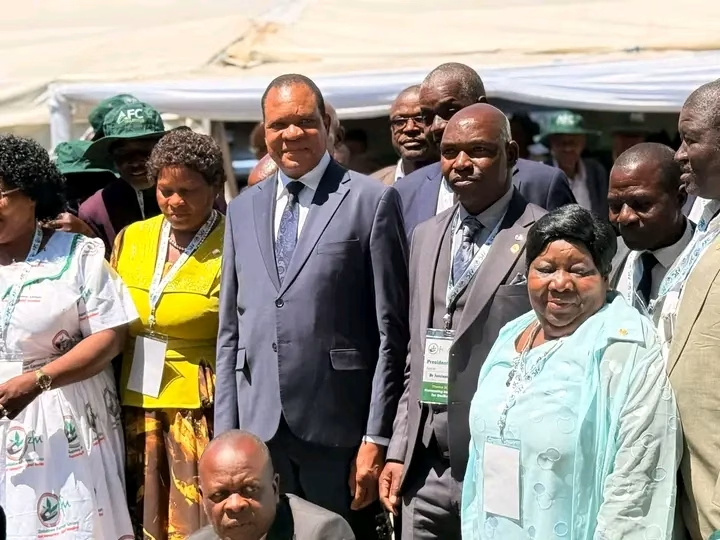
That was the broader significance of Minister Masuka’s address at the 86th Zimbabwe Farmers Union Annual Congress at Village Lodge in Gweru, where he outlined five principles shaping the country’s agricultural transformation, agriculture as a business, accelerated climate-smart production, a systems approach, value-chain development and positioning Zimbabwe as an agro-industrial hub.
The language is significant because the farmer, in this framework, is no longer viewed only as a producer at the beginning of the economic chain.
The farmer becomes part of a larger commercial system.
A successful agricultural economy therefore cannot be measured only by what comes out of the field. It must also be measured by what happens afterwards, whether the crop reaches a functioning market, whether it is processed locally, whether farmers receive sustainable returns, whether industries have reliable raw materials, whether consumers have access to affordable food and whether the country ultimately captures greater value from its own production.
This is where the concept of agriculture as a business intersects directly with Zimbabwe’s wider industrialisation agenda.
For decades, one of the structural challenges facing African economies has been the export or consumption of relatively unprocessed commodities while higher-value stages of production take place elsewhere.
Zimbabwe’s agricultural transformation is increasingly being framed around changing that equation.
A farmer producing milk, for example, is not operating in isolation from the dairy processor, transport operator, retailer, financial institution, packaging company and consumer. The same principle applies to beef, horticulture, grain, cotton and other agricultural value chains.
The economic objective is therefore not simply to increase production, but to build the infrastructure and commercial relationships that allow production to generate wider economic activity.
This explains the emphasis Minister Masuka placed on structured markets, transparent pricing and reforms aimed at reducing selected fees, permits and levies affecting areas such as dairy, beef, horticulture and water.
For farmers, market access is ultimately as important as production itself.
A farmer can increase output and still remain economically vulnerable if prices are unpredictable, markets are fragmented or transaction costs consume the return from production.
The business approach consequently requires greater predictability across the agricultural value chain.
But there is another dimension to the Minister’s message which is becoming increasingly important, resilience.
Zimbabwe’s agricultural economy remains exposed to climatic variability, meaning that commercialisation without resilience can leave farmers and the national food system vulnerable to the same shocks that have disrupted production in previous seasons.
The forecast of a strong El Niño and below-normal rainfall for the 2026/27 season has therefore placed preparedness at the centre of agricultural planning.
Government’s Summer Plan, incorporating a six-pillar Drought Plan covering strategic grain reserves, climate-smart production, financing, livestock drought mitigation, imports, and strengthened coordination and early-warning systems, represents an attempt to move the response from reacting to drought towards anticipating it.
That distinction matters.
Early warning has little economic value if it does not produce early action.
For agriculture to function as a business, farmers need to know the risks they are entering before they commit scarce capital, while Government needs mechanisms capable of responding before a climatic shock becomes a national food-security crisis.
This also explains why climate-smart agriculture is being placed alongside finance, markets and value chains rather than treated simply as an environmental issue.
Climate resilience is becoming an economic requirement.
The farmer who invests in irrigation, drought-tolerant varieties, water harvesting, improved livestock management or other climate-smart technologies is effectively managing business risk.
The same principle applies at national level.
Water security, therefore, becomes inseparable from food security, while food security becomes inseparable from industrial development.
Minister Masuka’s subsequent programme in Bulawayo, where he is scheduled to officially open the Zimbabwe Water Indaba and WASH Joint Sector Review 2026, provides an interesting continuation of that same policy conversation.
Agriculture requires water. Industry requires water. Communities require water.
The separation of these issues into different policy compartments can therefore obscure their economic relationship.
Zimbabwe’s emerging development model increasingly requires them to be viewed as parts of one system.
This is where the agro-industrial hub ambition becomes particularly important.
If agriculture is connected to processing, processing to manufacturing, manufacturing to logistics and logistics to export markets, then agricultural growth has the potential to generate activity far beyond the farm gate.
It can create demand for machinery, fertiliser, irrigation equipment, transport, cold-chain infrastructure, packaging, financial services and industrial inputs.
In that sense, agriculture can become an industrialisation engine rather than merely a food-production sector.
The political and parliamentary significance of this shift lies in the question of implementation.
Policy statements can establish direction, but the transformation will ultimately be judged by whether farmers can access finance, whether markets operate transparently, whether infrastructure keeps pace with production, whether water systems are reliable, whether processing capacity expands and whether value addition translates into improved incomes and employment.
The real test is therefore not whether Zimbabwe can produce more.
It is whether Zimbabwe can capture more value from what it produces.
That is arguably the deeper message emerging from Masuka’s address.
The agricultural question is becoming an economic question.
The farm is increasingly being viewed not as the end of a rural livelihood system, but as the starting point of a wider production chain stretching from the field to the factory, from the factory to the market and potentially from the market to the export destination.
For Zimbabwe, that transition could define whether agricultural recovery remains primarily about seasonal production or becomes part of a sustained agro-industrial transformation.
The immediate challenge, particularly under the shadow of another potentially difficult rainfall season, is to make resilience, commercialisation and value addition work together.
The long-term objective is larger.
It is to build an agricultural economy that does not merely feed Zimbabwe, but helps finance, supply and drive Zimbabwe’s industrial economy.
That is the strategic significance of treating agriculture as a business.