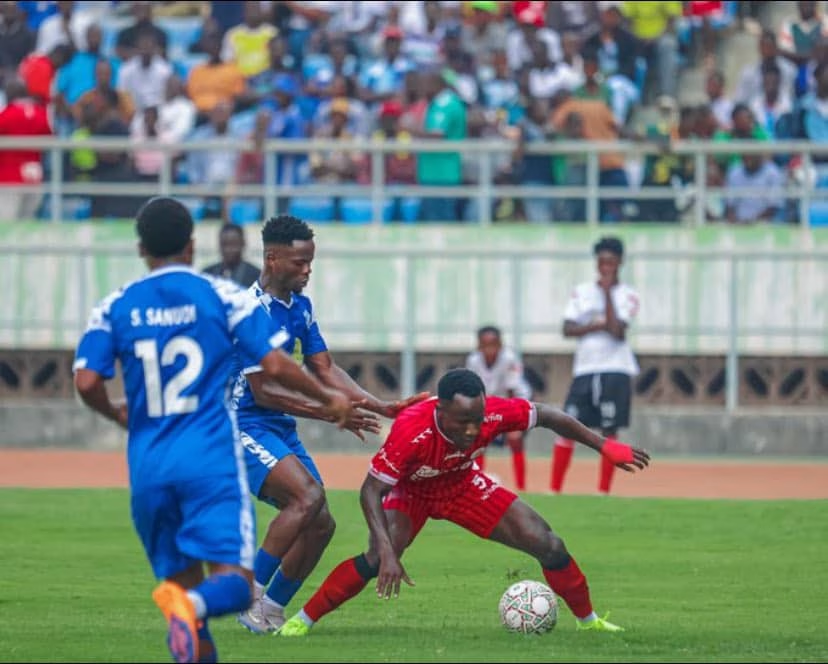
HARARE — Scottland FC’s 1-0 victory over Nsingizini Hotspurs in the opening leg of the CAF Champions League preliminary round was more than a narrow home win.
For Zimbabwean football, it was a small but important statement.
Making their maiden appearance in Africa’s premier club competition, the Zimbabwean champions showed that they can compete on the continental stage, even if the manner of the victory exposed some of the challenges that continue to confront domestic football.
Cameroonian forward Neville Tengeg supplied the decisive moment in the 66th minute, converting Emmanuel Jalai’s excellent work on the right flank to give Scottland a valuable advantage heading into the return leg in Eswatini.
But the scoreline tells only part of the story.
The more significant question is what Scottland’s continental adventure could mean for Zimbabwe.
Zimbabwe has historically produced clubs capable of making an impact in African football, from Dynamos and Highlanders to CAPS United and FC Platinum. However, sustained success at continental level has become increasingly difficult.
Scottland’s appearance therefore represents an opportunity to begin rebuilding Zimbabwe’s presence in CAF competitions.
A club’s progress in continental football does not only benefit that particular team. Strong performances can enhance the country’s reputation, expose domestic players to higher levels of competition and demonstrate that Zimbabwean clubs can once again become credible representatives of the national game.
That makes every stage of Scottland’s campaign important.
The immediate objective is progression, but the broader value lies in building a culture of competitiveness beyond Zimbabwe’s borders.
There is also a cautionary lesson in Sunday’s match.
Nsingizini were reduced to 10 men after only three minutes following Kingsley Mkwakyi’s dismissal for a dangerous tackle on Moses Shidolo. Scottland consequently had more than 85 minutes with a numerical advantage.
Yet they managed only one goal.
That is perhaps the biggest concern to emerge from the match.
Scottland dominated possession and territory for long stretches, but Nsingizini’s disciplined defensive structure exposed the difference between controlling a match and killing it off.
Against stronger continental opposition, opportunities to play against 10 men may be rare. When they come, they have to be converted into a commanding advantage.
For coach Norman Mapeza, that will be one of the major lessons from the first leg.
His decision to introduce Tengeg and Emmanuel Ziocha at half-time ultimately proved decisive. Tengeg provided what Scottland had lacked in the first half, movement and composure in the final third.
His goal was also the product of good attacking execution, with Jalai carrying the ball forward before finding the Cameroonian inside the box.
That combination will be encouraging for Scottland, while also underlining an important reality about Zimbabwean clubs competing in Africa. Domestic familiarity alone is not enough. Clubs need tactical flexibility, squad depth and players capable of producing decisive moments under continental pressure.
Scottland’s victory should therefore be viewed within the wider conversation about the development of Zimbabwean football.
Continental football provides something domestic competition cannot fully replicate. It tests players against different tactical systems, different football cultures and different levels of physical and psychological pressure.
For young Zimbabwean footballers, these matches provide valuable experience that can ultimately benefit the national team.
A successful Scottland campaign could therefore have a ripple effect. Players gain exposure, coaches gain experience, the club gains continental credibility and Zimbabwe gains visibility.
If other domestic clubs can consistently reach the latter stages of CAF competitions, the cumulative effect could help restore Zimbabwe’s standing in African club football.
But one goal is not enough.
Scottland now face the more difficult task. A 1-0 advantage is useful, but it provides little room for complacency.
Nsingizini demonstrated that they can defend under pressure, and playing at home in the return fixture could produce a completely different contest.
Scottland therefore need to approach the second leg not simply as a team protecting a lead, but as a team attempting to win the tie.
That distinction could determine how far this campaign goes.
For Zimbabwe, however, the significance is already visible.
Scottland have opened the door.
The responsibility now is to walk through it.
A club making its continental debut has secured a first-leg victory, but the bigger prize is potentially much larger, restoring belief that Zimbabwean football can once again compete, progress and make its presence felt on the African stage.
One goal has given Scottland the advantage. What happens next could determine whether this becomes merely a successful debut, or the beginning of a new chapter for Zimbabwean club football.