By Aldridge Dzvene
HARARE – President and Commander-in-Chief of the Zimbabwe Defence Forces, His Excellency Cde. E. D. Mnangagwa, has placed sovereignty, self-reliance and national capability at the centre of Zimbabwe’s evolving defence outlook, signalling a broader understanding of national defence that goes beyond conventional military preparedness.
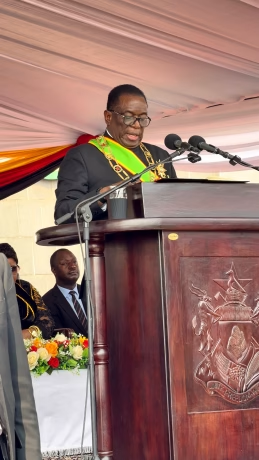
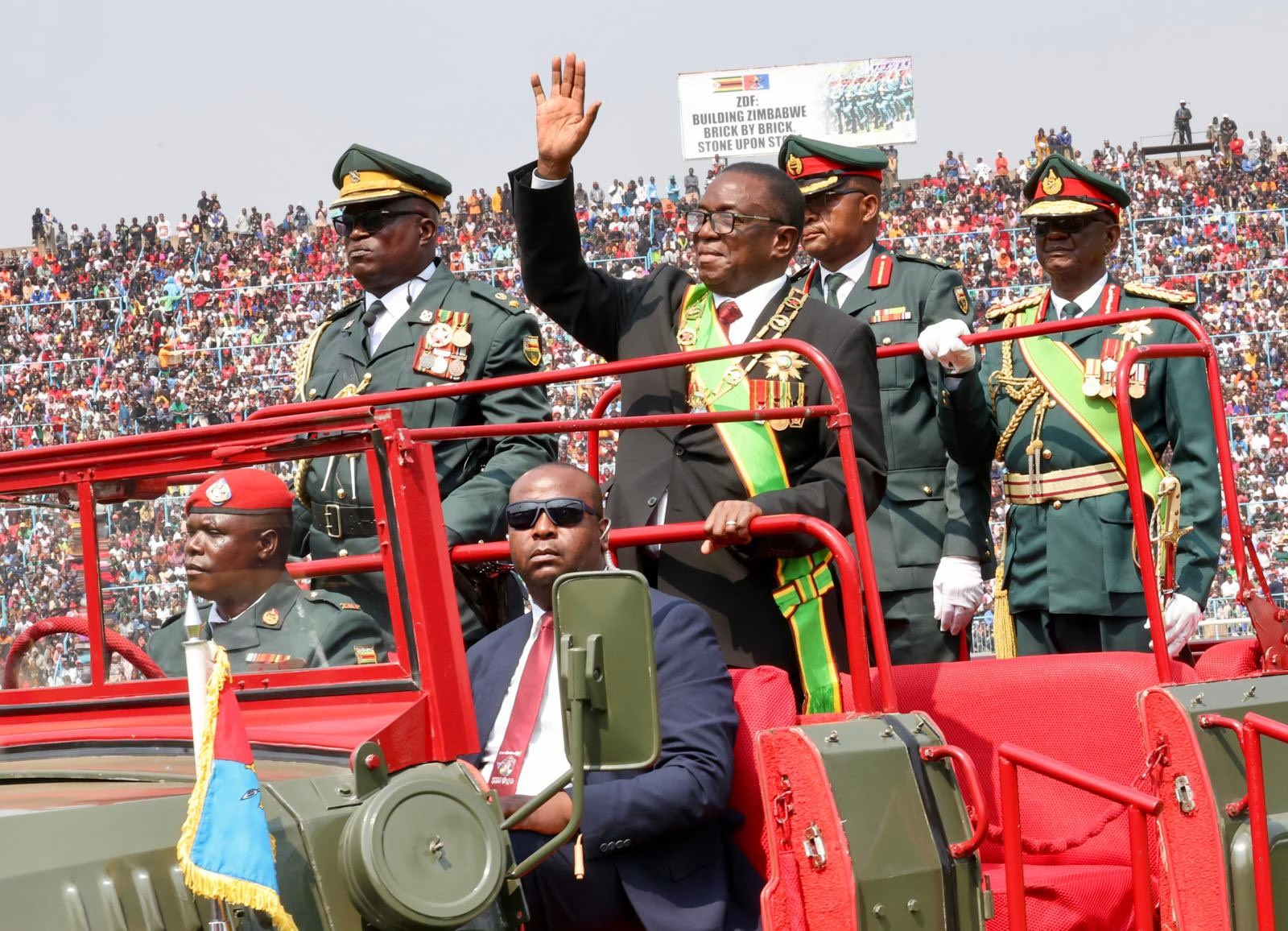
Addressing the nation during the 46th Defence Forces Day commemorations at Rufaro Stadium on Tuesday, President Mnangagwa said Zimbabwe must continue strengthening its internal capabilities as the global security environment becomes increasingly unpredictable and international relations grow more turbulent.
His message was significant not simply because of the call for modernisation, but because of how he connected defence to the wider question of national independence and the country’s ability to determine and protect its own interests.
The President said independence, self-reliance and sovereignty remained key objectives of the Second Republic, while stressing that internal defence capability was vital to the protection of national sovereignty.
That position effectively broadens the meaning of defence.
For Zimbabwe, the protection of sovereignty is increasingly being presented as a question of national capability, the ability to secure the country’s territory, protect its critical interests, develop its own technologies, strengthen food production and build institutions capable of responding to emerging challenges.
This was evident in the President’s call for a science and technology-driven national defence industry.
Rather than viewing technology simply as an instrument for improving military equipment, the address placed innovation within the broader objective of strengthening Zimbabwe’s capacity to produce solutions from within.
President Mnangagwa pointed to innovations emerging from the Zimbabwe National Defence University and called on industry and stakeholders in the security and technology space to support their eventual deployment and commercialisation.
The underlying message is that sovereignty in the modern era increasingly depends on what a country can develop and sustain for itself.
The changing nature of the international environment has made that consideration more important.
President Mnangagwa noted that global peace and security were facing unpredictable dynamics, with turbulence in international relations producing economic and social shocks across the world.
Against that backdrop, Zimbabwe is pursuing the modernisation of its defence systems, with greater attention to combat readiness, coordination, efficiency, science and technology.
The President specifically identified cyberspace security and artificial intelligence as areas requiring increased attention, directing the strengthening or establishment of relevant capabilities to keep pace with contemporary military trends.
This represents a significant shift in the understanding of preparedness.
The security environment facing states is no longer defined exclusively by conventional threats. Technological disruption, cyber vulnerabilities, information systems and the ability to rapidly develop and deploy new capabilities increasingly influence national resilience.
For Zimbabwe, the response outlined by the President is centred on adaptation without abandoning the country’s established military ethos.
He challenged senior military officers to create an innovation ecosystem capable of developing fluid and resource-efficient systems while maintaining the fundamental character of the Zimbabwe Defence Forces.
The approach also links directly to the country’s economic development ambitions.
The President said the ZDF has a responsibility to help create a stronger nexus between development and security, arguing that peace and stability must facilitate the national development trajectory towards Vision 2030.
This connection is important because it places national security within the wider architecture of economic transformation.
A stable environment creates the conditions for investment, production, infrastructure development and social progress. At the same time, a resilient economy and stronger domestic productive capacity increase a country’s ability to withstand external pressures.
It is this broader resilience that was also reflected in the President’s emphasis on food security.
He commended the Defence Forces for their contribution through institutional farms and called for increased production, agro-processing and the export of high-value agricultural products.
The message moves the concept of national resilience beyond the traditional boundaries of defence.
A country that can produce more of its own food, develop its own technological solutions and strengthen its productive systems possesses greater room to determine its own national priorities.
The ZDF’s wider contribution to society was also highlighted, including infrastructure development, medical outreach, disaster response, search and rescue operations and border control activities.
President Mnangagwa cited cooperation between the ZDF, the Zimbabwe Republic Police and other security agencies along Zimbabwe’s borders with South Africa, Botswana, Zambia and Mozambique as contributing to public security while facilitating the movement of people and trade.
The Defence Forces were similarly commended for their role in civil protection and disaster management, demonstrating how national preparedness increasingly encompasses both security emergencies and humanitarian challenges.
At the international level, Zimbabwe’s defence outlook remains linked to diplomacy and multilateral engagement.
President Mnangagwa reiterated Zimbabwe’s position as a “friend to all and enemy to none”, while highlighting the country’s election to the United Nations Security Council for the 2027 to 2028 period.
The continued participation of Zimbabwean personnel in United Nations, African Union and SADC peace support missions was presented as part of the country’s contribution to international peace and security.
Military diplomacy, including training exchanges, skills enhancement and interoperability, was also identified as an important avenue through which the ZDF is strengthening its professional capabilities and international relationships.
This gives Zimbabwe’s defence posture two complementary dimensions, strengthening internal capacity while maintaining external engagement.
The strategic direction emerging from the President’s address is therefore not one of isolation, but of greater national capability within an interconnected world.
Zimbabwe is seeking to engage internationally while simultaneously reducing vulnerabilities that could arise from excessive dependence on external capabilities.
That is where sovereignty becomes the central thread running through the address.
The President’s message suggests that sovereignty cannot be preserved only through declarations. It must be continuously supported by capable institutions, productive capacity, technological competence, professional defence structures and the ability to respond to changing circumstances.
The challenge now placed before the ZDF is consequently one of evolution.
President Mnangagwa called on the Defence Forces to evolve, innovate and adapt in line with the needs and national interests of Zimbabwe as the country moves towards becoming a prosperous and empowered Upper-Middle Income Society.
That challenge reflects a wider expectation of the Second Republic, that national institutions must develop alongside the country’s transformation agenda.
The Defence Forces are therefore being positioned not merely as guardians of territory, but as part of a broader national resilience architecture supporting peace, stability, sovereignty and development.
The political significance of the address lies precisely in this shift.
The question of defence is being connected to the larger question of who possesses the capacity to shape Zimbabwe’s future.
In an increasingly competitive international environment, the President’s message is that protecting national sovereignty requires Zimbabwe to strengthen what it can do for itself while maintaining constructive relations with the rest of the world.
The 46th Defence Forces Day address thus presented a clear strategic proposition: Zimbabwe’s development, sovereignty and security are no longer being treated as separate national questions, but as interconnected pillars of the same national trajectory.
The task before the Defence Forces is to remain ready for that changing environment, while the broader national project is to build the capabilities that make independence meaningful and sustainable.
As President Mnangagwa put it, the country’s defence establishment must continue to evolve, innovate and adapt.
The message from Rufaro Stadium was therefore about more than the Defence Forces of today. It was about the capabilities Zimbabwe will need to protect its sovereignty and sustain its development ambitions tomorrow.