By Aldridge Dzvene
HARARE — President Emmerson Dambudzo Mnangagwa’s 46th Heroes Day address has placed Zimbabwe’s liberation legacy firmly within the country’s present development journey, portraying the defence of independence as a continuing national responsibility expressed through economic transformation, social stability, industrialisation and the building of a modern state.
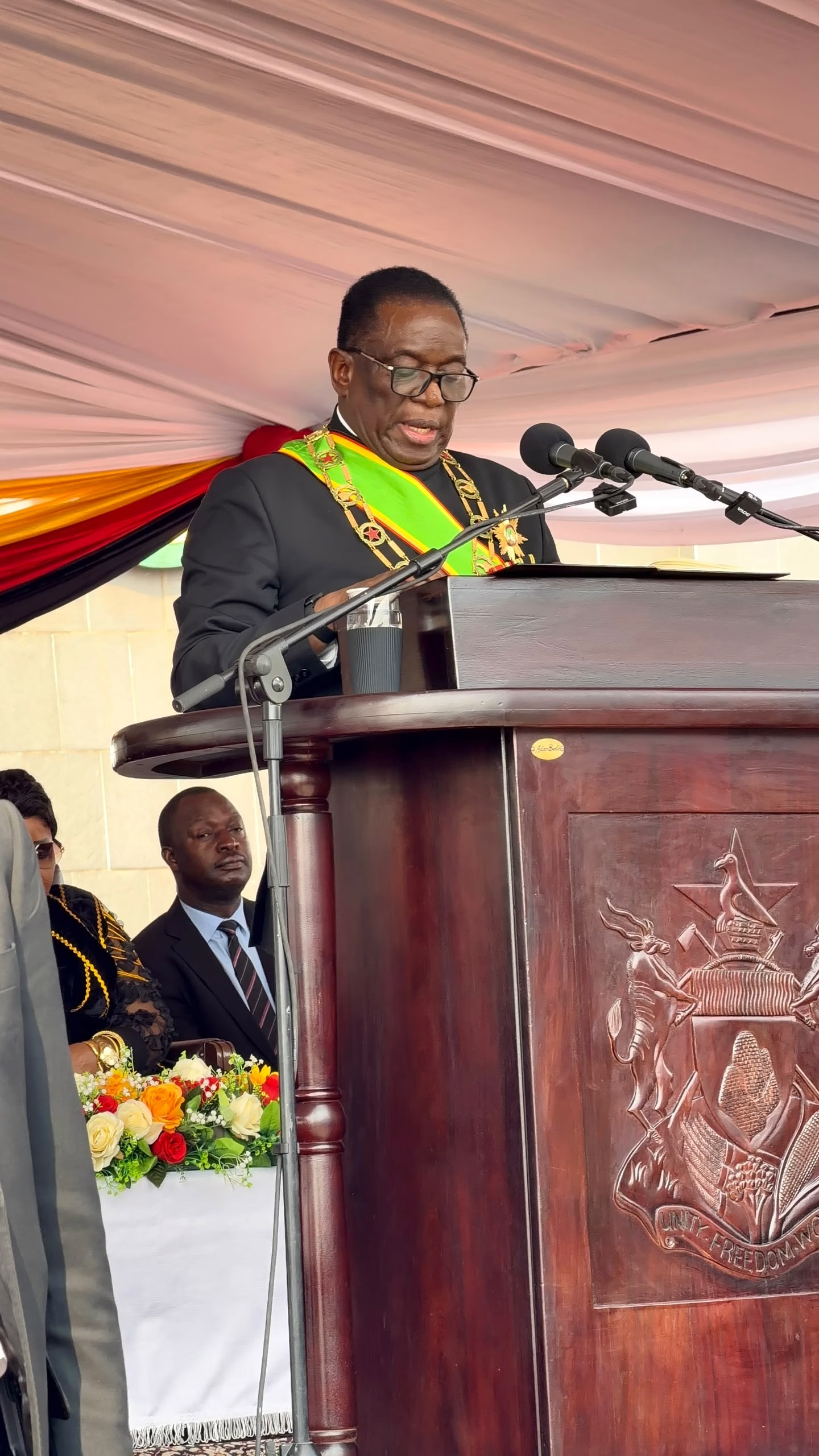
Speaking at the National Heroes Acre, President Mnangagwa used the theme “Lest We Forget” to connect the sacrifices of the liberation generation with the responsibilities facing Zimbabwe today, arguing that freedom and sovereignty cannot be preserved through remembrance alone, but require continuous stewardship and purposeful national development.
The significance of the message lies in the way the liberation narrative was connected to the practical question of how Zimbabwe develops.
The President presented the Second Republic’s development agenda as a continuation of the aspirations that underpinned the liberation struggle. Food security, industrialisation, beneficiation, infrastructure development, technological advancement and improved livelihoods were consequently placed within the wider question of what it means for a country to exercise meaningful sovereignty.
Zimbabwe’s progress towards food security was highlighted alongside the expansion of irrigation, increased utilisation of agricultural land and new production targets. Farmers were described as emerging “new heroes and heroines”, effectively extending the national idea of service beyond the battlefield to those contributing to the country’s productive capacity.
The same political-development narrative runs through the country’s industrialisation programme.
President Mnangagwa said Zimbabwe would no longer export raw natural resources, pointing instead towards value addition, beneficiation, manufacturing and the expansion of domestic industries. The shift represents an attempt to translate control over natural resources into wider economic opportunities, employment and stronger domestic production.
In this context, the country’s development agenda also becomes part of the broader preservation of sovereignty.
Economic strength reduces vulnerability, while productive capacity gives a country greater room to determine its own priorities. The President’s emphasis on energy security, infrastructure, local manufacturing and stronger supply chains therefore reflects a development model centred on building national capacity rather than merely measuring growth through headline economic indicators.
That approach extends into rural Zimbabwe, where the Government is directing investment towards rural infrastructure, manufacturing hubs and agro-processing under the “Invest Rural” policy. The President invited the private sector and Zimbabweans in the diaspora to participate in these opportunities, presenting rural development as an increasingly important component of the national transformation agenda.
The political significance of this approach is difficult to separate from its development implications.
The liberation struggle was fought largely around questions of land, sovereignty and political control. The contemporary development agenda is increasingly framed around what Zimbabweans can produce from that sovereignty and how effectively the country’s resources can be converted into better livelihoods.
This is also why the speech placed considerable emphasis on young people.
The expansion of vocational training, investment in research and innovation, and the development of technological skills are being positioned as mechanisms for preparing Zimbabwe’s next generation to participate in a more industrialised economy.
The message is that independence must produce capability.
A politically independent country must also possess the skills, institutions, infrastructure and productive capacity required to sustain its development choices.
The President’s attention to national memory adds another dimension to this process. The planned digitisation of liberation war archives, historical research and integration of liberation heritage into education and tourism is intended to ensure that the country’s history remains part of the national consciousness.
This gives the “Lest We Forget” theme a distinctly contemporary meaning.
The concern is not simply that future generations should remember the names of those who fought for independence. It is that they should understand the historical foundation upon which the current national development project rests.
The speech also linked development with the preservation of national cohesion.
President Mnangagwa called for the rejection of divisive machinations and reaffirmed the importance of a peaceful and stable society as Zimbabwe pursues economic growth and modernisation.
That emphasis is significant in a development environment where major economic transformation requires political and social stability. Infrastructure projects, industrial investment, agricultural expansion and technological development all depend on an environment in which national institutions and communities can function with continuity.
Zimbabwe’s growing international role was similarly brought into the development narrative, with the President pointing to the country’s election to the United Nations Security Council for the 2027–2028 term as evidence of growing international confidence in Zimbabwe’s constructive role in global affairs.
Taken together, the address presented a country attempting to move the meaning of independence from its historical political foundation towards a broader development reality.
The heroes of the liberation struggle secured the political space for Zimbabwe to determine its own future. The present challenge, as reflected in the President’s address, is to make that freedom visible in the economy, in communities, in schools, in industries and in the everyday lives of citizens.
This is ultimately where the political meaning of “Lest We Forget” becomes most powerful.
Remembering the liberation struggle is being presented not as an exercise in looking backwards, but as a responsibility to build forward.
The President’s closing call for a high-performance culture and life-transforming results across provinces, districts, wards and villages captures that transition.
The next chapter of the liberation legacy, therefore, is increasingly being measured not only by what Zimbabwe defended in the past, but by what it can build in the present.
The message from the Heroes Acre was clear: independence created the foundation. Development is the continuing test of what that independence can deliver.