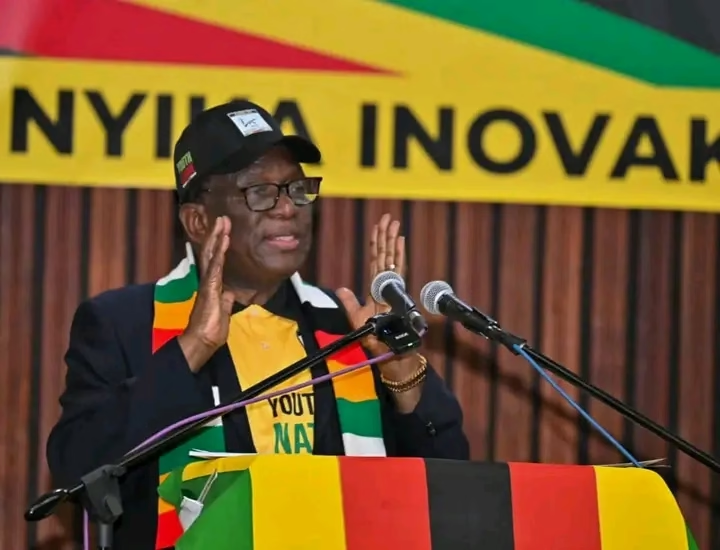
Harare, His Excellency the President of the Republic of Zimbabwe, Cde. Dr. Emmerson Dambudzo Mnangagwa has called on Zimbabwe’s youths to position themselves at the centre of the country’s modernisation, industrial transformation and economic development agenda, declaring young people the inheritors and implementers of the nation’s future under the Second Republic.
Addressing delegates during the ZANU PF Youth League National Assembly held at the party headquarters in Harare under the theme, “An Empowered Youth, A Stronger Nation,” His Excellency President Dr. Emmerson Dambudzo Mnangagwa framed the role of the youth not merely as political participants, but as strategic actors within Zimbabwe’s long term developmental trajectory.
Analytically, the President’s remarks reflected an increasingly deliberate shift toward positioning youth empowerment as an economic and ideological pillar of the country’s transformation agenda under Vision 2030 and the National Development Strategy framework.
By describing youths as the “modernisers of the economy” and inheritors of the Fourth Chimurenga, His Excellency President Dr. Emmerson Dambudzo Mnangagwa linked the liberation ethos of Zimbabwe’s past with the economic struggles and developmental aspirations of the present. The messaging reinforced a broader ideological narrative that national development, economic sovereignty and technological advancement are now the defining battlegrounds of the current generation.
The President urged young leaders to reject division, complacency and individualism, while embracing innovation, discipline, productivity and national consciousness. This emphasis signals growing recognition within Government and the ruling party that the country’s demographic structure, dominated by youths, represents both a developmental opportunity and a strategic national responsibility.
Importantly, the call for stronger partnerships with institutions such as ZimTrade highlighted the increasing convergence between youth empowerment and economic diplomacy. Rather than limiting empowerment to political mobilisation alone, the Second Republic appears to be broadening the concept toward entrepreneurship, export participation, industrial productivity and integration into regional and international markets.
The focus on technology and innovation further reflects Zimbabwe’s wider adaptation to changing global economic realities where competitiveness is increasingly determined by digital capacity, industrial modernisation and knowledge driven production systems. Youths are therefore being positioned not only as beneficiaries of development, but as implementers of technological transformation across agriculture, mining, manufacturing, trade and services sectors.
His Excellency President Dr. Emmerson Dambudzo Mnangagwa’s emphasis on decentralised empowerment programmes also aligns with ongoing Government efforts to spread economic opportunities beyond major urban centres. The decentralisation agenda seeks to ensure that youths in provinces, districts, growth points and rural communities are integrated into national development processes through access to skills development, production initiatives and economic participation platforms.
Equally significant was the President’s reference to national consciousness training at institutions such as the Joshua Mqabuko Nkomo Training Centre. This reflects the continued importance attached to ideological orientation within Zimbabwe’s governance framework, where patriotism, national identity, discipline and historical consciousness are viewed as foundational to sustainable nation building.
From a political and developmental perspective, the President’s directive for the Youth League leadership to begin reporting on tangible economic contributions marked a notable shift from rhetoric toward measurable developmental accountability. The instruction suggests growing expectations for youth structures to transition from mobilisation platforms into practical engines of production, entrepreneurship and community development.
Analysts note that Zimbabwe’s developmental ambitions increasingly depend on converting its youthful population into an economically productive force capable of driving industrialisation, innovation and national competitiveness. High youth unemployment levels across the region continue presenting socio economic risks, making empowerment programmes, skills development and enterprise creation central to long term stability and growth.
The address also reinforced the ideological positioning of ZANU PF as a party seeking to merge liberation history with modern economic transformation. By connecting the sacrifices of the liberation struggle with the responsibilities of economic development, the leadership continues advancing the narrative that sovereignty must now be defended through productivity, industrial capacity, innovation and self reliance.
Ultimately, the Youth League National Assembly emerged not merely as a political gathering, but as a broader platform projecting Zimbabwe’s evolving developmental philosophy, one that increasingly views youths as central drivers of economic modernisation, technological advancement, national resilience and the long term realisation of Vision 2030.