By Aldridge Dzvene
The President of the Republic of Botswana, His Excellency Advocate Duma Boko, has thrown his weight behind Zimbabwe’s economic momentum, describing the country’s trajectory as a compelling model of resilience, innovation and industrial ambition within the Southern African region.
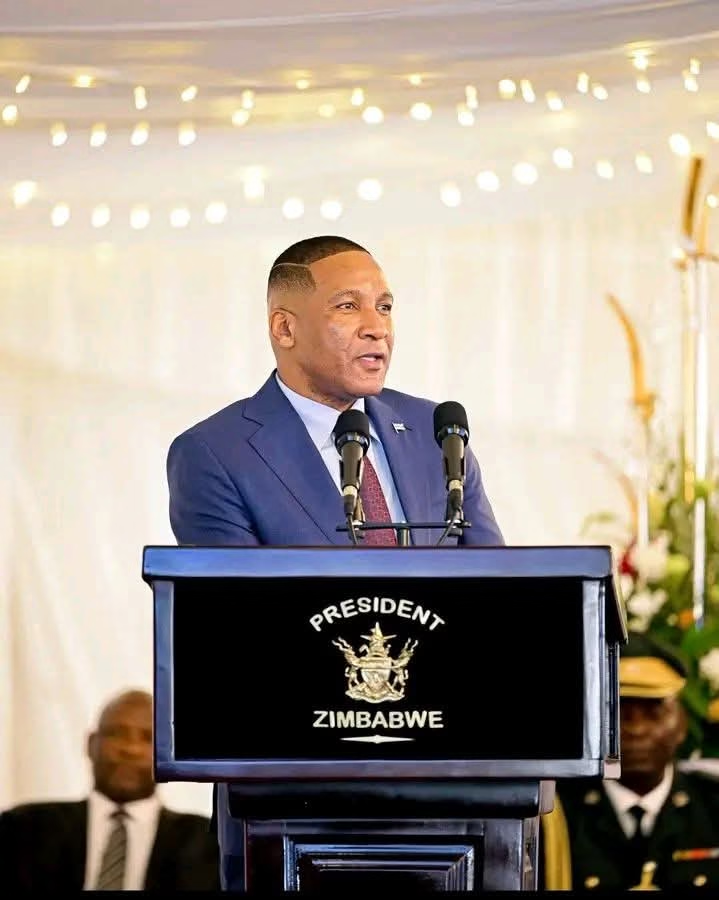
Speaking at the official opening of the Zimbabwe International Trade Fair 2026 in Bulawayo, the President of Botswana positioned Zimbabwe’s progress as both instructive and catalytic for regional transformation, while elevating the importance of coordinated economic policy and integration across borders.
Addressing a high level gathering of Heads of State, diplomats, business leaders and industry players, the President of Botswana framed Zimbabwe’s development as a reflection of a broader shift within the region, where economies are increasingly defined by innovation, enterprise and internal capacity building rather than dependency.
He emphasized that the future of regional prosperity lies in dismantling structural inefficiencies that continue to constrain trade, revealing that discussions with the President of the Republic of Zimbabwe, His Excellency Dr. Emmerson Dambudzo Mnangagwa, during the Fifth Session of the Bi National Commission in Harare had converged on the urgent need to remove non tariff barriers.
The President of Botswana identified customs delays, administrative bottlenecks and border inefficiencies as critical impediments to trade expansion, stressing that failure to address these challenges undermines the region’s ability to fully leverage its production capacity and market potential.
Within this context, the Zimbabwe International Trade Fair was presented not merely as an exhibition platform but as a strategic economic instrument, reflecting Zimbabwe’s capacity to sustain industrial activity, attract investment and promote value driven production in a competitive global environment.
The President of Botswana’s remarks signal a subtle but significant recalibration in regional economic discourse, where Zimbabwe is increasingly being viewed not only as a participant but as a reference point in key sectors such as agriculture, mineral value addition and small to medium enterprise development.
This perspective aligns with broader continental frameworks such as the African Continental Free Trade Area, which seek to reposition African economies through enhanced intra continental trade, industrialisation and the removal of both tariff and non tariff barriers.
Analytically, the emphasis on urgent reforms at border posts introduces a critical policy dimension, as efficiency at strategic crossing points such as Beitbridge Border Post remains central to unlocking trade volumes and reducing the cost of doing business.
The President of Botswana’s acknowledgment of Zimbabwe’s economic strides, coupled with an expressed willingness to draw lessons from its experience, reflects an emerging pragmatism within the region, where collaboration is increasingly informed by mutual benefit and shared economic objectives.
This development also reinforces Zimbabwe’s broader re engagement thrust, where diplomacy is being systematically aligned with trade and industrial policy to position the country as a competitive and reliable partner within both regional and continental markets.
However, the real test will lie in translating political consensus into operational efficiency, particularly in streamlining customs systems, harmonising regulations and accelerating infrastructure development to support seamless trade flows.
The convergence of political will at the highest level suggests that the Zimbabwe Botswana economic corridor could evolve into a more dynamic axis of trade and production, with implications extending beyond bilateral relations into the wider Southern African Development Community region.
In this regard, the address by the President of Botswana moves beyond ceremonial endorsement, articulating a clear economic logic, that regional integration, underpinned by efficiency, cooperation and industrial capacity, remains the most viable pathway to sustainable growth and shared prosperity.