By Aldridge Dzvene
MASVINGO – Vice President General (Retired) Dr Constantino Chiwenga has elevated the role of the Church in Zimbabwe’s development architecture, describing faith-based institutions as strategic partners in building social cohesion, strengthening human development and complementing Government’s delivery of essential services.
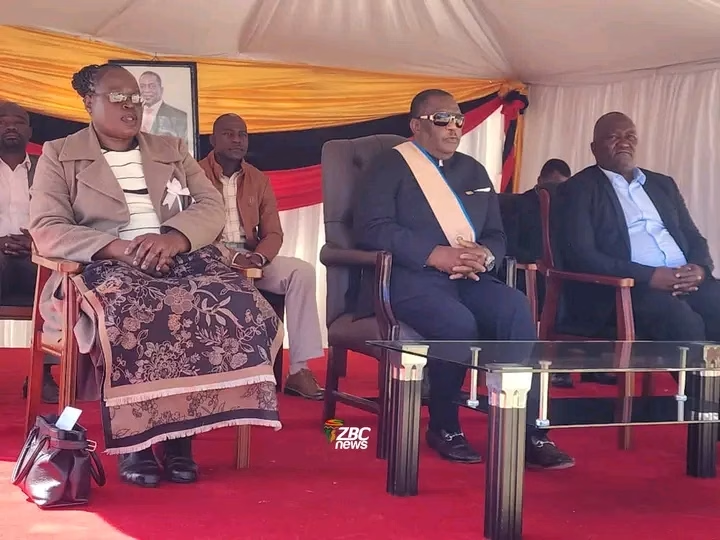
Speaking at the 25th Priestly Anniversary of the Right Reverend Bishop Raymond Mupandasekwa at St Patrick’s Gokomere Mission in Masvingo, Vice President Chiwenga presented the Church–State relationship as extending beyond religious affairs, placing it within the broader national development agenda.
His intervention is significant because it frames development as a process that requires more than Government investment in physical infrastructure. While the State remains responsible for policy, public institutions and national programmes, the Church possesses an extensive community presence through schools, hospitals, clinics, orphanages, parishes and grassroots structures.
It is this institutional reach that gives faith-based organisations the potential to become important partners in translating national development policies into practical interventions at community level.
“Government recognises the Church as a pillar of social cohesion and moral renewal. Where Government builds infrastructure, the Church builds conscience. Where Government provides policy direction, the Church provides the ethical compass,” Vice President Chiwenga said.
The distinction is important. Infrastructure can provide the physical foundation for development, but sustainable development also depends on the quality of the people using that infrastructure and the social values governing communities.
A school, for example, does more than provide classrooms. It develops human capital. A hospital does more than provide a building. It sustains the productive capacity of communities. Agricultural programmes do more than increase output. They influence household incomes, food security and rural livelihoods.
The Church’s involvement in these sectors therefore places it within some of the same development spaces prioritised by Government.
Vice President Chiwenga said the Church’s work in schools, hospitals, clinics, orphanages and communities contributes significantly to social cohesion and national development, effectively recognising faith-based institutions as part of the wider ecosystem through which Zimbabwe delivers social services.
This approach also carries significance for the country’s human-capital agenda. Zimbabwe’s development ambitions under Vision 2030 require a population equipped with education, skills, good health and a strong sense of social responsibility. Institutions with an established presence in communities can help reinforce these foundations.
The Masvingo engagement further demonstrated that such cooperation is already taking place at provincial level.
Minister of State for Provincial Affairs and Devolution Honourable Ezra Chadzamira acknowledged the contribution of the Roman Catholic Church to education, agriculture and other development programmes in the province.
The reference to agriculture is particularly relevant to Masvingo, where rural communities depend heavily on agricultural production and where improving productivity remains central to household livelihoods and food security.
The emerging model is therefore one of complementarity rather than substitution. Government provides the national policy framework and public investment, while institutions such as the Church bring community networks, infrastructure, human resources and long-established relationships with citizens.
That distinction is critical to understanding the political-development significance of Vice President Chiwenga’s message.
Zimbabwe’s development challenge is not simply about producing policies. It is about ensuring that those policies reach communities and generate measurable improvements in people’s lives. This requires institutions capable of operating at the point where national policy meets everyday community realities.
The Church is particularly positioned in that space because its institutions are often embedded within communities for generations.
The celebration of Bishop Mupandasekwa’s 25 years of priestly service consequently provided a wider platform to reflect on the relationship between leadership, service and national development.
Bishop Mupandasekwa, who became Bishop of the Diocese of Masvingo in 2023 and serves as President of the Zimbabwe Catholic Bishops’ Conference, represents a Church leadership structure with influence extending beyond individual congregations.
His anniversary therefore became an occasion not only to recognise personal service but also to acknowledge the wider institutional contribution of the Catholic Church to Zimbabwean society.
The development dimension becomes even more pronounced when viewed through the principle of social cohesion.
Economic development can be undermined where communities are fragmented, public trust is weak and social institutions are unable to provide guidance during periods of economic or social pressure. Institutions capable of bringing communities together can consequently contribute to the stability required for development.
Vice President Chiwenga’s characterisation of the Church as a source of “moral renewal” places this social dimension at the centre of the partnership.
It suggests that the national development question is not exclusively about roads, dams, factories, schools or hospitals. It is also about the values, responsibility and social relationships that determine whether communities can sustain those gains.
For the Second Republic, which has placed Vision 2030 at the centre of its development agenda, this presents an important policy consideration: achieving an upper-middle-income economy requires a whole-of-society effort.
Government alone cannot deliver every development outcome.
The private sector remains essential for investment and employment. Communities are central to local development. Traditional leaders influence rural governance and resource management. Universities generate knowledge and innovation. Civil society organisations provide specialised community interventions. Faith-based organisations contribute through education, healthcare, welfare and social mobilisation.
The Church therefore occupies a distinctive position within this broader development ecosystem.
The Masvingo engagement points towards a development model in which national progress is increasingly viewed as a shared responsibility, with different institutions contributing according to their comparative strengths.
For Zimbabwe, the deeper test will be whether such partnerships can move beyond expressions of goodwill into structured cooperation, measurable programmes and clearly defined development outcomes.
If effectively coordinated, the Church’s existing infrastructure and community reach can provide Government with an additional platform for strengthening education, healthcare, agriculture, social welfare and community development.
Vice President Chiwenga’s message consequently carries significance beyond the anniversary being celebrated at Gokomere Mission.
It places the Church within the broader national conversation on how Zimbabwe builds the human, social and institutional foundations required to sustain economic transformation.
The central proposition is clear: national development cannot be measured only by what the State builds, but also by the strength of the institutions and communities that sustain those gains.