By Aldridge Dzvene
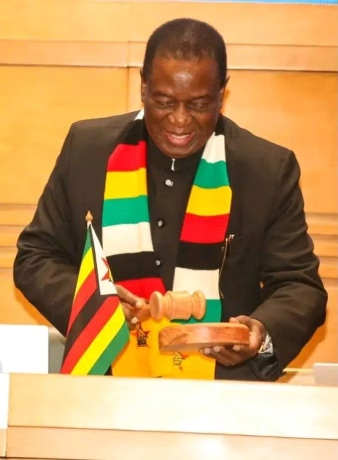
In Blantyre, Malawi, the Speaker of the Parliament of Zimbabwe, Advocate Jacob Francis Nzwidamilimo Mudenda, is not merely facilitating a post-election orientation programme, he is imprinting Zimbabwe’s parliamentary philosophy, institutional memory and democratic consciousness onto a regional stage increasingly hungry for depth, balance and credibility.
What is unfolding at the high-level Orientation and Capacity-Building Programme for the 2025–2030 Parliament of Malawi is less a routine induction and more an intellectual recalibration of parliamentary leadership. At its centre stands Speaker Mudenda, whose interventions have transformed the programme into a forum of ideas, constitutional reflection and lived parliamentary wisdom.
On the second day of proceedings, Speaker Mudenda delivered a forceful and intellectually layered paper on International Perspectives and Good Practices in the Role of Presiding Officers of Parliament. With deliberate clarity, he dismantled the notion of the Speaker as a passive referee and reconstructed the office as the living conscience of Parliament, the final moral checkpoint between raw political power and constitutional restraint.His framing of the Presiding Officer as the custodian of democratic equilibrium, balancing majority authority with minority protection, executive oversight with legislative independence, struck at the very heart of modern parliamentary struggle.
In doing so, Speaker Mudenda drew from Zimbabwe’s own constitutional journey, where Parliament has had to continuously assert its relevance, dignity and authority within a competitive political environment.The power of his address lay not only in its intellectual range, but in its moral undertone. Speaker Mudenda reminded his audience that authority in Parliament is never imposed, it is accumulated through fairness, consistency and visible neutrality.
His warning that institutional legitimacy collapses when neutrality is practised but not seen was a sobering reflection for any legislature operating under public scrutiny and political tension.Unlike abstract academic discourse, his presentation was steeped in practicality. It challenged newly elected Malawian leaders to interrogate how they chair debates, set agendas, manage dissent and protect institutional integrity in moments of pressure.
His message was unmistakable: the health of Parliament is measured not by the loudness of politics, but by the quiet discipline of its procedures.The presence of former Canadian Speaker Geoffrey Regan and former Malawian Speaker Chimunthu Banda enriched the dialogue, but it was Speaker Mudenda’s African-centred articulation of global best practice that gave the programme its distinctive character.
By rooting international norms within African political realities, history and ethics, he elevated the conversation beyond borrowed templates to authentic institutional ownership.The appreciation expressed by Malawi’s Speaker, Rt Hon Sameer Gaffar Suleman, was a recognition of substance rather than symbolism. It reflected the immediate relevance of Speaker Mudenda’s contributions to a Parliament seeking coherence, authority and legitimacy at the dawn of a new legislative term.
As he prepares to deliver his final paper on the governance and professionalism of Parliamentary Service Commissions, Speaker Mudenda’s presence in Blantyre has already sent a clear signal. Zimbabwe’s Parliament is no longer positioned at the periphery of parliamentary development conversations. It is increasingly a reference point, a source of ideas and a contributor to the intellectual architecture of democratic governance in Southern Africa.This engagement is not about Malawi alone. It is a projection of Zimbabwe’s parliamentary confidence, an assertion of its institutional maturity and a reaffirmation that democratic leadership, when grounded in principle and experience, travels well beyond national borders.