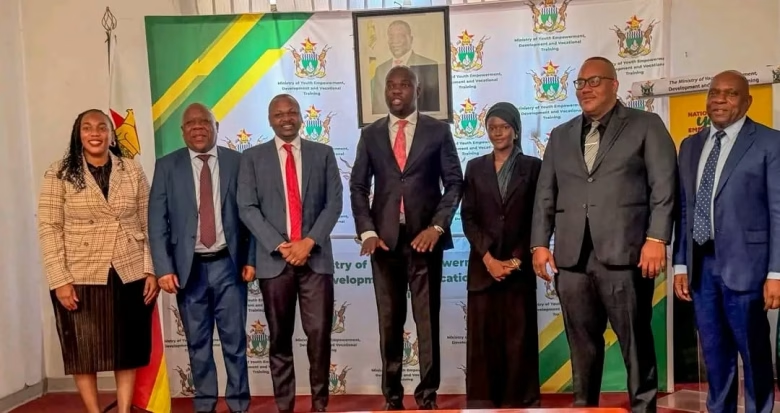
Four ambassadors-designate to the United States, the United Arab Emirates, South Africa and Cuba have bid farewell to Vice President Dr Constantino Chiwenga at Munhumutapa Building, in a moment that underlines how Zimbabwe is quietly but deliberately repositioning its diplomacy around economic interests, strategic partnerships and re-engagement. Ambassador David Hamadziripi heads to Washington, Ambassador Isaac Moyo to Abu Dhabi, Ambassador-designate Lovemore Mazemo to Pretoria and Ambassador-designate Patrick Mutasa to Havana, forming a strategic diplomatic quartet deployed to capitals that are central to Zimbabwe’s foreign policy outlook and economic aspirations.
The farewells come shortly after President Mnangagwa officially dispatched the envoys at State House, charging them to deepen cooperation, unlock investment and advance Zimbabwe’s national interests abroad. Their deployment reflects the Second Republic’s emphasis on “economy-first diplomacy,” where every mission is expected to translate political goodwill into concrete economic gains in trade, investment, technology transfer and development cooperation. In his remarks after the closed-door meeting, Ambassador Hamadziripi framed his mission to the United States as one anchored on continuing the thaw in relations, building a respectful, mutually beneficial partnership and seeking areas of convergence despite the long shadow of sanctions and historical mistrust.
In South Africa, Ambassador-designate Mazemo assumes the delicate task of managing relations with Zimbabwe’s largest trading partner and home to a huge Zimbabwean diaspora. His brief goes beyond traditional diplomacy to sustaining cross-border economic ties, promoting Zimbabwe as a competitive investment destination and ensuring that political, economic and social cooperation remains stable in the face of migration pressures and global headwinds. His mission will be critical in supporting trade flows, industrial linkages and regional value chains under SADC and the African Continental Free Trade Area, where Pretoria and Harare both play influential roles.
For Ambassador-designate Moyo, the posting to the United Arab Emirates places him at the centre of Zimbabwe’s growing engagement with Gulf economies, which have emerged as important partners in mining, energy, tourism, aviation and investment promotion. He indicated that his mandate from President Mnangagwa is clear, to pursue opportunities, bring business to Zimbabwe and expand trade and investment ties, with the economy as the organising principle of his work. The UAE has already become a significant market for Zimbabwean gold and other commodities, and the expectation is that this relationship will diversify into infrastructure, renewable energy and logistics.
In Havana, Ambassador-designate Mutasa is tasked with consolidating a long-standing friendship forged in the trenches of anti-imperialist solidarity. Zimbabwe and Cuba already cooperate in pharmaceuticals and health, and both nations share the experience of enduring United States sanctions. Mutasa’s mission is to turn solidarity into structured economic cooperation, ensuring existing agreements yield practical projects on the ground, while opening new avenues in areas such as agriculture, sport and human capital development. By focusing on sectors that build resilience and self-reliance, the Havana posting becomes an important front in Zimbabwe’s wider effort to diversify partnerships beyond traditional Western and regional actors.
Collectively, the four appointments reveal a coherent diplomatic logic. Washington represents re-engagement and the long road to normalising relations with the West. Abu Dhabi symbolises new capital flows, global capital markets and the energy of Gulf investment. Pretoria stands for neighbourhood stability, regional trade and industrial integration. Havana carries the weight of ideological solidarity, innovation in health and education, and the search for alternative development models. By seeing off the envoys personally, Vice President Chiwenga reinforced the message that diplomacy is now tightly bound to economic performance and that ambassadors are accountable for turning political access into measurable national benefit.
As VP Chiwenga travels to South Africa to lead Zimbabwe’s delegation at the G20 Summit, the farewell ceremony sits neatly within a broader picture of a country seeking voice, space and opportunity in an uncertain global order. The four envoys depart not merely as ceremonial representatives, but as frontline economic actors expected to secure markets, investment and solidarity that can feed into Vision 2030. In that sense, the quiet scene at Munhumutapa signals something larger, a diplomatic service being recalibrated to match the ambitions of a nation determined to turn its foreign relations into tangible development outcomes.