MAJOR companies, including an airline, are through with the necessary technicalities allowing them to accept payments in ZiG, with Reserve Bank Governor Dr John Mushayavanhu assuring Parliament yesterday that the Central Bank has enough reserves to back the new currency.
ZiG continues to show its viability as the exchange tender of choice with more industry players now accepting the new local currency in exchange for goods and services.
In a business update, fastjet airline said customers could now book and pay for flights using the local currency.
“Fastjet Zimbabwe is pleased to advise that we have successfully migrated to the ZiG currency.
“Customers may now book and pay in ZiG. Payments in ZiG can only be made at any fastjet airport ticketing desk or fastjet sales shops,” said the air line.
In an interview yesterday, Confederation of Zimbabwe Industries (CZI) president, Mr Kurai Matsheza, said the demonstration of confidence in ZiG across all sectors was evidence that the country was on the right path.
“We welcome that demonstration of confidence, we hope it will spread to all sectors of the economy.
“As we observed, some companies are accepting the ZiG, which demonstrates that confidence is building up, so our hope is that over the coming months and year there will be more and more confidence in ZiG,” he said.
Mr Matsheza said the increase in confidence would undoubtedly see the reliance on the US dollar diminishing as the use of the local currency gains traction.
“If you remember the speech by the Reserve Bank Governor, he said he would be happy if by the end of the year the use of the US dollar will have come down from levels where it is now to may be 70 percent or below, so we hope that target will be achieved.
“Well, the market will tell and as we observe, these small steps we are seeing now are showing that there is confidence. By and large, any economy needs to have its own currency so a country must have its own currency and I do not think there is any debate about that,” he said.
Confederation of Zimbabwe Retailers (CZR) president Dr Denford Mutashu said current indications pointed at increased ZiG use once notes and coins were introduced on Tuesday next week.
“The market has embraced ZiG and the joy will be doubled once the notes and coins start circulating as people can’t wait.
“The ZiG will be a sustainable currency because it’s gold backed, a precious mineral whose value can only firm up than depreciate,” he said.
Mr Mutashu said 50 percent of all provisional tax payments for companies would be done in the local currency, hence increasing demand for it.
“We are working closely with Government and are quite satisfied we share the same interests of a stable currency, exchange rate and inflation.
“Fifty percent of QPDs will be paid in ZiG and all big companies will be chasing after the ZiG. Creating demand and space for ZiG is one of the ways of attaining stability,” he said.
Service providers and supermarket chains across the country have enjoyed brisk business owing to the continued growth of confidence in the ZiG.
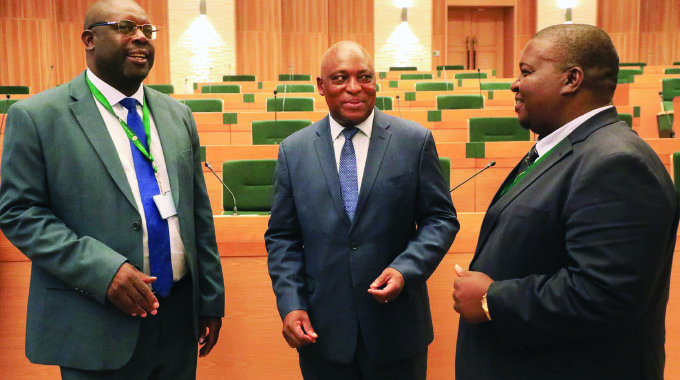
Dr Mushayavanhu yesterday told a joint sitting of the Portfolio Committees of Budget, Finance, Economic Development and Investment Promotion and Industry and Commerce that the Central Bank had enough reserves to back the new currency.
He said the RBZ had US$100 million in cash and nostro balances and US$185 million worth of gold. “That is enough to anchor the currency and, going forward, Government is also going to be purchasing the 25 percent surrender requirement from exporters and of that 25 percent, half of that, 50 percent, is going to be sold back to the market through the banks to ensure that there is foreign exchange liquidity in the market so that any importer, or any person, who wants to purchase something from outside the country can access the foreign exchange from their bank.
“So, I can assure you Honourable Members that we have enough reserves to support ZiG,” Dr Mushayavanhu said.
He said the value of the local currency would be determined by market forces through the willing buyer willing seller concept.
“The exchange rate is going to be determined by market forces. However, the Central Bank will only intervene in the market if the exchange rate is depreciating too fast or appreciating too fast, just like any other Central Bank in the world does,” he said.
Dr Mushayavanhu added that they had created a monetary policy implementation committee to track variables like money supply, inflation and productivity to ensure that the Central Bank sticks to the issues it announced in the monetary policy.
He said the value of the ZiG was likely to rise due to an expected increase in demand when companies pay their quarterly tax payments in June, with half of those payments to be done in ZiG.
Dr Mushayavanhu also told the committees that they had consulted widely in coming up with ZiG.
“I was told by His Excellency, the President that I was going to be the Governor of the RBZ on September 11, 2023. I started preparing to do the job and holding consultations.
“I and my incoming team consulted widely. As I have said before, we consulted CZI, the Chamber of Mines, other business organisations, civil society, we consulted opinion leaders, we even sought assistance from consultants from multi-lateral organisations who were generously seconded to us.
“I heard that yesterday (Monday) people were saying we got the structured currency that we introduced from the World Bank, that is not true.
“We got a consultant seconded to us by the World Bank and that assisted us in getting further information on the structured currency and refining our thoughts on that currency.”
Herald