Trust Freddy Herald Correspondent
ZIMBABWE is committed to overcoming its energy deficit through pro-business policies that encourage investment, the Minister of Energy and Power Development, Edgar Moyo, has said.
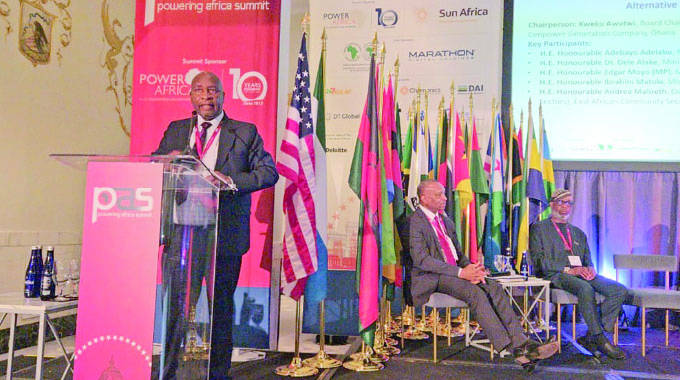
Minister Moyo said this at the 9th Powering Africa Summit 2024, which concluded in Washington DC, United States, yesterday.
The summit focused on energy project development and infrastructure and the enabling environment, running under the theme: “Capital flows underpinning the energy transition.”
Sponsors, African utilities, regulators, and delegates among others were selected from Egypt, Ethiopia, Sudan, Zimbabwe, Malawi, Senegal, Eswatini, Djibouti and São Tomé and Príncipe.
The conference featured discussions on the effects of lowering loan costs, looking for alternatives to sovereign guarantees, and unlocking the climate financing pledged to Africa’s energy industry.
Minister Moyo made a presentation on the potential impact of reducing the cost of debt and different approaches to sovereign guarantees.
“A low cost of debt enhances the return on investment attracting foreign investors into the sector. Financial stability reduces pressure on utilities because when the cost of debt is very high there is a lot of pressure on the utilities and a lot of turbulence then occurs.
“With more independent power producers able to supply affordable power, national utilities can reduce their financial deficit. Improved utility performance results in competition from independent power producers and can lead to efficiency gains in the electricity sector,” he said.
The Minister said Zimbabwe was working on creating a more favourable environment for business.
“In the Zimbabwe case, the Government has finalised risk guarantee mechanisms through what we call a government implementation agreement and just last week we were issuing these agreements to prospective developers in the private sector.
“These energy sector reforms create an enabling environment that allows increased participation of the private sector in developing electrified infrastructure by improving efficiencies, allowing a recovery of efficient costs, including connection costs and increasing accountability reforms that would include tariff regulatory accounting frameworks, tariff review methodologies, energy planning, electricity planning structure and all that which goes with it.
“A conducive regulatory policy framework would promote independence of energy regulation. For example, in Zimbabwe we have what we call the Zimbabwe Energy Regulatory Authority which regulates the sector — fostering accountability, fairness, transparency, viability and affordability among suppliers and consumers.”
The delegation’s participation underscores the Second Republic’s dedication to finding sustainable solutions to its power woes.
It also focused on the critical financial aspects needed to develop Africa’s energy sector more effectively, with conversations rooted in reducing the cost of the debt and innovative solutions to the sovereign guarantee impasse.
African Development Bank vice president for power, energy, climate change and green growth, Dr Kevin Kariuki, said: “To address the energy poverty on the continent, the international community should rely more on the empirical evidence of risk and not perceived risk.
“The default risk of Africa is less than anywhere else in the world, so we should just use realistic risk not perceived risks.”