ZIMBABWE has witnessed increased agricultural output and productivity, which have led to the improvement of household incomes, as well as food and nutrition security, despite not being spared the adverse effects of climate change, thanks to climate-smart agricultural policies implemented by the Second Republic, President Mnangagwa has said.
On several occasions, the country, as many others, has been hit by erratic rainfall, prolonged droughts and extreme weather events that have negatively affected economic stability and agricultural production.
These adverse weather events have particularly affected women and children.
President Mnangagwa said adoption of climate-smart agriculture as one of the pathways towards sustainable agriculture — through the climate-proofed Pfumvudza/Intwasa programme — had enabled the country to increase agricultural production and productivity, as well as overall food security and sovereignty.
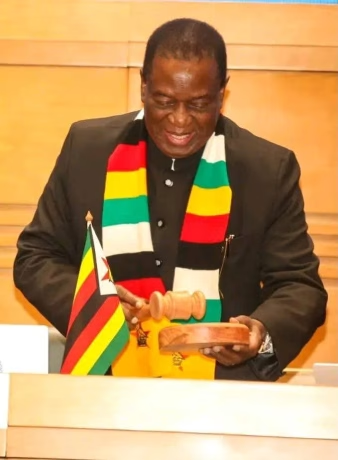
In his opening statement at the High-Level Party Event on Climate-Smart Agriculture for Food Security: Success, Challenges and Opportunities, which he hosted here yesterday as part of COP28 meetings, President Mnangagwa said his administration’s policies and initiatives had ensured that Zimbabwe is food-secure.
He also said Zimbabwe has “developed multi-pronged policies and strategies, in line with climate-smart agriculture”.
At national level, the fruits of climate-smart policies are also starting to bear fruit, with the country now wheat self-sufficient.
Further, it now has the capacity to export.
President Mnangagwa outlined some of Government’s interventions, including the National Climate Policy, which promotes climate-smart agriculture through reduced tillage, mulching, crop rotation, water harvesting, efficient irrigation and promotion of drought-tolerant crops, among other practices.
He also mentioned the National Climate Change Response Strategy, which seeks to mainstream climate change across all sectors of the economy.
“With regards to livestock production, the strategy is promoting the adoption of indigenous and improved livestock breeds that are tolerant to climate-related stresses,” he said.
Other initiatives that have been put in place by the Second Republic include Zimbabwe’s National Adaptation Plan, aimed at identifying climate change adaptation actions for vulnerable sectors; as well as Zimbabwe’s Revised Nationally Determined Contribution, which strengthens the resilience of agricultural value chains and markets.
Under the Presidential Vision 2030 Accelerator Model, Government has put in place policies and programmes to spur rural industrialisation and the development of irrigation schemes into viable business units.
Speaking in an earlier interview, Environment, Climate and Wildlife Minister Mangaliso Ndlovu said: “The President is impacting rural communities in ways not seen in Africa.
“We are reaching out to 1,8 million households and beneficiaries in the region of three million people, where we have not only assured food security for our people, but they are also now economic participants.
“We felt that we had a good story to share so that it is not only a success for Zimbabwe, but other countries can tap into it,” he said.
With proper financing, Minister Ndlovu said, the Pfumvudza/Intwasa programme “can be a game changer in Africa”.
His counterpart, Lands, Agriculture, Fisheries, Water and Rural Development Minister Dr Anxious Masuka said the Pfumvudza/Intwasa programme had resulted in a threefold increase in yields.
“Zimbabwe is a good example of success of our adaptation to climate change,” he said.
President Mnangagwa used COP28 to highlight the negative impact of climate change and also what his Government has done in terms of climate adaptation.
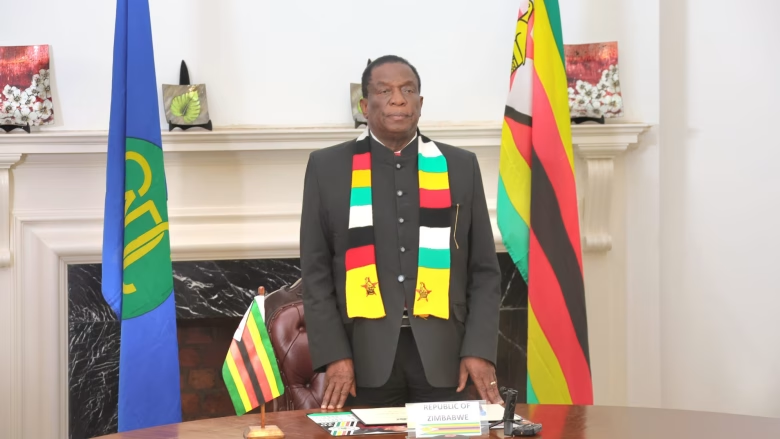
Speaking during a meeting of Landlocked Developing Countries (LLDC3) convened by Botswana’s President Mokgweetsi Masisi, President Mnangagwa said Zimbabwe has embarked on transformative actions towards climate resilience.
“The construction of dams and expansion of irrigation capacity, coupled with renewable energy, continues to improve water and energy use efficiencies,” he said.
“The climate-smart agriculture ‘Pfumvudza/Intwasa’ model adopted by our country is mitigating climate vulnerabilities and guaranteeing household food security, especially among communal and smallholder farmers.”
The meeting also saw participation by officials from Afreximbank, the World Bank and Mozambique, who all pledged support to the country’s climate-smart agricultural initiatives.
Meanwhile, President Mnangagwa made use of his short breaks yesterday to meet fellow leaders, including President Masisi and his Mozambican counterpart, President Filipe Nyusi.
He also met with United Kingdom Minister for Development and Africa Mr Andrew Mitchell.
President Mnangagwa also granted media interviews to Emirates News Agency and AI Qahera News.
Sunday Mail