ZIMBABWE’s destiny is structured on economic growth leveraging on its vast natural resources, skills and competencies, President Mnangagwa has said.
He said while everyone was welcome to work with Government to achieve economic growth, they could not impose their own programmes on Zimbabwe.
The International Monetary Fund (IMF) has listed Zimbabwe as one of the fastest growing economies in SADC on the back of unprecedented development and economic milestones, as the country registered a gross domestic product growth rate of 6,2 percent in 2022.
Since the coming into power of the Second Republic in November 2017 under the stewardship of President Mnangagwa, Zimbabwe has achieved significant milestones in key economic sectors such as mining, agriculture, infrastructure and tourism.
According to official figures from Treasury, Zimbabwe has been on a sustained economic growth trajectory, recording Gross Domestic Product growth rates of 8,5 percent in 2021 and 6,5 percent in 2022.
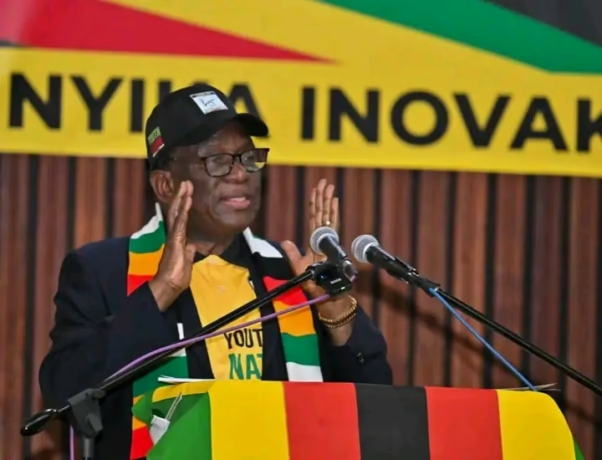
Speaking during the fourth interface with chiefs from the Matabeleland region at State House in Bulawayo on Friday, President Mnangagwa said Zimbabwe’s economy has recovered and the country is now on a growth trajectory despite being saddled with sanctions for over two decades.
“Currently, in SADC, in spite of these sanctions which have been slapped on us for the past 23 years, the last four years, Zimbabwe has enjoyed the fastest economic growth in the region. Those who would want to assist us to prosper should join our programmes and not bring their programmes to us to prosper, I say no!” he said.
President Mnangagwa said for the country to prosper it required more home-grown solutions hence the need to intensify efforts in mobilising domestic resources, particularly in the face of limited access to international capital markets.
“Instead of looking outside for solutions and to better our own lives, we have said ‘nyika inovakwa nevene vayo, igotongwa nemi vene vayo, igonamatirwa nemi vene vayo’. If you follow that philosophy, the three-prongs of philosophy, you become solid,” he said.
“Having embraced those aspects of philosophy, I have no doubt that Zimbabwe’s destiny is structured and we shall continue moving forward with focus based on our domestic resources, skills and competencies.
“Yes, global skills and global capital will be needed, but first and foremost, we must look at our own internal resources and say God gave us this land without us asking for it from him and when he did so, he put at our disposal resources for us to prosper, and let us embrace that and we will prosper.”
Turning to the imminent Gukurahundi public hearings, President Mnangagwa said through a shared vision and future, the nation is committed to having a peaceful Zimbabwe that is geared towards development in line with Vision 2030.
“Let me say that when we began this process, very few among yourselves and my team here had the foresight that this will bring about understanding among ourselves because we share our vision and our future,” he said.
“We are all committed to having a peaceful Zimbabwe that is geared to develop our country. We are doing what we think is good for ourselves. I have spoken out on your proposal to launch the community engagement phase for this programme, and this time around Honourable Professor Ncube has provided a budget for that.
“So the task and burden now remains with those who have to implement because the budget is now available.”
The public hearings, which are expected to start in the first quarter of the year, will be led by chiefs in their communities.
The aim of community engagement is to address the legacy of Gukurahundi, a period of violence and conflict that affected some parts of Matabeleland and Midlands provinces in the 1980s.
President Mnangagwa has shown his commitment to facilitate processes that will bring closure to post-independence conflicts, as part of his vision of nation-building and fostering national unity.
The Second Republic embarked on the initiative to pursue the resolution of the Gukurahundi issue through an internal and home-grown process in February 2019, as part of Government efforts to maintain and strengthen national unity among Zimbabweans.
The chiefs have since crafted and adopted the Gukurahundi manual, which will guide the holding of victim-friendly public hearings, to ensure national healing as the country confronts its unfortunate past.
The manual, which is a product of inclusive engagements between chiefs and various stakeholders, is a culmination of traditional leaders’ meetings with President Mnangagwa.
Herald