By Aldridge Dzvene
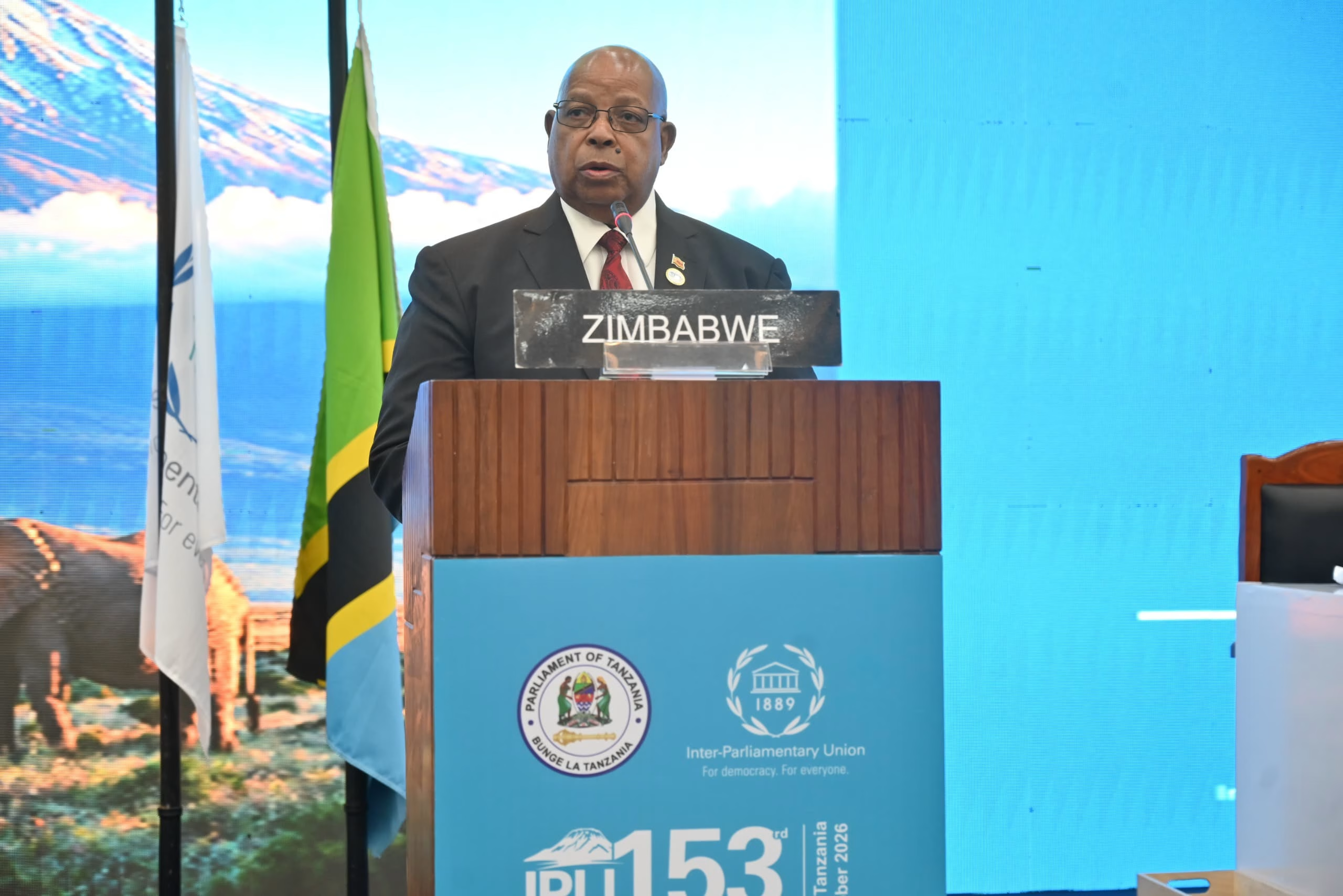
Speaker of the Parliament of Zimbabwe, Hon. Advocate Jacob Francis Nzwidamilimo Mudenda, has used the 153rd Assembly of the Inter-Parliamentary Union (IPU) in Arusha, Tanzania, to articulate Zimbabwe’s position on inclusive governance, African participation in shaping international standards and the growing responsibility of parliaments to address inequalities arising from the digital revolution.
Addressing the General Debate on “Enhancing Good Governance and Empowering Communities Through Inclusivity, Trust and Opportunities for All” on 9 October 2026, Speaker Mudenda placed Zimbabwe’s parliamentary engagement within a broader argument about the place of African institutions in global decision-making. His intervention went beyond conventional diplomatic courtesies, raising questions about who defines international governance standards, whose experiences inform them and whether the frameworks governing the world adequately respond to the realities of developing countries.
The address also provided an opportunity for Zimbabwe’s Parliament to communicate the country’s appreciation to the IPU family for supporting its election as a non-permanent member of the United Nations Security Council. By connecting parliamentary diplomacy with international peace and security, Speaker Mudenda highlighted the role of legislatures in sustaining multilateral relationships and advancing national interests through established international institutions.
The importance of the intervention lies in its attempt to connect three dimensions of governance that are often discussed separately: national development, the legitimacy of international institutions and the capacity of parliaments to respond to emerging global challenges. In doing so, the Speaker presented Parliament not merely as a lawmaking institution operating within national borders, but as a participant in the international conversation over the rules, principles and systems that shape development and public administration.
One of the most consequential elements of the address was Speaker Mudenda’s assertion that Africa does not approach international parliamentary forums as a supplicant. By referencing a continent of more than 1.4 billion people and 54 states, he framed Africa as a substantial participant in global affairs whose experience should contribute to the formation of international standards rather than simply be measured against standards developed elsewhere.
That argument speaks to a longstanding institutional challenge for developing countries. International governance frameworks are frequently expected to operate across countries with widely differing economic capacities, administrative systems, technological infrastructure and historical experiences. Standards that do not adequately account for those differences risk becoming difficult to implement or producing uneven outcomes. Speaker Mudenda’s call for partnership rather than approval therefore placed emphasis on participation in the design of global norms, not merely compliance with decisions already made.
The distinction is important. Partnership does not require the rejection of international cooperation or common standards. Rather, it calls for broader participation in determining how those standards are developed, interpreted and implemented. For African parliaments, this creates a case for deeper engagement in international legislative networks, where practical experience from national institutions can inform discussions on governance, development, accountability and the protection of vulnerable communities.
Speaker Mudenda’s remarks also underscored the potential of parliamentary diplomacy to strengthen relationships between countries while giving legislatures a more substantive role in international affairs. Unlike engagements limited to formal protocol, parliamentary diplomacy can create channels for sustained dialogue, policy exchange and cooperation among institutions that share responsibility for legislation and oversight.
The Speaker’s appreciation to the Tanzanian Government and Parliament for their hospitality, together with his commendation of IPU President Dr. Tulia Ackson for her leadership in facilitating the assembly, situated Zimbabwe’s participation within this spirit of institutional cooperation. Such acknowledgements are part of diplomatic convention, but they also reinforce the importance of the multilateral platforms through which national parliaments exchange experiences and pursue common interests.
Zimbabwe’s election as a non-permanent member of the United Nations Security Council gave the address an additional dimension. Speaker Mudenda conveyed the country’s gratitude to the IPU family for its support and referred to President Dr. Emmerson Dambudzo Mnangagwa’s commitment to advancing international peace and security through preventive diplomacy, multilateralism and respect for international law.
The Security Council role and the IPU are distinct institutions with different mandates, and parliamentary support should not be confused with the formal voting process through which countries are elected to the Council. Nevertheless, the Speaker’s message highlighted how parliamentary relationships can contribute to the wider diplomatic environment in which countries pursue international cooperation.
For Zimbabwe, the challenge associated with Security Council membership is to translate international representation into constructive engagement on questions of peace, conflict prevention and collective security. Preventive diplomacy, as referenced in the address, places importance on identifying tensions before they escalate and using dialogue and diplomatic mechanisms to reduce the risk of conflict. Multilateralism, meanwhile, requires countries to work through international institutions and negotiated processes, while respect for international law provides a framework for the conduct of relations between states.
Parliament has a role in this broader undertaking through legislative scrutiny, debate on international commitments and engagement with counterpart institutions. The Speaker’s intervention therefore connected Zimbabwe’s diplomatic responsibilities with the parliamentary relationships needed to sustain dialogue and promote understanding across national boundaries.
At the domestic level, Speaker Mudenda anchored his argument in the development philosophy of “leaving no one and no place behind” and the principle that Zimbabwe should be developed by its own people, expressed through the Swahili idiom “Inchi hujengwa na watu wake wenyewe.” The emphasis on local participation placed communities at the centre of development rather than treating them merely as recipients of policies formulated elsewhere.
The address identified several initiatives through which Zimbabwe seeks to institutionalise inclusion, including parliamentary women’s and youth caucuses, women’s and youth empowerment banks, implementation of the Disability Act and constitutional provisions for the allocation of five percent of national revenue to provincial and local authorities through devolution.
These mechanisms represent different approaches to participation and empowerment. Parliamentary caucuses create platforms through which legislators can focus attention on issues affecting particular groups. Empowerment banks are intended to broaden access to finance, while disability legislation establishes a legal basis for addressing barriers faced by persons with disabilities. Devolution provides a constitutional framework for distributing resources to subnational levels of government and supporting development beyond the principal urban centres.
The deeper institutional question, however, is how effectively these mechanisms translate policy commitments into accessible opportunities and measurable improvements in people’s lives. The existence of a caucus does not by itself guarantee that legislation will address every concern raised by the groups it represents. Access to finance depends on the practical terms and accessibility of lending facilities, while the benefits of devolution depend on resource availability, project selection, implementation capacity and accountability.
This is where Parliament’s oversight role becomes essential. Legislative institutions can examine whether programmes are reaching their intended beneficiaries, whether public funds are being used for their designated purposes and whether implementation challenges are being addressed. By connecting the language of inclusion to institutions and funding mechanisms, Speaker Mudenda’s address opened an important discussion about the relationship between national development philosophy and the machinery required to deliver it.
The most forward-looking part of the speech, however, concerned digital exclusion, an issue that is increasingly central to economic participation, public administration and access to information. Speaker Mudenda cited a global estimate of 2.6 billion people without internet access and placed sub-Saharan Africa’s internet penetration at approximately 37 percent, figures he used to demonstrate the scale of the challenge facing governments and legislatures. These figures were presented in the address and should be assessed against the relevant reporting period and definitions of internet access when used for detailed policy planning.
His underlying argument was that digital transformation can deepen existing inequalities if legislation and public policy fail to keep pace with technological change. As public services, education, commerce and civic participation increasingly move online, people without reliable connectivity, suitable devices, digital skills or affordable services risk being excluded from opportunities available to connected communities.
Digital exclusion is therefore not simply a telecommunications problem. It affects the ability of citizens to access government services, participate in public life, obtain information, develop businesses and benefit from technological advances. For rural communities, low-income households, persons with disabilities and other underserved groups, digital barriers can compound inequalities that already exist in access to finance, education and public infrastructure.
Speaker Mudenda’s call for parliaments to take responsibility for the regulatory framework governing digital inclusion is consequently significant. Legislatures must consider how laws respond to questions of affordability, access, privacy, cybersecurity, digital rights and the responsible use of emerging technologies. They must also consider whether existing legal frameworks provide adequate protection as artificial intelligence becomes more capable and more deeply integrated into economic and public institutions.
In this context, the Parliament of Zimbabwe’s Committee of the Future, which the Speaker described as advancing a 50-year vision, introduces a longer-term dimension to legislative planning. The reference to a half-century horizon is particularly relevant because the consequences of emerging technologies may extend well beyond the electoral, budgetary and policy cycles through which governments typically operate.
A forward-looking parliamentary committee can provide a forum for examining technological trends, identifying possible legal gaps and considering how today’s decisions may affect future generations. Its potential contribution will depend on the quality of its research, its engagement with scientific and technological expertise, its capacity to consult affected communities and the extent to which its findings inform legislation and policy.
Artificial intelligence, including the more advanced systems anticipated in future technological development, raises questions that cannot be addressed through technological enthusiasm alone. Legislatures must weigh opportunities for productivity, innovation and improved public services against concerns about privacy, accountability, discrimination, employment disruption and the concentration of technological power. A long-term approach allows these issues to be considered before technological adoption outpaces the capacity of institutions to govern it effectively.
The Speaker’s call for the IPU family to work together on robust legal frameworks therefore extends beyond an appeal for general cooperation. It points towards a practical agenda in which parliaments can exchange legislative experience, compare regulatory approaches and develop institutional capacity to respond to technologies that operate across borders. The challenge will be to promote innovation while ensuring that the benefits of technological progress are not confined to those with the greatest financial and digital resources.
For the Parliament of Zimbabwe, the international address also places a responsibility on the institution to connect its participation in global discussions with its domestic legislative work. Parliamentary diplomacy acquires lasting value when ideas exchanged abroad inform debates at home, strengthen committee work and contribute to laws that respond to citizens’ needs. The same principle applies to inclusion: its credibility rests not only on the commitments expressed in international forums, but also on the consistency with which those commitments are pursued through national institutions.
Speaker Mudenda’s intervention at the 153rd IPU Assembly brought these issues together through a common theme: governance must create opportunities for participation, earn public trust and remain responsive to the realities of the people it serves. His emphasis on African participation in shaping global standards, Zimbabwe’s engagement in multilateral diplomacy and the regulation of digital transformation placed parliamentary institutions at the intersection of national development and international cooperation.
The lasting measure of the address will be the extent to which its arguments translate into sustained parliamentary engagement, practical legislative initiatives and stronger mechanisms for inclusion. The IPU platform has provided an opportunity to place Zimbabwe’s experiences and policy priorities within a wider international discussion. The task ahead is to ensure that this exchange continues beyond the assembly and contributes to institutional learning, effective oversight and a development process in which access to opportunity is supported by practical delivery.
For Zimbabwe’s Parliament, the proceedings in Arusha demonstrate the breadth of issues a modern legislature must confront, from international peace and security to the financing of local development and the regulation of emerging technologies. They also reinforce the importance of parliamentary leadership that can connect national priorities with global debates while recognising that credible governance ultimately depends on institutions, implementation and public confidence.