By Aldridge Dzvene
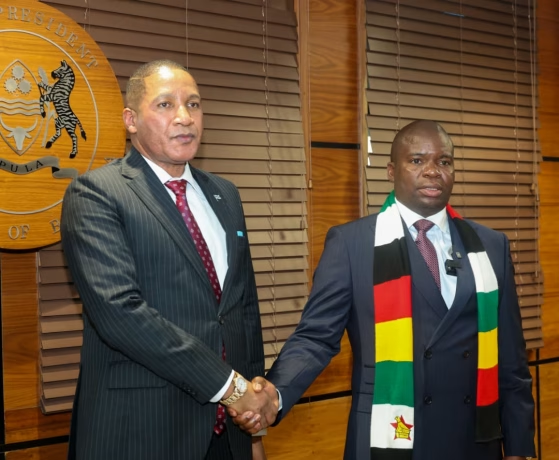
Speaker of the National Assembly of Zimbabwe, Hon. Advocate Jacob Francis Nzwidamilimo Mudenda, will lead a parliamentary delegation to the United Kingdom from 18 to 24 October 2026 in an engagement that presents Zimbabwe with an opportunity to convert parliamentary diplomacy into practical institutional gains, stronger legislative cooperation and a more effective framework for international engagement.
The visit comes at a time when parliamentary diplomacy is increasingly important to how countries exchange legislative experience, cultivate institutional relationships and create channels for cooperation beyond conventional executive-to-executive engagements. For Zimbabwe, the value of the mission will therefore depend not simply on the meetings conducted in London, but on whether the engagement produces knowledge, relationships and institutional practices that can be translated into measurable outcomes at home.
The delegation is expected to engage British parliamentary leadership and inter-parliamentary organisations, while observing Prime Minister’s Questions, a prominent feature of the United Kingdom’s parliamentary system. The programme also identifies possible engagements with parliamentary committees responsible for foreign affairs, science and technology, education, and energy security, alongside the All-Party Parliamentary Group on Africa. However, those committee meetings had not been confirmed in the programme available at the time of reporting, making it important to distinguish proposed engagements from formally scheduled activities.
At the institutional level, the visit offers an opportunity to examine how parliamentary systems organise scrutiny, question executive decisions, process legislation and hold public institutions accountable. These functions are central to the credibility of any legislature because Parliament’s effectiveness is measured not only by the laws it passes, but also by its capacity to interrogate policy, examine public expenditure and ensure that government commitments are subjected to meaningful oversight.
For Zimbabwe, the potential benefit lies in identifying practices that can strengthen parliamentary performance within the country’s own constitutional and political context. Exposure to another legislature does not automatically translate into reform, and institutional differences make direct imitation impractical. The more useful approach is to identify workable methods in committee administration, research support, legislative scheduling, public engagement and oversight, then assess which can be adapted to improve the efficiency and quality of Zimbabwe’s parliamentary processes.
The observation of Prime Minister’s Questions is particularly relevant in this regard because it provides an opportunity to study the relationship between executive accountability, political contestation and public communication. Its value for the Zimbabwean delegation will not be in replicating the format, but in considering how parliamentary questioning can be structured to elicit substantive responses, clarify government policy and make the work of the legislature more accessible to citizens.
Effective oversight also depends on the institutional capacity supporting legislators. Parliamentary committees require timely research, access to reliable information, technical expertise and sufficient administrative support to scrutinise complex policy areas. As Zimbabwe pursues development across infrastructure, energy, education, agriculture and investment, the ability of Parliament to examine policy implementation and public resource allocation becomes increasingly important. Legislative oversight that is informed by evidence can help identify implementation gaps, improve transparency and strengthen public confidence in state institutions.
The proposed engagement with the British Group of the Inter-Parliamentary Union and the United Kingdom branch of the Commonwealth Parliamentary Association provides another avenue for sustaining cooperation beyond the official visit. Such networks can facilitate exchanges among legislators, provide platforms for discussing common governance challenges and create opportunities for continued institutional learning. Their long-term value, however, depends on whether initial contact develops into regular engagement, joint initiatives and clearly defined areas of cooperation.
The composition of the Zimbabwean delegation, which includes legislators from ZANU PF and the Citizens Coalition for Change, also gives the mission a parliamentary character that extends beyond a single political grouping. The delegation includes Hon. Webster Kotiwani Shamu, Hon. Mercy Mugomo, Hon. Noah Mangondo, Hon. Vivian Chitimbe and Hon. Consillia Chinanzvavana. Their participation creates an opportunity for shared institutional learning, although the practical value of that diversity will depend on the delegation’s ability to establish common objectives and bring lessons from the visit into parliamentary work across party lines.
Zimbabwe’s diplomatic representation in the United Kingdom will also be relevant to the engagement, with Ambassador Col. (Rtd) C.M. Katsande and embassy officials listed among those involved. Parliamentary diplomacy can complement formal diplomatic channels by creating relationships among legislators and institutions, opening space for dialogue and helping sustain communication where wider bilateral relations require consistent engagement. Its contribution should nevertheless be understood as complementary to, rather than a substitute for, the diplomatic and economic work undertaken through established government channels.
The wider question is how parliamentary engagement can contribute to Zimbabwe’s development priorities without overstating what a visit can achieve. Legislative cooperation may support discussions on investment conditions, energy policy, education, technological development and governance, but these conversations do not by themselves constitute investment agreements, trade deals or new bilateral programmes. No such commitments are specified in the programme available for the visit, and the proposed committee engagements should not be presented as confirmed until formally established.
That distinction is important because international visits are often judged by the visibility of the delegation, the seniority of its hosts and the number of meetings conducted. Yet the more meaningful measure is what follows after the delegation returns. Without a structured process for documenting lessons, assigning responsibility and integrating recommendations into parliamentary practice, even a well-organised visit risks remaining a diplomatic event rather than becoming an instrument of institutional improvement.
A practical outcome would be a post-visit report identifying the key lessons acquired, the parliamentary procedures worth examining further and the areas where continued cooperation could be pursued. The report could also distinguish immediate improvements from longer-term reforms requiring administrative planning, resources or legislative consideration. Such an approach would enable Parliament to assess the value of the mission against tangible institutional objectives rather than relying exclusively on ceremonial outcomes.
The visit also presents an opportunity to deepen the understanding of how legislative institutions contribute to national development. Parliament’s role in scrutinising budgets, examining the implementation of public programmes and assessing legislation has direct implications for how effectively public resources are used. Stronger oversight does not replace the responsibility of the Executive to implement policy, but it can help ensure that commitments are examined, implementation challenges are exposed and public institutions remain answerable for their performance.
Ultimately, the significance of Hon. Advocate Mudenda’s forthcoming engagement will be determined by the quality of the institutional relationships established and the practical lessons Zimbabwe’s Parliament is able to apply. Parliamentary diplomacy delivers its strongest results when international exposure is followed by domestic implementation, sustained dialogue and measurable improvements in legislative work.
For Zimbabwe, the challenge is therefore to ensure that the October visit becomes more than an exercise in parliamentary protocol. Its enduring value will lie in whether it strengthens the capacity of the National Assembly, improves the quality of legislative scrutiny and establishes a durable basis for cooperation that serves the country’s institutional and development priorities.