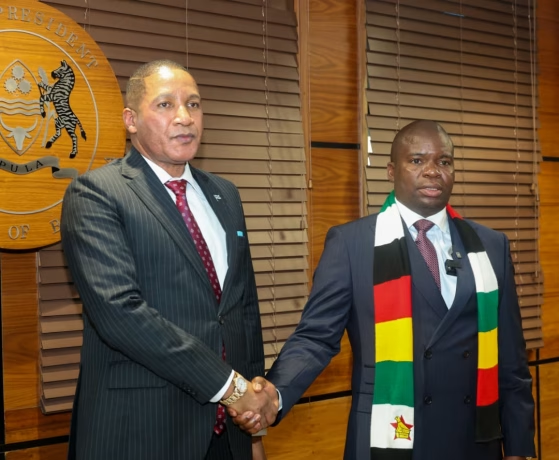
HARARE, October 9, 2026 — President Mnangagwa has reconfigured Zimbabwe’s economic management structure, appointing businessman and Senator Dr Kudakwashe Tagwirei as Minister of Economic Development and Investment Promotion while reassigning Professor Mthuli Ncube to the Ministry of Finance, in a move that places renewed focus on investment mobilisation, fiscal management and the coordination of economic policy.
The appointments, announced through separate statements issued by the Office of the President and Cabinet on October 8, 2026, took immediate effect. Dr Tagwirei’s appointment was made in terms of Section 104(1) of the Constitution of Zimbabwe, while Professor Ncube returns to the Treasury portfolio after serving in the economic development and finance leadership structure.
Beyond the change of personnel, the restructuring raises a central economic question: whether a clearer division between investment promotion and public finance can improve the Government’s ability to convert investment opportunities into productive capacity, employment and sustainable growth.
The appointment also brings a different professional profile into the investment promotion portfolio. Dr Tagwirei’s background in business, including interests associated with energy, mining, agriculture and infrastructure, gives him experience in sectors central to Zimbabwe’s productive economy. He has also chaired the Land Tenure Implementation Committee, which is working on reforms intended to make agricultural land more secure and usable to unlock financing and investment.

herald
+1
Yet private-sector experience alone will not determine the success of the new ministry. Investment promotion requires more than identifying opportunities or engaging prospective investors. It depends on predictable regulations, transparent procurement, reliable infrastructure, policy consistency, efficient licensing and confidence that investors can operate under clear and fairly applied rules. The new minister’s performance will therefore be judged by whether the portfolio can turn investment interest into actual capital commitments, completed projects, increased production and jobs.
The separation also creates a coordination challenge. Investment decisions are affected by taxation, public spending, foreign-currency arrangements and the wider fiscal environment, areas closely connected to the Finance Ministry. Professor Ncube’s return to Treasury could allow him to concentrate on budget management, revenue mobilisation and public finances, while Dr Tagwirei focuses on attracting capital and advancing development initiatives. But the two portfolios cannot operate in isolation: investment incentives must be consistent with fiscal priorities, while economic growth plans must be supported by credible financing and macroeconomic management.
herald
+1
A further issue is investor confidence. Dr Tagwirei’s business profile may offer access to commercial networks and an understanding of investment decisions, but his appointment also places a premium on transparent governance and the management of potential conflicts between private business interests and public responsibilities. A minister responsible for attracting investment must help build confidence that opportunities are accessible through clear rules and that decisions are made in the public interest. The credibility of the new portfolio will depend not only on the deals it attracts, but also on the processes through which those deals are negotiated and implemented.
The timing is significant as Zimbabwe pursues its Vision 2030 ambitions and implements the National Development Strategy 2. The key challenge is to make investment contribute to productive transformation rather than merely announce headline figures. Capital directed towards manufacturing, mining value addition, energy, agriculture, infrastructure and technology can strengthen domestic production, expand exports and create employment, provided projects are implemented and their economic benefits reach beyond a narrow group of investors.
The restructuring also raises questions about the authority and resources available to the newly separated ministry. Investment promotion involves multiple institutions and government departments responsible for approvals, land, infrastructure, taxation and sector-specific regulation. Without a clear mandate and effective coordination mechanisms, a dedicated investment ministry risks promoting opportunities that other arms of Government are not adequately prepared to facilitate.
Ultimately, President Mnangagwa’s decision is more than a Cabinet reshuffle. It creates a new division of responsibility at the centre of economic policy, separating the task of managing public finances from the task of attracting investment and driving development. Whether this produces better results will depend on the quality of coordination between the two ministers, the transparency of investment decisions and the Government’s ability to remove obstacles facing productive businesses.
For Dr Tagwirei, the immediate test is to demonstrate that his commercial experience can translate into effective public administration and measurable investment outcomes. For Professor Ncube, the task is to manage Treasury in a way that supports economic stability while enabling credible development priorities. The ultimate measure of the new economic team will not be the prominence of its appointments, but whether Zimbabwe secures more productive investment, expands domestic industry, creates sustainable jobs and improves the living standards of its people.