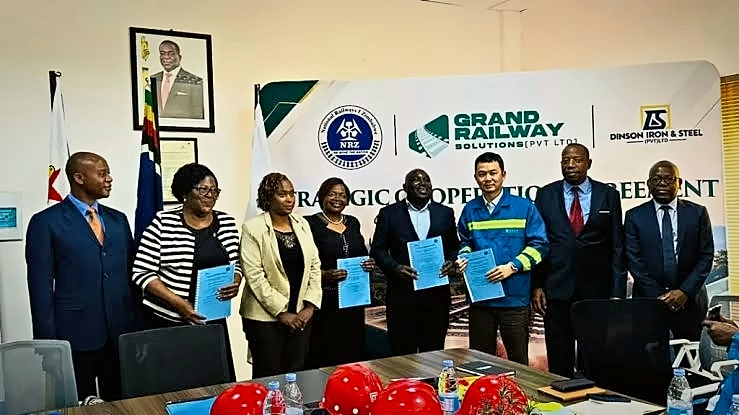
The National Railways of Zimbabwe (NRZ) has secured a strategic freight partnership with Grand Rail Solutions (GRS) targeting 1.6 million tonnes of annual cargo for the Dinson Iron and Steel Company’s Manhize plant, a development that could reshape the economics of Zimbabwe’s steel industry while providing a major source of business for the country’s struggling rail transport system.
The agreement introduces a dedicated Hook and Haul arrangement for transporting coal from Hwange to Manhize and finished steel products to domestic and export markets. Its significance extends beyond the movement of freight, bringing together industrial production, private infrastructure investment and railway rehabilitation in a model designed to address one of manufacturing’s persistent constraints, the cost of moving raw materials and finished products.
At the centre of the deal is a commercial reality that will increasingly determine the competitiveness of Zimbabwean industry. Establishing production capacity is only one part of industrialisation. Manufacturers must also secure reliable supplies of inputs and move finished goods to customers at costs that allow them to compete with regional and international producers. Where transport costs remain high, the advantages of local production can be eroded before goods reach the market.
The Manhize agreement seeks to address that challenge by shifting bulk freight from road to rail. NRZ says the partnership is expected to increase its annual freight volumes by 1.6 million tonnes, providing a substantial traffic base for an operator whose recovery depends on attracting large, consistent customers and restoring the commercial utility of its railway network.
Under the agreement signed at the Manhize plant in the Midlands, GRS, a local logistics company co-owned by Dinson Iron and Steel Company and Zambezi Coal and Gas, will procure rolling stock dedicated to the traffic. It will also assist in refurbishing the railway line between Gweru and Mvuma and construct a new 50-kilometre siding linking Mvuma to the steel plant.
GRS will recover its investment in rolling stock and infrastructure through offsets against railage charges. This arrangement connects the financing of transport infrastructure to the commercial requirements of an industrial customer, potentially reducing the immediate financing burden on NRZ while creating a dedicated logistics route for Manhize.
The model is particularly important because railway rehabilitation requires substantial capital, while the returns depend on sustained freight demand. By tying infrastructure improvements to the needs of a major steel producer, the partnership creates a clearer commercial basis for investment. However, the effectiveness of the model will depend on the detailed recovery terms, maintenance obligations, delivery timelines and the ability of the parties to sustain the projected freight volumes over time.
The scale of the proposed shift is evident in the difference between road and rail capacity. Dinson currently transports its traffic using trucks carrying approximately 30 tonnes each. Under the new arrangement, NRZ trains will carry up to 25 wagons, each with a capacity of 54 tonnes, giving a fully loaded train a combined capacity of 1,350 tonnes.
At those stated capacities, one train can carry the equivalent of 45 fully loaded 30-tonne trucks. The calculation illustrates the potential to consolidate large volumes of freight into fewer movements, reducing dependence on road haulage and potentially lowering fuel consumption, vehicle maintenance costs and pressure on the national road network.
The comparison, however, is not simply about the number of trucks replaced. The economic benefit will ultimately depend on the full cost of moving each tonne from origin to destination, including rail tariffs, loading and unloading, the availability of locomotives, transit times and the efficiency of connecting infrastructure. Rail becomes a competitive advantage when its capacity is matched by reliability and predictable delivery schedules.
For Dinson Steel, the commercial implications could be considerable. Steel production requires the movement of heavy raw materials and finished products in volumes that can make transport a significant component of total operating costs. A reliable rail service could reduce logistics expenditure, improve supply-chain planning and strengthen the plant’s ability to serve customers beyond its immediate production location.
Export competitiveness is particularly important because locally manufactured steel must compete on more than production capacity alone. Freight costs influence the price at which steel reaches regional and international markets. If the partnership delivers sustained savings, Dinson could gain greater flexibility in pricing and distribution. Domestic manufacturers and consumers could also benefit if lower logistics costs are reflected in the prices of steel products.
Those benefits should not, however, be treated as automatic. Lower transport costs do not necessarily translate directly into lower retail prices, as the final outcome depends on production expenses, market demand, competition and pricing decisions. The measurable test will be whether the agreement produces lower delivered costs and improves the commercial performance of Zimbabwean steel.
For NRZ, the deal represents an opportunity to anchor its operations around a major industrial customer rather than depend solely on fragmented freight demand. A projected 1.6 million tonnes of additional annual traffic would provide a significant foundation for revenue generation, capacity planning and the utilisation of railway assets.
The wider question is whether this traffic can help establish a more sustainable recovery model for the national railway system. Industrial growth and railway rehabilitation are mutually reinforcing: manufacturers need efficient transport to compete, while rail operators need dependable industrial volumes to justify investment in infrastructure and rolling stock.
The planned rehabilitation of the Gweru-Mvuma section and construction of the Manhize siding could therefore carry benefits beyond the immediate contract if the improvements strengthen the wider corridor and are maintained effectively. However, the extent of any spillover benefits will depend on the condition of connecting infrastructure, access arrangements and whether other freight customers can also use the improved network.
The agreement also provides a practical illustration of the infrastructure requirements underpinning Zimbabwe’s value-addition and beneficiation ambitions. Processing minerals and manufacturing finished products locally creates greater economic opportunities than exporting raw materials alone, but those gains depend on the efficiency of the entire production chain. Transport, energy, infrastructure and market access must work together if industrial investments are to generate durable value.
This places the NRZ-GRS partnership within the broader objectives of Vision 2030 and the National Development Strategy 2, which prioritise infrastructure modernisation, industrial growth and a more competitive economy. Its relevance lies not merely in its alignment with policy, but in whether it can deliver measurable improvements in industrial productivity, logistics costs and the movement of locally manufactured goods.
The agreement also raises a broader policy consideration: how Zimbabwe can replicate commercially viable infrastructure partnerships across mining, agriculture and manufacturing. A steel producer may provide sufficient freight volumes to justify dedicated rail investment, while agricultural processors and mining companies could offer different opportunities for similar arrangements. Any expansion, however, would require transparent contracts, viable financing structures and safeguards to ensure that investment recovery does not undermine the long-term commercial interests of the rail operator.
Ultimately, the Manhize deal will be judged by implementation rather than its projected tonnage alone. The timely completion of railway works, procurement of rolling stock, reliability of train services and actual freight volumes will determine whether the arrangement delivers the anticipated economic benefits.
If those targets are achieved, the partnership could demonstrate how industrial demand can finance critical logistics improvements, strengthen NRZ’s revenue base and lower the cost of moving Zimbabwean steel to market. If implementation falters, the projected savings and wider industrial benefits will remain largely theoretical.
The central economic test is whether Zimbabwe can turn a major investment in steel production into a competitive industrial value chain, supported by reliable infrastructure and commercially sustainable logistics. The 1.6 million-tonne target provides the scale; execution will determine the national economic return.