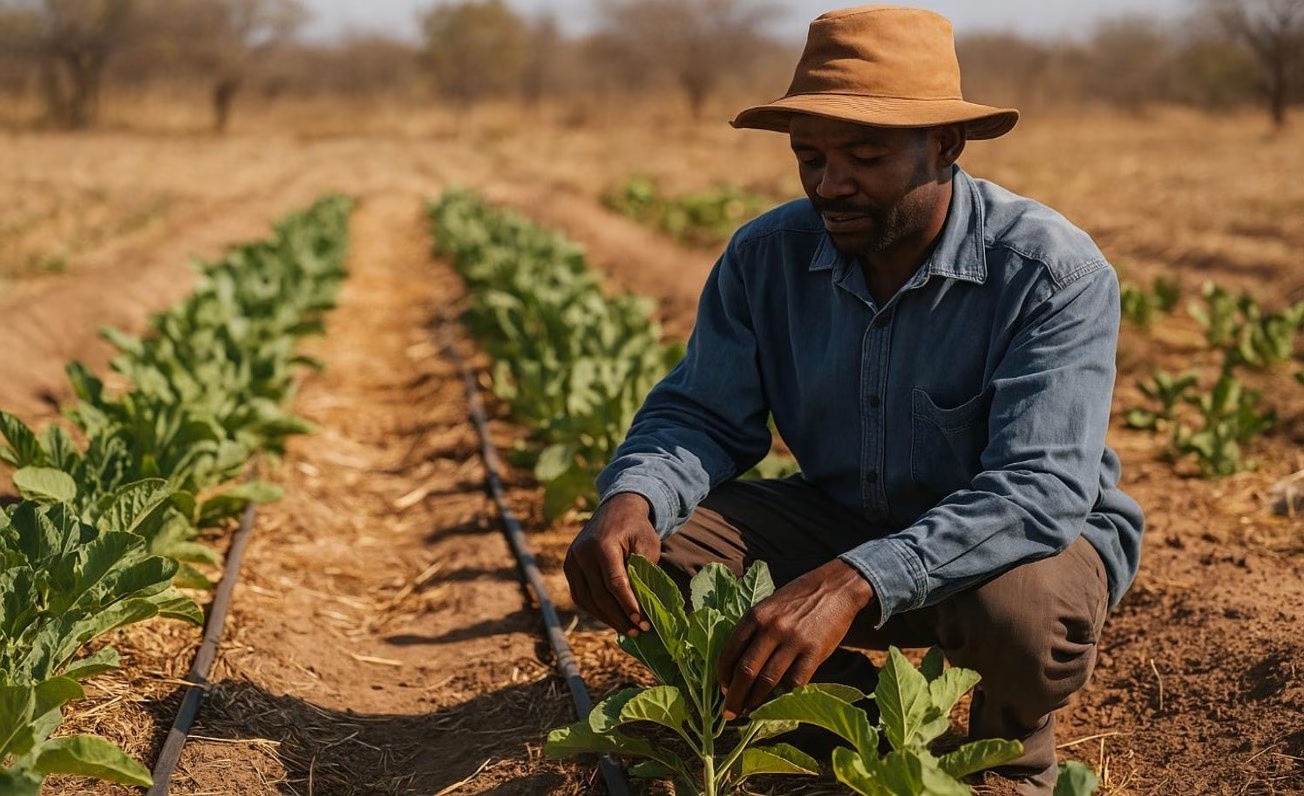
HARARE, October 8, 2026 — The European Union (EU) and the International Fund for Agricultural Development (IFAD) have launched a €14 million regional programme to strengthen climate-resilient horticulture, improve smallholder farmers’ productivity and expand access to profitable markets in Zimbabwe, Zambia and Botswana.
The Agroecological Transitions for Horticulture in Arid Zones (ATHAZ) programme will target approximately 15,000 smallholder farming households, representing about 75,000 people, with particular emphasis on women and young people. Running from 2026 to 2030, the initiative seeks to address the growing pressure that water scarcity, changing climatic conditions and limited market access place on agricultural production and rural livelihoods.
For Zimbabwe, the programme comes at a critical intersection of agricultural productivity, climate adaptation and rural economic development. Horticulture offers opportunities to diversify farm incomes and supply domestic, regional and international markets, but its long-term viability depends on farmers’ ability to manage water efficiently, maintain production under difficult climatic conditions and secure reliable buyers for their produce.
Building on IFAD’s Horticulture Enterprise Enhancement Project, ATHAZ will support farmers in adopting water-efficient production methods, resilient seed systems, integrated pest management and agroecological practices. The programme will also strengthen market connections and opportunities for value addition, recognising that increased production alone does not guarantee higher incomes if farmers lack access to competitive markets.
IFAD Country Director for Zimbabwe Francesco Rispoli said the programme would build on existing investments in irrigation and market access by bringing farmers, researchers and agricultural extension services together to test and scale practical solutions. The approach is intended to improve productivity while helping smallholder farmers use scarce water resources more efficiently and secure better markets for their produce.
EU Chargée d’Affaires a.i. to Zimbabwe Francesca Fabbri said the initiative was designed around the practical realities confronting farmers, particularly the financial cost of dry seasons and the increasing difficulty of relying on predictable rainfall. She emphasised the importance of combining farmers’ experience with research, investment and market access to help rural producers improve their livelihoods.
The programme’s economic significance extends beyond agricultural production. By connecting climate-resilient farming with processing, value addition, finance, technology and higher-value markets, ATHAZ seeks to strengthen the commercial foundations of horticulture. Improved market access, including opportunities in the European market, could create incentives for farmers and agribusinesses to invest in quality, productivity and more reliable supply chains.
The EU is also seeking to expand opportunities for Zimbabwean and European businesses through access to technology, equipment and expertise. If these links translate into productive investment and stronger local value chains, the benefits could extend to input suppliers, processors, transport operators, exporters and other businesses supporting horticultural production.
Across Zimbabwe, Zambia and Botswana, ATHAZ plans to establish nine innovation hubs and strengthen 30 horticultural value chains. The programme will be implemented by IFAD in partnership with the International Centre of Insect Physiology and Ecology, the Research Institute of Organic Agriculture and Biovision Africa Trust, working alongside national research institutions, agricultural extension services, farmer organisations, governments and private-sector players.
The innovation hubs are expected to provide a platform for testing practical approaches, sharing research and helping farmers adopt methods suited to local conditions. The regional design also creates opportunities for the three participating countries to exchange lessons on water management, sustainable production and market development, although the programme’s eventual impact will depend on how effectively successful approaches are adopted beyond the initial beneficiaries.
A central test will be whether the initiative improves farmers’ net earnings, not simply their harvests. Water-saving technologies and more resilient production methods can reduce exposure to climate risks, but lasting gains will require dependable buyers, affordable financing, appropriate infrastructure and commercially viable prices. Without these complementary conditions, farmers may increase output without securing the income needed to sustain their businesses.
ATHAZ therefore places horticulture within a wider development agenda in which climate adaptation and commercial agriculture must advance together. For Zimbabwe, the opportunity is to build stronger agricultural enterprises capable of producing sustainably, creating rural employment and supplying markets despite mounting environmental pressures.
The programme’s success will ultimately be measured by whether smallholder farmers can translate improved production practices into more reliable incomes, stronger businesses and greater resilience to drought and other climate shocks. Its €14 million investment provides a foundation, but sustained progress will depend on the ability of farmers, researchers, government institutions and private-sector partners to turn innovation into lasting economic opportunity.