By Aldridge Dzvene
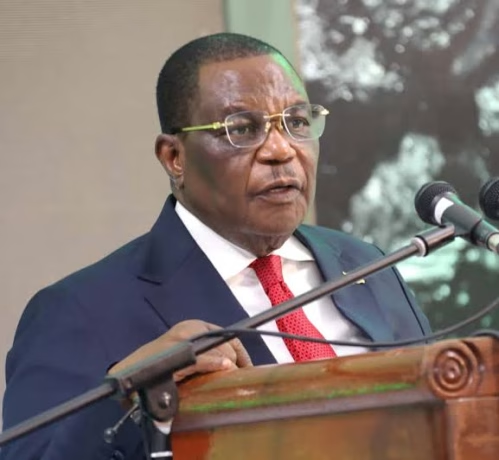
HARARE — ZANU PF and Government officials in Harare have moved to tighten political and administrative coordination over the capital’s development agenda, with party provincial chairman Senator Cde Godwills Masimirembwa calling for closer cooperation with decision-makers while Minister of State for Provincial Affairs and Devolution Hon. Sen. C.Z. Tawengwa pressed ministries, councils and local authorities to accelerate implementation of major infrastructure and service-delivery programmes.
The call came at the first joint 2026 Provincial Development Committee and Harare ZANU PF Provincial Coordinating Committee meeting, bringing senior party officials, Government departments, mayors, councillors and technical administrators together to assess progress under the National Development Strategy 2 and Vision 2030.
The meeting is politically significant because it places Harare’s development challenges at the intersection of party policy, Government implementation and local authority performance, areas that have often operated with varying degrees of coordination.
Minister Tawengwa reported progress in energy, water, roads and public infrastructure, including more than 200 consecutive days without load shedding, 83,650 smart prepaid water meters installed, 82 kilometres of ageing water pipelines replaced and the construction of major road and water projects.
But the political significance of the meeting goes beyond the infrastructure figures. It raises the more difficult question of whether project delivery is moving quickly enough to produce measurable improvements in the daily lives of Harare residents.
A water meter installed is an infrastructure output. Reliable water supply is a development outcome. A rehabilitated road is a project achievement. Reduced congestion and lower transport costs are the economic outcome. A completed market structure is a capital investment. Increased incomes for traders and artisans are the social and economic dividend.
The credibility of the development agenda will ultimately be determined by the second category.
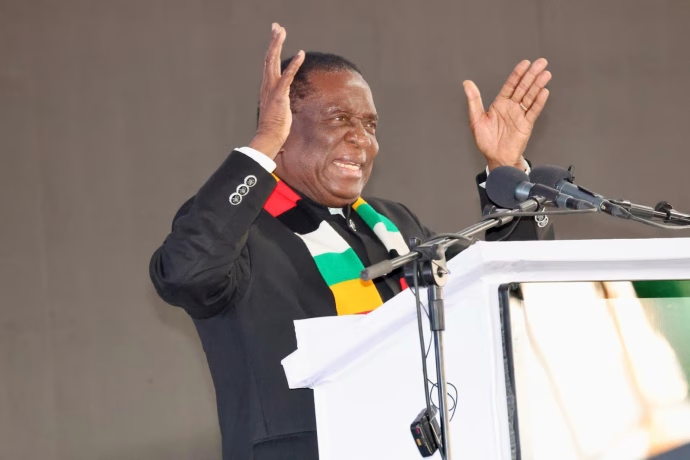
Senator Cde Godwills Masimirembwa’s emphasis on party supremacy and closer cooperation with Government adds a political dimension to that implementation challenge. His call for the urgent participation of decision-makers, including directors, mayors and senior administrators, reflects an attempt to ensure that political priorities are connected directly to the officials with the authority to act on them.
This is particularly important in Harare, where many service-delivery failures are not necessarily the result of an absence of policy, but of institutional fragmentation, delayed decisions, financing constraints, weak maintenance and unclear accountability.
Bringing political leadership and implementing authorities into the same development platform creates an opportunity to close those gaps. But coordination will only have value if it produces decisions, assigns responsibility and establishes deadlines rather than simply generating another layer of meetings.
The Kunzvi Dam project illustrates the challenge. While the dam is reportedly about 74 percent complete, only approximately 4.5 kilometres of the associated 48-kilometre pipeline have been laid. The disparity demonstrates why infrastructure must be approached as an interconnected system. A completed dam cannot solve Harare’s water crisis without the transmission infrastructure needed to move water into the city.
The same principle applies to roads, sewer rehabilitation, electricity, markets and public facilities. The province’s development performance will increasingly be measured not by the number of projects announced, but by whether those projects function together as an economic and social system.
The Provincial Economic Development Plan 2 for 2026 to 2030 could provide that framework, particularly because it is intended to cover Harare, Chitungwiza, Ruwa and Epworth. Its effectiveness will depend on whether planning is matched by financing, implementation capacity and mechanisms capable of holding institutions accountable for delivery.
Harare also faces an immediate test through preparations for Africa Skills Week and forthcoming COMESA engagements. The province is expected to improve roads, street lighting, waste management and the appearance of key routes linking the airport to the New Parliament Building at Mount Hampden.
These preparations provide an opportunity to demonstrate the capital’s investment and hosting capacity, but they also expose a wider development dilemma. Improvements undertaken for major international events must ultimately become permanent public infrastructure rather than temporary interventions concentrated along ceremonial routes.
The financial condition of local authorities remains another major constraint. Government arrears, high operating costs and salary challenges limit the capacity of councils to maintain infrastructure and provide reliable services, meaning that political direction must be accompanied by a realistic fiscal strategy.
The meeting therefore represents more than a routine provincial review. It is an attempt to bring the political machinery of ZANU PF and the administrative machinery of Government closer to the point where development decisions are made and implemented.
For Harare, the real test will now be whether that political coordination produces faster decisions, clearer accountability and better services.
The capital does not primarily need more development commitments. It needs the machinery of Government and local administration to convert existing commitments into functioning infrastructure, reliable services and a more productive urban economy.
That is where the politics of the Second Republic will ultimately be judged, not only in provincial meetings, but at the tap, on the road, in the marketplace, at the clinic and across the workplaces of Harare.