Aldridge Dzvene
HARARE — Zimbabwe’s participation at the 81st United Nations General Assembly has reinforced the broader international strategy being pursued by the Second Republic, with President Dr Emmerson Dambudzo Mnangagwa increasingly using high-level diplomacy to connect Zimbabwe’s political relationships, economic interests and development ambitions to a changing global order.
The Cabinet-adopted report presented by the Minister of Foreign Affairs and International Trade, Honourable Amon Murwira, shows that Zimbabwe’s engagement at UNGA 81 went beyond attendance at the General Debate, placing bilateral diplomacy, economic partnerships, multilateral reform, debt resolution and international reintegration at the centre of the country’s foreign policy.
At the centre of this approach is the President’s engagement and re-engagement policy, which seeks to reconnect Zimbabwe with countries and institutions where relations had weakened while simultaneously creating new partnerships across the international system. The policy is closely linked to the “Zimbabwe is Open for Business” mantra, but its wider strategic purpose is to create an international environment capable of supporting Zimbabwe’s domestic development ambitions.
This was evident throughout the programme of His Excellency Dr Emmerson Dambudzo Mnangagwa, President and First Secretary of ZANU PF, in New York, where participation in the General Debate and high-level United Nations meetings was combined with bilateral engagements, discussions with potential investors and wider diplomatic outreach.
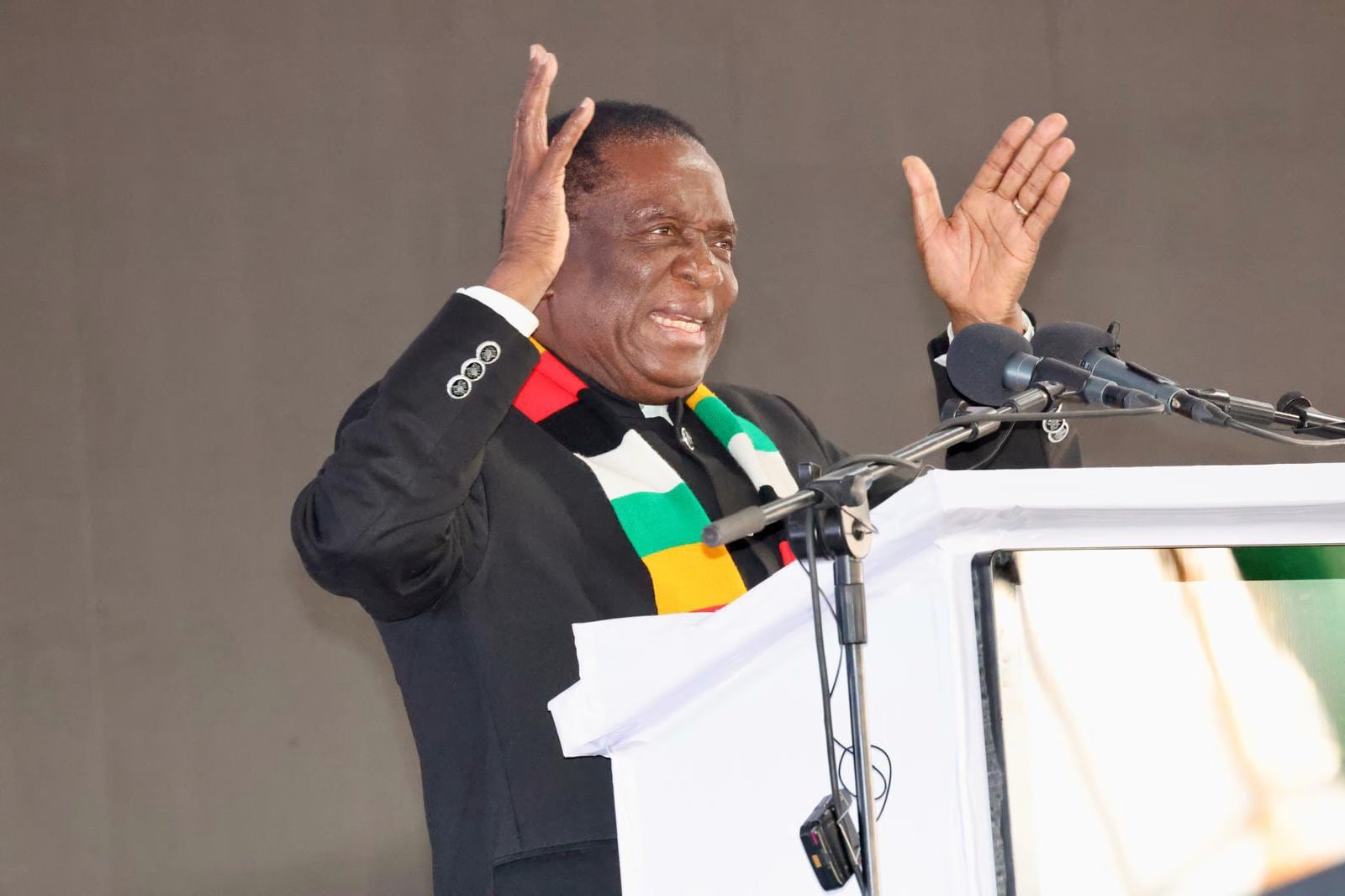
In his address to the General Assembly, President Mnangagwa placed Zimbabwe within broader African and Global South debates on international development, climate change, artificial intelligence, access to affordable development finance and reform of the global governance system. His advocacy for accelerated climate action and ethical artificial intelligence, alongside his demand for the unconditional removal of illegal unilateral coercive measures, allowed Zimbabwe to advance its national interests while aligning itself with wider developing-country concerns.
The emphasis on climate and technology also has a direct economic dimension. As global investment increasingly shifts towards green technologies, critical minerals and digital industries, Zimbabwe’s ability to participate in these emerging sectors will depend partly on its capacity to attract technology, capital and strategic partnerships. President Mnangagwa’s interventions therefore connected the country’s domestic development priorities to international debates that are increasingly determining where capital and technology will flow.
This connection was particularly visible in Zimbabwe’s pursuit of partnerships in energy and mineral value chains. The country has vast mineral resources, but the strategic challenge is to move increasingly beyond the extraction and export of raw materials towards beneficiation, processing and industrial production. International partnerships capable of bringing investment, technology, infrastructure and access to markets are therefore central to the transformation of mineral wealth into broader economic value.
The cooperation instruments signed with Benin, Azerbaijan, the United Arab Emirates, Saint Lucia and the Sovereign Order of Malta provide additional channels through which Zimbabwe can deepen political, economic and technical cooperation. Their importance will ultimately be determined by the extent to which these diplomatic instruments develop into practical programmes, investment relationships and market opportunities.
The engagement with the United Arab Emirates is particularly relevant in this regard, given the country’s position as an international commercial and investment hub and the emerging focus on cooperation in energy and mineral value chains. For Zimbabwe, such relationships provide an opportunity to connect its resource base with international capital and expertise while pursuing greater value addition at home.
The same principle is visible in the debt arrears clearance process. Support secured from Algeria and the United Arab Emirates adds diplomatic weight to Zimbabwe’s efforts to resolve its external debt challenges ahead of the targeted conclusion of a Comprehensive Partnership Agreement by October 2026. Debt resolution has implications beyond the settlement of obligations, because improved relations with creditors and international financial institutions can strengthen the conditions for accessing development finance and attracting long-term investment.
Zimbabwe’s pursuit of Commonwealth re-admission also fits into this wider re-engagement architecture. Advocacy from Antigua and Barbuda, the current Commonwealth Chair, provides another avenue for restoring Zimbabwe’s institutional connections within an organisation whose membership creates networks across trade, investment, education, governance and people-to-people relations.
The country is simultaneously strengthening its regional diplomatic position. Its forthcoming chairmanship of COMESA provides an additional platform through which Zimbabwe can advance regional trade, investment and industrialisation while connecting domestic producers to a wider African market. Coming after Zimbabwe’s SADC chairmanship, the regional responsibilities add weight to Harare’s broader attempt to position itself more actively within continental economic and political structures.
The international strategy is also being shaped by Zimbabwe’s forthcoming tenure on the United Nations Security Council for 2027 and 2028. President Mnangagwa has indicated that Zimbabwe intends to use the position to advance African interests, including the continent’s longstanding call for reform of the Security Council and greater African representation in global decision-making structures.
This gives the engagement and re-engagement policy a dimension beyond bilateral economics. Zimbabwe is seeking not only stronger relations with individual countries, but also a more influential role within the institutions that shape international peace, security, development and economic governance.
The deposit of Zimbabwe’s Instrument of Ratification for the United Nations Marine Biodiversity Agreement further demonstrated the country’s growing participation in international frameworks covering emerging global challenges. Such commitments expand the areas in which Zimbabwe can engage internationally while creating potential opportunities for cooperation around environmental protection, sustainable development and climate-related financing.
The cumulative picture emerging from UNGA 81 is therefore one of a foreign policy increasingly designed to serve national development objectives. Political relationships are being cultivated alongside economic partnerships, regional leadership, multilateral diplomacy and efforts to restore international financial relations, creating a wider platform from which Zimbabwe can pursue investment, trade, technology and development finance.
This also places a greater responsibility on the implementation phase. Diplomatic agreements and high-level engagements create opportunities, but their ultimate economic significance will depend on whether they result in actual investment, new industries, mineral beneficiation, energy projects, expanded export markets, technology transfer and improved access to finance.
For President Mnangagwa’s engagement and re-engagement policy, UNGA 81 therefore represents another stage in a longer process rather than an isolated diplomatic event. The strategy is increasingly about positioning Zimbabwe within multiple international networks while ensuring that those relationships support the country’s domestic transformation agenda.
With Zimbabwe preparing for its UN Security Council tenure, assuming the COMESA chairmanship and continuing efforts to resolve its debt obligations and attract investment, the country’s foreign policy is entering a phase in which diplomatic relationships will increasingly be judged by their ability to generate practical economic and developmental outcomes.
The central proposition behind the Second Republic’s international strategy remains that Zimbabwe’s development cannot be separated from its place in the global economy. UNGA 81 demonstrated how that principle is being pursued across multiple fronts, from multilateral diplomacy and regional leadership to investment, critical minerals, debt resolution and international institutional reintegration.