By Aldridge Dzvene
The Presidential Interface with Children of Veterans of the Liberation Struggle has opened a significant new dimension in Zimbabwe’s national development discourse, shifting the question of liberation legacy from remembrance alone to the practical challenge of building the country’s next generation of entrepreneurs, professionals, innovators and industrialists.
At the heart of the interface was a strategic proposition, that the greatest way for descendants of the liberation generation to honour their parents is not simply to inherit their history, but to convert that inheritance into productive capacity capable of strengthening Zimbabwe’s economy.
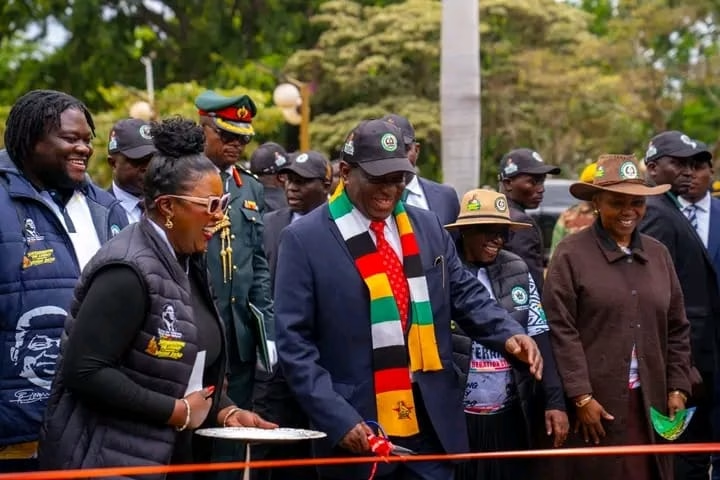
Addressing the gathering in Harare, His Excellency, Cde. E. D. Mnangagwa, President and First Secretary of ZANU PF, challenged children and descendants of veterans of the armed liberation struggle to make their own bold choices about their future and connect their individual talents to the national development agenda. The President described this as the meaning of the theme, “Safeguarding the Legacy, Moving Towards Vision 2030.”
The significance of that message extends beyond the veterans’ community. It speaks to a broader question facing Zimbabwe as the country approaches its Vision 2030 targets, namely, whether the sacrifices and political gains of the liberation generation can be translated into an economically productive inheritance for generations that did not experience the struggle themselves.
From a national development and strategic stability perspective, this is arguably one of the most important elements emerging from the interface.
Liberation movements historically derive their strength from the ability to organise people around a national objective. The challenge in the contemporary period is different. Political independence has to be continuously reinforced by economic independence, productive capacity, industrialisation, technological capability and institutions capable of sustaining development across generations.
The President therefore placed production and productivity at the centre of the responsibility facing young Zimbabweans, arguing that hard and honest work must remain central to the modernisation and industrialisation agenda.
This represents an important evolution in the interpretation of liberation legacy.
Instead of treating the children of veterans primarily as beneficiaries of history, the policy direction presented at the interface positions them as potential economic actors. Government programmes, targeted financing, educational support, vocational training and enterprise development are consequently being framed as mechanisms for creating capacity rather than permanent dependency.
The President said Government had already established tailor-made welfare and empowerment programmes aimed at integrating veterans and their dependants into the mainstream economy, including representation on public sector boards, strategic deployments across Government institutions and a continued empowerment drive through quota arrangements.
Under the National Development Strategy 2, the Government is also pursuing targeted financing windows for enterprises owned by veterans, while legislation concerning veterans, national heroes and war victims is under consideration alongside the development of a broader veterans policy.
The more consequential question, however, is what happens when these interventions meet a young generation possessing modern skills, technology and entrepreneurial ambition.
That is where the interface potentially becomes more than a veterans’ welfare platform.
The children of liberation war veterans occupy an unusual position in Zimbabwean society. They carry direct familial connections to the generation that fought for independence, but they also belong to a demographic shaped by contemporary realities such as digital technology, new forms of enterprise, global markets, artificial intelligence, changing industrial systems and an increasingly interconnected African economy.
The President explicitly called on them to use their youthfulness, skills and training across the public and private sectors, entrepreneurial enterprises, business and industry. He further challenged students in higher and tertiary education to develop innovations, solutions, goods and services capable of accelerating industrialisation and economic growth.
This is potentially the most important transition in the liberation legacy debate, from political inheritance to productive inheritance.
A liberation legacy that produces businesses, technologies, skilled professionals, manufacturers, farmers, engineers, researchers and institutions has the capacity to reproduce itself economically long after the generation of fighters has passed from the national stage.
In that sense, the Presidential interface can be read as an attempt to establish an inter-generational compact.
The older generation provides memory, historical experience and the record of sacrifice, while the younger generation is expected to provide innovation, enterprise and the capacity to convert national sovereignty into sustainable economic strength.
The President placed this responsibility within a wider African framework, linking Zimbabwe’s Vision 2030 with SADC Vision 2050 and the African Union Agenda 2063. He described the task as inter-generational, with the current generation responsible for translating the inheritance of liberation into sustainable socio-economic development that leaves no one and no place behind.
There is therefore a deeper strategic implication.
Zimbabwe’s development challenge is not merely about attracting investment or implementing individual projects. It is about developing a national class of people capable of owning, managing, financing, designing and sustaining the productive systems that will define the economy of the future.
That requires education that leads to employable and entrepreneurial skills, financing that rewards viable production, institutions that support enterprise, technology that increases productivity and a policy environment capable of turning ideas into commercially sustainable enterprises.
The President’s emphasis on sustainable empowerment that builds people’s capacity to produce, establish viable businesses, develop skills and participate actively in the economy points directly towards that model.
Seen through this lens, the children of war veterans are not being asked merely to preserve a historical narrative.
They are being challenged to become custodians of Zimbabwe’s economic future.
That distinction matters.
The preservation of history without economic transformation risks turning liberation memory into a museum piece. But when history becomes an inspiration for enterprise, innovation, industrialisation and national service, the liberation legacy acquires a living economic dimension.
The strategic test now lies in implementation.
If the financing windows, scholarships, vocational programmes, policy reforms and empowerment mechanisms outlined by Government translate into functioning enterprises, skilled graduates, productive investments and measurable economic activity, the interface could ultimately prove to be an important bridge between Zimbabwe’s liberation generation and its industrialisation generation.
The most powerful tribute to those who fought for Zimbabwe may therefore not be another monument or commemorative speech.
It may be a factory established by a young Zimbabwean, a technology developed locally, a farm producing at scale, a company exporting into Africa, an engineer designing national infrastructure, a scientist solving a local problem or a new generation of entrepreneurs creating employment for others.
That is the point at which liberation becomes development.
And as Zimbabwe moves towards Vision 2030, the central question is no longer simply what the children of the liberation generation inherited.
It is what they will build with it.
The President’s closing message was unmistakable: the responsibility to build Zimbabwe belongs to every generation, with national interests placed above personal and group interests and recommendations from the interface expected to drive accelerated action across key nodes of the economy.
The real measure of safeguarding the liberation legacy, therefore, will ultimately be found not in the preservation of its memory, but in the productive Zimbabwe that memory inspires the next generation to build.