By Aldridge Dzvene
The Airports Company of Zimbabwe’s recent Annual General Meeting has brought into sharp focus a broader transformation taking place in the country’s aviation sector, with airports increasingly being positioned not simply as points where passengers arrive and depart, but as strategic economic infrastructure capable of supporting tourism, trade, investment, logistics and regional connectivity.

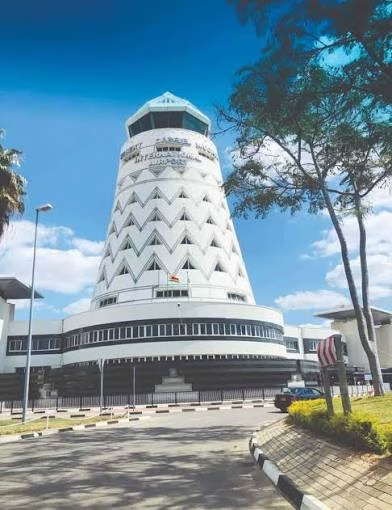
The AGM, which reviewed the company’s operations and financial performance for the 2022 and 2023 financial years, came at a significant stage in Zimbabwe’s aviation development. The country has invested heavily in upgrading airport infrastructure, most notably by expanding Robert Gabriel Mugabe International Airport, while other airports across the country are undergoing rehabilitation and modernisation to improve their capacity to support growing economic activity.
The importance of this investment now extends beyond the physical infrastructure itself. The central question is increasingly whether Zimbabwe can convert improved airports into commercially productive economic platforms that generate sustainable revenues, attract airlines, facilitate exports and strengthen the country’s position as a regional gateway.
ACZ has set ambitious growth targets towards 2030, projecting annual revenue of about US$60.3 million, up from a forecast US$34.5 million in 2025, while passenger numbers are expected to rise from approximately 1.83 million to 3.5 million. Cargo throughput is also projected to more than double, while the number of airlines operating in Zimbabwe is expected to increase from 21 to 26.
These projections point to a fundamental shift in the airport business model, because passenger charges alone cannot provide the entire foundation for long-term growth. ACZ is increasingly looking towards commercial property, retail, hospitality, cargo, logistics and other non-aeronautical activities as additional sources of revenue, reflecting the changing role of major airports across the world.
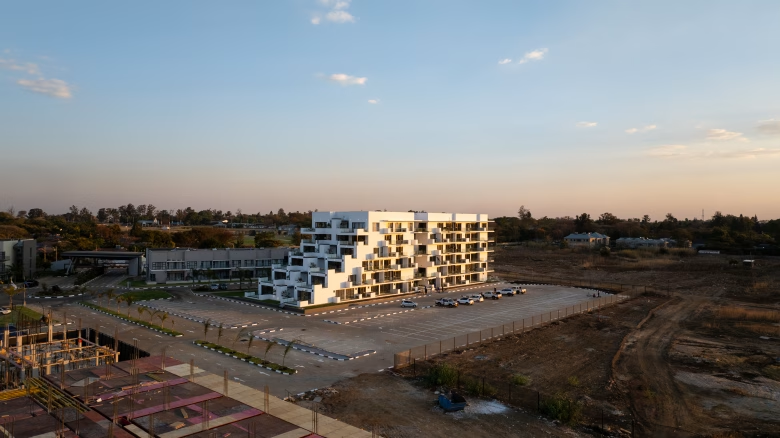
The proposed Airport City concept at Robert Gabriel Mugabe International Airport is therefore significant. The idea is to develop the airport precinct into a broader commercial ecosystem incorporating hotels, retail facilities, offices and other businesses, allowing economic activity to develop around the airport rather than limiting the facility to aviation operations.
This approach could create an important connection between infrastructure development and private-sector investment. An airport surrounded by logistics centres, hotels, conference facilities, commercial developments and other businesses can become an economic node that supports employment, investment and services well beyond the airport boundary.
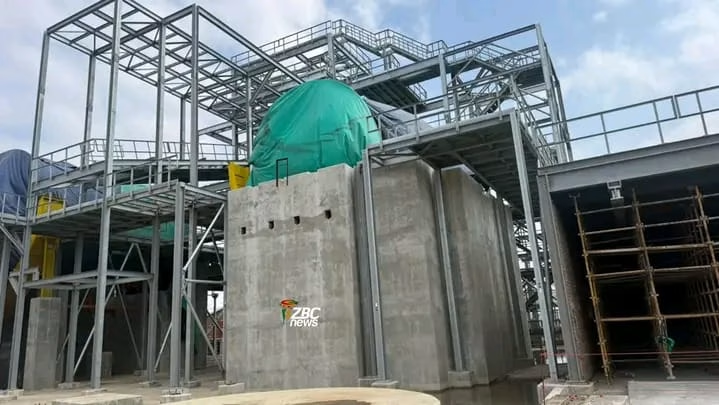
The proposed US$1 billion cargo village at Robert Gabriel Mugabe International Airport provides another indication of where Zimbabwe’s aviation strategy could be heading. The project is intended to provide logistics, grading, sorting and packaging facilities, with the broader objective of strengthening the airport’s position as a cargo hub for Zimbabwe and the region.
For an economy seeking to increase exports and move towards greater value addition, this is particularly important. Agriculture, horticulture, pharmaceuticals, manufactured products and other time-sensitive goods depend on efficient logistics, and stronger air-cargo infrastructure can reduce the distance between Zimbabwean producers and international markets.
The same logic applies to tourism. Zimbabwe’s airports are connected to different economic and tourism centres, meaning that their development cannot be considered in isolation. Victoria Falls is directly linked to international tourism, Bulawayo serves a major industrial and commercial centre, Masvingo provides access to Great Zimbabwe and surrounding tourism assets, while airports serving areas such as Hwange and Kariba have strategic relevance to the tourism economy.
The rehabilitation of Masvingo Airport ahead of the Sanganai/Hlanganani/Dzimbahwe World Tourism Expo demonstrated how airport infrastructure can support provincial economic strategies. Improving the airport increases the potential for tourism traffic while also strengthening the province’s ability to host business, investment and international visitors.
However, the expansion of infrastructure also creates a new requirement for competitiveness. Modern terminals and upgraded runways can increase capacity, but airlines ultimately consider the cost of operating routes, passenger demand, turnaround times, connectivity, ground-handling efficiency and the overall commercial viability of their operations.
This makes the question of aviation charges particularly important. Parliamentary discussions have already raised concerns around the competitiveness of Zimbabwe’s aviation fees, with calls for a review of charges as the country seeks to attract additional airlines and strengthen connectivity.
The issue is therefore not simply how much Zimbabwe invests in airports, but how efficiently that investment is converted into increased traffic, commercial activity and economic value. If infrastructure expansion is accompanied by competitive charges, efficient services, reliable connectivity and stronger commercial partnerships, the airport network can become an important contributor to national economic growth.
The reconstitution of the ACZ board also comes at a critical moment, with Advocate Tichaona John Muhonde retained as chairperson and new members appointed to provide oversight as the company pursues its longer-term strategy. The challenge for the board and management will be to translate the infrastructure gains of recent years into stronger financial performance, increased commercial activity and measurable economic impact.
For Zimbabwe, the opportunity is much bigger than passenger numbers. The real potential lies in connecting airports to the country’s productive sectors, ensuring that agricultural producers can reach markets, tourists can access destinations more efficiently, investors can enter the country with greater ease, cargo can move through modern logistics systems and provincial economies can benefit from improved connectivity.
The ACZ AGM therefore provides an important window into the next phase of Zimbabwe’s aviation story. The first phase was largely about infrastructure rehabilitation and expansion; the emerging phase is about utilisation, commercialisation and economic impact.
The runway, terminal and control tower are ultimately only the physical foundations. The larger measure of success will be whether the infrastructure generates new routes, more passengers, greater cargo volumes, stronger tourism receipts, increased investment and sustainable business activity around Zimbabwe’s airports.
Zimbabwe’s aviation sector is consequently entering a period in which airports must increasingly be viewed as engines of economic connectivity. The challenge now is to ensure that the infrastructure already being developed is fully integrated into the country’s tourism, trade, investment and industrialisation ambitions, turning airports from places where economic activity passes through into places where economic value is created.