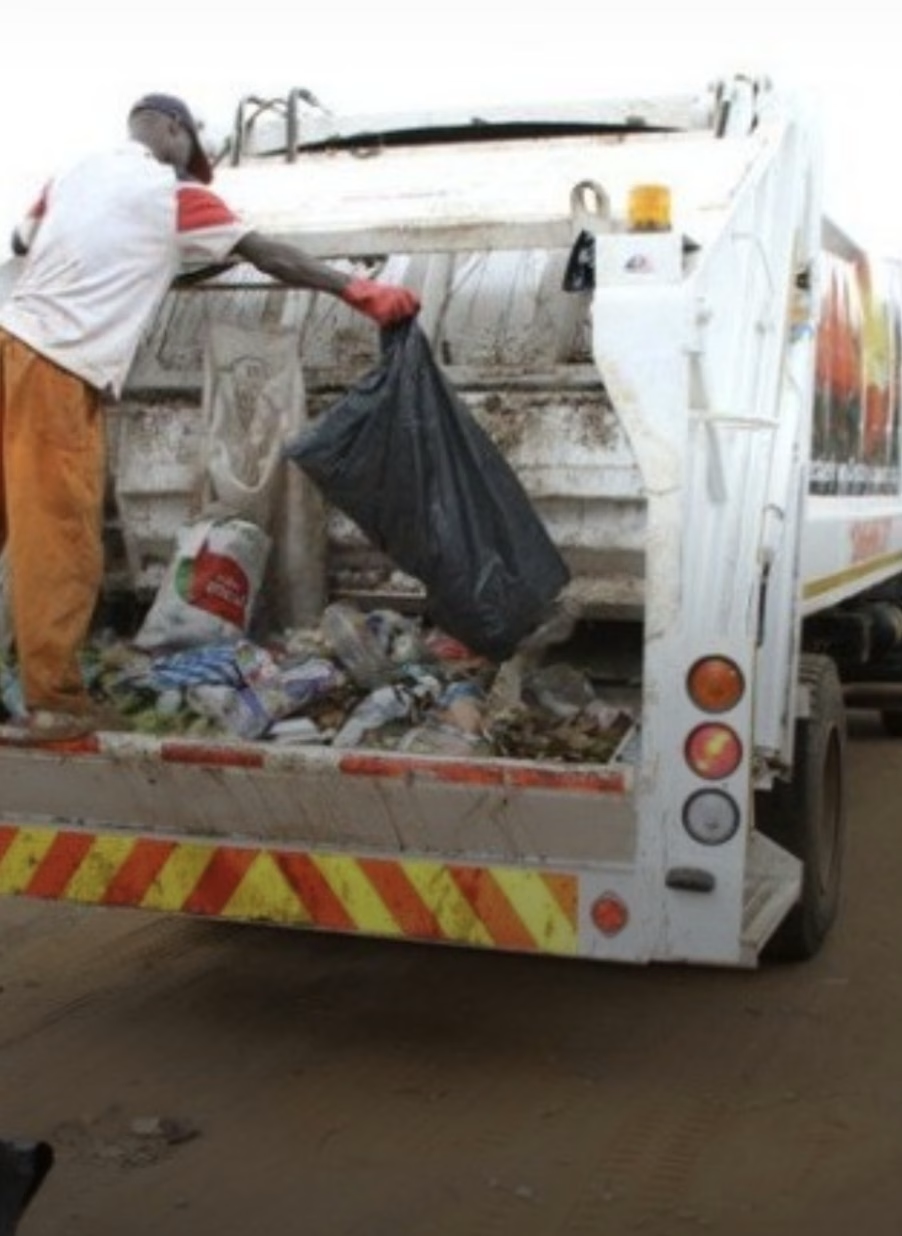
The Government has gazetted revised duty rebates for refuse collection, waste management, road maintenance and waste-to-energy equipment in a move designed to ease the burden on local authorities and accelerate improvements in service delivery.
The new measures are contained in Statutory Instrument 150 of 2026, the Customs and Excise (General) (Amendment) Regulations, 2026 (No. 133), published by the Minister of Finance, Economic Development and Investment Promotion under section 235 of the Customs and Excise Act [Chapter 23:02]. The regulations are deemed to have come into operation on 1 January 2026 and amend the Customs and Excise (General) Regulations, 2001, published in Statutory Instrument 154 of 2001, by repealing section 144G which previously covered only refuse collection and road maintenance vehicles and replacing it with a more comprehensive provision.
Under the new section 144G, which now provides for a rebate of duty on refuse collection, waste management and road maintenance vehicles, ancillary refuse equipment, components and spare parts and waste-to-energy spare parts, Government has widened both the scope and definition of eligible equipment. The law defines ancillary refuse equipment as any refuse apparatus, appliance, implement, tool, receptacle or container, whether self-propelled, towed, movable or static, used in the collection, transportation, handling, storage, sorting, separation, treatment, recovery, recycling, baling, compaction or disposal of waste, or in the servicing, repair or maintenance of any refuse collection vehicle, waste management and road maintenance vehicle, plant, machinery or equipment. In terms of subsection (2), a rebate of duty will be granted in respect of any such vehicle and equipment, including components and waste-to-energy spares, imported or taken out of bond for use by, or on behalf of, a local authority, subject to such conditions as the Commissioner of the Zimbabwe Revenue Authority may determine.
The rebate will only apply to goods appearing on an approved list specified in the Schedule to the Statutory Instrument, as approved by the Commissioner in consultation with the Minister. The Schedule contains 178 items and represents a significant expansion from the previous framework. It includes heavy duty service delivery vehicles such as mobile fuel bowsers, truck wreckers, mobile truck workshops, landfill compactors, front-end loaders, forklifts, low-bed trailers, mobile cranes, telehandlers, pallet jacks and cherry pickers, as well as refuse compactor trucks, tipper trucks and skip trucks. It also covers waste receptacles including 85-litre galvanized steel household bins, 240-litre and 1000-litre HDPE municipal solid waste collection bins and black plastic bin liners. The list further provides for workshop support equipment such as hydraulic hose crimping machines, high-pressure automatic washers, industrial air compressors, pedestal and magnetic drills, and spares for generators and excavators.
Crucially, the Schedule includes an extensive range of components and spares for waste-to-energy plants, covering hydraulic cylinders, pumps, valves, filters, conveyor belts and rollers, bale guider groups, walking base assemblies, pallet carriers, chain covers, sprockets, sensors, safety units, relays, circuit breakers, contactors and other electrical control units, together with consumables such as oils and greases, bale wire, seals, gaskets, packings, tyres for Howo, Sany, Daewoo, Bobcat and skid steer equipment, fasteners, billets, rods and sweeper brushes.
The Government’s decision to revise and expand duty rebates for refuse collection, waste management, road maintenance and waste-to-energy equipment is a strategic intervention directly aligned to the aspirations of Vision 2030 and the priorities of the National Development Strategy 2.
Vision 2030 envisions Zimbabwe as an empowered and prosperous upper middle-income society with a clean, safe and sustainable environment and modern infrastructure that supports improved quality of life. The Second Republic has consistently identified efficient waste management, resilient urban infrastructure and environmental sustainability as foundational enablers of that vision. By granting rebates on a comprehensive range of 178 items, Statutory Instrument 150 of 2026 removes cost barriers that have constrained local authorities and strengthens their capacity to deliver.
Under NDS2, whose core pillars include Infrastructure Development, Environmental Protection and Climate Resilience, Devolution and Decentralisation, and Service Delivery, the Government has prioritised the modernisation of local government systems and the creation of smart, clean and functional human settlements. The amended Section 144G operationalises this priority by ensuring that equipment imported for use by or on behalf of local authorities is more affordable and accessible. The inclusion of ancillary refuse equipment and the formal definition that covers apparatus used in collection, transportation, sorting, recycling, baling, treatment and disposal of waste, as well as waste-to-energy spares such as hydraulic systems, conveyor belts, filters, rollers, sensors and electrical control units, directly supports the circular economy and the transition from waste disposal to waste recovery and energy generation.
This shift is critical for NDS2’s thrust on value addition, climate change mitigation and sustainable energy. Waste-to-energy initiatives, enabled through the duty-free importation of specialised spares and components, will allow councils to reduce landfill pressure, cut greenhouse gas emissions and generate alternative energy, thereby contributing to both environmental sustainability and energy security, two key results areas under NDS2. Similarly, the provision for road maintenance vehicles, low-bed trailers, cranes, telehandlers, excavators and workshop tools aligns with the infrastructure rehabilitation agenda, enabling local authorities to maintain and upgrade roads, improve urban mobility and attract investment.
Furthermore, the rebate regime reinforces devolution by capacitating local authorities as primary drivers of development at the sub-national level, consistent with the NDS2 principle of leaving no one and no place behind. By lowering the cost of service delivery equipment, councils can reallocate resources towards expanding services, improving public health outcomes through effective refuse collection and enhancing the liveability of cities and towns, which are essential conditions for achieving upper middle-income status by 2030.
In essence, S.I. 150 of 2026 is not merely a customs adjustment but a deliberate policy tool that links fiscal incentives to national development outcomes, translating Vision 2030’s broad aspirations and NDS2’s concrete strategies into tangible improvements in municipal services, environmental management and sustainable industrialisation.