MASVINGO – Air Zimbabwe’s return to Masvingo is emerging as more than a temporary aviation intervention for the Sanganai/Hlanganani World Tourism Expo, with the restored air link creating a potential gateway for business tourism, investment and commercial activity in one of Zimbabwe’s most strategically positioned provinces.
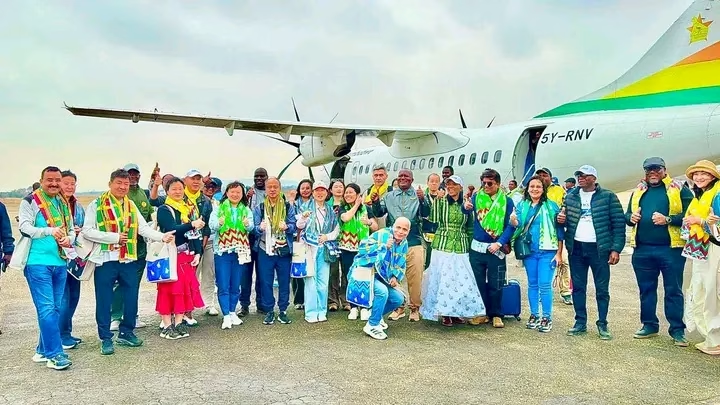
The national carrier resumed Harare–Masvingo and Victoria Falls–Masvingo services on September 5, with flights running through September 12, directly supporting the movement of exhibitors, international buyers, investors, delegates and tourism operators attending the Expo.
The significance of the development lies in what happens beyond the Expo.
For years, Masvingo’s tourism proposition has been constrained by the distance between its attractions and Zimbabwe’s principal business and tourism gateways. The return of scheduled air services changes that equation by reducing the time required for business travellers and tourists to move between Harare, Victoria Falls and Masvingo.
The inaugural Harare–Masvingo flight, operated by an ATR 42-500, carried at least 44 passengers, providing an early indication that there is a market for faster connectivity to the province.
But the bigger commercial question is whether this temporary demand can be converted into a permanent business case.
That question is important because business tourism operates differently from conventional leisure tourism.
A business traveller does not only purchase a seat on an aircraft.
They occupy a hotel room, hire transport, eat at restaurants, attend conferences, visit investment sites, engage suppliers, conduct meetings and potentially return with business partners or capital.
The economic value of connectivity therefore extends across an entire local supply chain.
For Masvingo, this creates an opportunity to reposition the city from being primarily a destination people travel through or visit for its heritage attractions into a place where business can actually take place.
Sanganai/Hlanganani provides an important demonstration of that potential.
The Expo brings together tourism buyers, exhibitors, investors and industry professionals, effectively concentrating a business network in Masvingo. The availability of direct flights reduces one of the practical barriers to participation and gives the city an opportunity to demonstrate whether it can accommodate larger volumes of business visitors.
The commercial opportunity is consequently not limited to selling tourism packages.
It includes conferences, corporate retreats, investment meetings, hospitality, events, transport, food production, cultural products and professional services.
This is where Masvingo’s heritage becomes economically important.
Great Zimbabwe is not simply a historical monument. Properly integrated into a broader tourism economy, it can function as an anchor around which accommodation, guided tours, cultural experiences, conferences, creative industries and premium tourism products are developed.
The challenge is to capture more of the value generated by visitors within the local economy.
A visitor who flies into Masvingo, stays overnight, visits Great Zimbabwe, purchases locally produced goods, employs a local guide and extends their stay creates substantially more economic value than a visitor who simply passes through the province.
Air connectivity makes that higher-value visitor economy more feasible.
The Victoria Falls–Masvingo connection could be particularly important in this regard.
Victoria Falls already functions as Zimbabwe’s strongest international tourism gateway. Connecting it directly with Masvingo creates the possibility of packaging two very different tourism propositions, the global natural attraction of Victoria Falls and the historical and cultural significance of Great Zimbabwe.
That could help Zimbabwe move towards a multi-destination tourism model in which visitors are encouraged to travel across several provinces rather than concentrating spending in a single destination.
The infrastructure surrounding the route will determine whether that opportunity is realised.
Masvingo Airport is undergoing upgrades, including terminal expansion, while Air Zimbabwe has worked with the Civil Aviation Authority of Zimbabwe, Airports Company of Zimbabwe and National Handling Services to support the service.
The combination of aviation infrastructure and tourism promotion is significant because connectivity and destination development have to grow together.
More flights create demand.
Demand creates pressure for better accommodation and services.
Improved services make the destination more attractive to investors.
Investment expands capacity.
And expanded capacity creates the basis for sustaining additional flights.
That cycle is what Masvingo now needs to establish.
The province therefore faces a different task after Sanganai/Hlanganani.
It must convert exposure into investment.
The Expo can introduce investors to Masvingo, but local authorities, tourism operators and businesses will ultimately have to turn those introductions into projects.
That could mean new hotels, conference facilities, tourism packages, transport services, restaurants, cultural enterprises and other businesses supporting the visitor economy.
The route also provides a useful commercial test for Air Zimbabwe.
If passenger demand generated by major events can be combined with leisure travel, corporate travel and growing tourism activity, temporary event-based services could potentially develop into commercially sustainable domestic connectivity.
The strategic importance extends to national tourism policy as well.
Zimbabwe’s tourism growth cannot depend exclusively on Victoria Falls. Secondary destinations need to become commercially accessible and capable of retaining a larger share of visitor expenditure.
Masvingo offers one of the strongest opportunities to demonstrate that model because it combines heritage, tourism, business potential and proximity to major national attractions.
The resumption of flights is therefore best understood as an economic connectivity experiment.
The immediate measure of success will be passenger numbers during Sanganai/Hlanganani.
The more important measure will come later.
Will investors return?
Will hotels expand?
Will tourism packages connect Masvingo with Victoria Falls?
Will conference and business tourism grow?
Will visitors stay longer?
Will local enterprises capture more tourism expenditure?
And, most importantly, will the route remain commercially viable when the Expo has left town?
If the answer is yes, Air Zimbabwe’s return could mark the beginning of a broader transformation in Masvingo’s economic geography, turning improved air access into a platform for business tourism, investment and value creation.
The Expo may be the reason the aircraft has returned.
The real test is whether business created during the Expo gives the aircraft a reason to keep coming back.