By Aldridge Dzvene
HARARE – Zimbabwe Revenue Authority’s 25th anniversary comes at a moment when the institution’s importance extends far beyond tax collection, placing it at the centre of a broader national question, whether Zimbabwe can build enough domestic fiscal capacity to finance its own development while protecting the economy from revenue leakages, illicit trade and increasingly sophisticated economic crime.
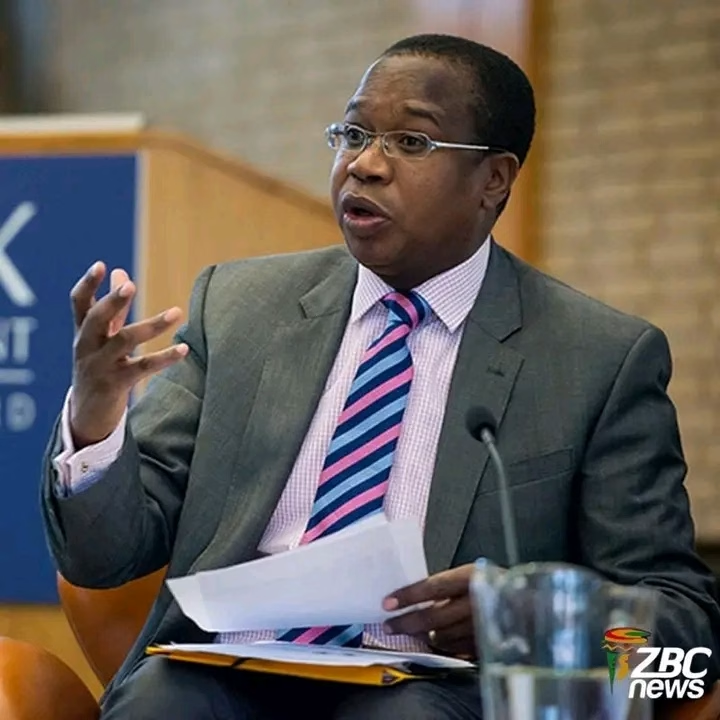
Speaking at the Authority’s Silver Jubilee in Harare on Wednesday, Minister of Finance, Economic Development and Investment Promotion, Hon. Prof. Mthuli Ncube, framed ZIMRA’s next chapter against an economy that has become considerably larger and more complex since the institution was established in 2001.
The significance of that evolution is not merely that ZIMRA now collects billions rather than the millions collected in its early years.
It is that the nature of the economy itself has changed.
Commerce is increasingly digital, financial transactions are more complex, supply chains stretch across borders and economic activity is becoming harder to capture through conventional revenue-administration methods.
The next challenge for ZIMRA is therefore not simply collecting more.
It is knowing where economic value is being created, where it is moving, where the State is losing revenue and how quickly those leakages can be detected.
That is the deeper meaning behind Government’s call for the Authority to broaden the tax base, strengthen compliance, reduce leakages and simplify the compliance environment as Zimbabwe moves towards Vision 2030.
The target of raising the tax-to-GDP ratio to 22 percent by 2030 places an increasingly measurable responsibility on the revenue authority.
It also raises an important development question.
Can Zimbabwe increase domestic revenue without placing disproportionate pressure on the same formal businesses and taxpayers already carrying the greatest compliance burden?
The answer lies partly in expanding the economic base rather than simply increasing the intensity of taxation.
As new businesses emerge, informal enterprises formalise and investment expands, the State must become increasingly capable of identifying economic activity that previously existed outside its revenue architecture.
This makes data, technology and institutional intelligence central to the future of ZIMRA.
The Minister’s warning that smuggling, corruption, illicit financial flows and economic crime are becoming increasingly sophisticated points to an important shift in the nature of revenue protection.
The old model of enforcement, where officers react after a violation has occurred, is becoming less sufficient.
The emerging model has to be preventive.
It has to identify unusual patterns before they become major losses.
It has to connect information from customs, taxation, financial institutions, border agencies and other Government departments.
It has to understand the movement of goods and money as interconnected systems rather than isolated transactions.
This is why the Government’s emphasis on an intelligence-led and technology-enabled response is particularly significant.
The border is no longer merely a physical line where goods are inspected.
It is part of a much larger economic information system.
A consignment crossing Beitbridge, for example, represents more than a truck entering Zimbabwe. It generates information about the importer, exporter, declared value, commodity, route, taxation, foreign currency exposure and ultimately the economic activity taking place around that transaction.
The ability to connect such information can determine whether revenue administration remains reactive or becomes predictive.
This is also where the fight against smuggling becomes more sophisticated.
Smuggling is not simply a customs problem.
It affects legitimate businesses that comply with the law, Government revenue, domestic manufacturing and the competitiveness of locally produced goods.
When illicit goods enter the market without bearing the same tax and compliance costs as formal businesses, the problem moves from the border into the factory, the shop and ultimately the employment market.
Protecting revenue therefore becomes part of protecting productive capacity.
The same logic applies to corruption.
A revenue authority can have strong laws and sophisticated systems, but institutional credibility ultimately depends on whether taxpayers believe that the rules are applied fairly.
That is why the Minister’s description of the relationship between Government and taxpayers as a social contract is important.
The State expects citizens and businesses to meet their lawful obligations.
In return, taxpayers expect professional, predictable and fair administration.
If either side fails, confidence in the fiscal system weakens.
For ZIMRA, the next 25 years will therefore involve balancing enforcement with legitimacy.
The Authority must be firm enough to protect revenue while becoming efficient enough that compliance itself does not become an unnecessary economic burden.
This becomes particularly important for small businesses and emerging enterprises.
If formalisation is too costly or complicated, economic actors have incentives to remain outside the system.
If compliance becomes simpler, predictable and increasingly digital, formalisation can become less of a burden and more of an economic advantage.
That is where ZIMRA’s future contribution to national development could become much broader than revenue collection.
A modern revenue authority can become an institution that provides Government with a real-time picture of economic activity.
That information can support policy decisions on industry, trade, investment and production.
It can reveal where economic activity is expanding, where sectors are contracting, where imports are displacing domestic production and where incentives are generating the intended results.
In that sense, ZIMRA’s data could become part of the country’s economic intelligence infrastructure.
But this also raises the standard of institutional responsibility.
The more information an institution possesses, the greater the need for professionalism, integrity, confidentiality and responsible use of that information.
The authority’s transformation must therefore be technological and institutional at the same time.
Technology without institutional discipline can simply make an inefficient system faster.
Technology combined with professional administration, information-sharing and accountable enforcement can fundamentally change how the State understands its economy.
The Minister’s emphasis on whole-of-Government cooperation points in this direction.
ZIMRA cannot independently solve smuggling, illicit financial flows or economic crime.
These challenges cross institutional boundaries.
They require revenue authorities, security agencies, law enforcement institutions, border authorities and other Government departments to share information and coordinate interventions.
The strategic question is consequently whether these institutions can move from operating alongside each other to operating as an integrated national economic protection system.
That transition could become one of the most consequential elements of ZIMRA’s next era.
There is also a wider sovereignty dimension.
With constrained access to affordable international financing and a shrinking development-assistance environment, Zimbabwe’s ability to finance its priorities increasingly depends on the strength of its domestic resource base.
This makes revenue mobilisation a question of economic sovereignty.
The stronger the domestic revenue base, the greater the State’s ability to finance infrastructure, public services and development without excessive dependence on external financing.
But this also means the revenue system must grow with the productive economy.
Taxation cannot substitute for production indefinitely.
Zimbabwe needs more businesses, more investment, more manufacturing, more exports and greater formal economic participation.
ZIMRA’s role is to ensure that the value generated by that expanding economy is captured fairly and lawfully for national development.
That is why the Authority’s 25th anniversary should not be viewed simply as an institutional celebration.
It is a transition point.
The first 25 years were about establishing and expanding a national revenue institution.
The next 25 must be about building an institution capable of understanding and protecting an increasingly sophisticated economy.
The standard is therefore higher.
ZIMRA must anticipate rather than merely react.
It must detect rather than merely inspect.
It must facilitate legitimate commerce while becoming increasingly difficult for illicit commerce to penetrate.
And it must use technology not merely to digitise existing procedures, but to change the quality of economic intelligence available to the State.
For taxpayers, the expectation is equally clear.
Compliance must become part of the country’s development culture, not merely an obligation imposed by law.
For Government, the responsibility is to ensure that the revenue collected is translated into visible national value.
For ZIMRA, the challenge is to prove that every stage of its transformation strengthens the relationship between the taxpayer, the economy and the State.
Twenty-five years after its establishment, the Authority has become too important to be measured only by how much money it collects.
Its deeper measure will be whether it can help Zimbabwe understand its economy better, protect the value being generated within it and convert domestic economic activity into sustainable fiscal capacity.
That is the real test of ZIMRA’s next chapter.
And as Zimbabwe moves towards Vision 2030, the country will increasingly need a revenue authority that does not simply follow the economy.
It must be capable of seeing where the economy is going.