HARARE — ART Holdings Limited (ART) delivered a mixed third-quarter performance to June 2026, with softer volumes across core markets but improved operating results, as the company pushes ahead with a corporate restructuring aimed at unlocking capital and accountability.
The update reflects a business navigating tight liquidity, import competition and working-capital constraints, while repositioning for a leaner, more focused operating model.
The operating environment in Zimbabwe was broadly stable. Lower inflation, exchange-rate stability and reduced policy interest rates supported business planning. Government policy backing for local manufacturing was also noted as encouraging.
However, demand remained muted. The anticipated seasonal uplift in replacement battery sales did not materialise, and growth in agriculture and mining did not translate into higher battery uptake. Consumer and business liquidity stayed tight.
Competition from low-priced imports continued to pressure pricing, particularly in batteries. Operating costs rose on packaging, fuel and raw materials. A stronger South African Rand increased the US dollar cost of regional inputs, while global supply chain tensions lengthened lead times. Positively, improved grid power availability cut reliance on costly alternatives.
In Zambia, the economy was stable but demand was weighed down by fiscal pressures, energy shortages, volatile oil prices and pre-election uncertainty.
Business Performance: Volumes Down, Margins Improving
Group sales volumes fell 15% in the quarter, leaving nine-month volumes 3% below last year.
Quarterly turnover declined 9% to US$7.06 million from US$7.79 million in the prior period. Nine-month turnover was largely flat at US$21.34 million vs US$21.32 million.
The drop was driven by weaker battery sales, working-capital limits and supply-chain disruptions. Export battery volumes were 24% down for the nine months as the Group prioritised cash collection and margin-sustainable orders over volume.
Despite this, operating results improved year-on-year, supported by restructuring, a better product mix and tighter cost control. Margins, however, remained under pressure from low plant utilisation and higher input costs. Working capital was cited as the key constraint to raising production.
Divisional Highlights
Energy Storage
The division returned to operating profitability but remains below capacity.
Battery volumes fell 26% in Zimbabwe and 16% in Zambia for the quarter. For the nine months, both markets were down 9%. Capacity utilisation averaged 62%.
Challenges included limited working capital, reduced scrap collections and supply disruptions. Tighter credit controls in riskier channels also impacted volumes but protected cash.
Management noted growing competition from cheaper imports and rising input costs. It welcomed stronger government support for local manufacturing and enforcement against non-compliant imports. In Zambia, restructuring helped improve performance despite lower volumes.
Exide Express
The retail arm improved performance through a shift to higher-value battery lines. The evolving vehicle fleet is driving demand for a wider range of sizes and maintenance-free products. Selective capital investment will be needed to capture these opportunities.
Stationery and Tissue
- Eversharp: Volumes rose 13% year-on-year on better product availability and brand acceptance. Raw-material availability and limited working capital constrained further growth. The focus is on expanding market presence and improving margins via cost control and supply-chain efficiency.
- Softex: Continues to operate a lean converting model after exiting integrated paper manufacturing. New local compact tissue mills are increasing supply of jumbo reels, which shortens supply chains, reduces import dependence and lowers working-capital needs. This supports Softex’s lower-capital strategy and validates the exit from power-intensive integrated production.
Mutare Estates
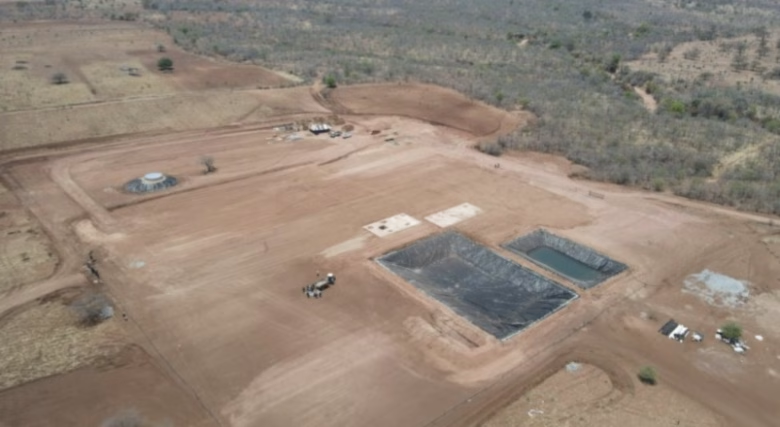
Remained the Group’s most stable performer. Nine-month sales volumes were 24% above prior year, driven by firm timber demand, improved milling efficiency, disciplined pricing and cost control. The estate continues to provide key cash flow and stability. No material fire losses were recorded. Opportunities to participate in mineral activities on the estate are under evaluation and look encouraging amid strong commodity prices.
Strategic Reset Underway
The company advanced its restructuring during the quarter. Principal operating divisions are being set up as separate subsidiaries, with banking and tax registrations complete.
The company’s Scheme of Reorganisation is now with tax and regulatory authorities for approval. If approved, it will simplify the corporate structure and remove the offshore holding company. The Board targets completion by year-end.
The new structure is designed to give each business clearer accountability and better access to working capital, equipment finance and strategic partners. It should also improve risk separation and flexibility for future capital raising.
Priorities are to finalise the reorganisation, settle remaining legacy obligations, and redirect capital to working capital and essential plant investment.
The final quarter is expected to remain competitive, with tight liquidity, higher input costs and import pressure persisti
The company’s focus is to restore battery volumes, lift plant utilisation, strengthen working capital, improve supply-chain reliability, and cut costs. As legacy obligations are cleared, more cash should flow to operations and essential capex.
Although the recovery remains gradual, the company believes these measures establish a stronger foundation for year-on-year growth and long-term value creation.