By Aldridge Dzvene
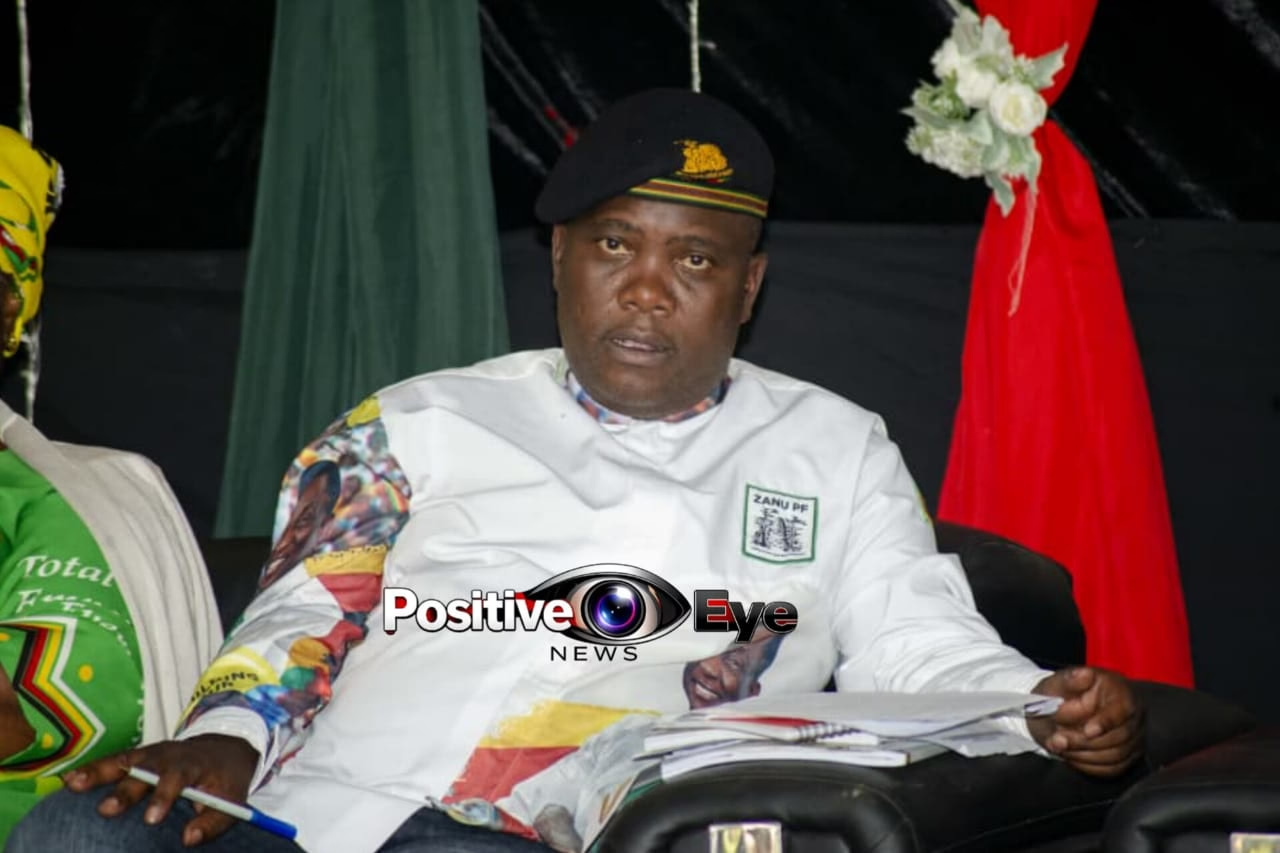
HARARE – ZANU PF Politburo Deputy Secretary for Security, Cde Tendai Chirau, has called on Zimbabweans to translate the ideals of the liberation struggle into economic productivity, arguing that the defence of national sovereignty in the post-independence era depends on citizens’ ability to utilise national resources for development.
Speaking ahead of this year’s Heroes Day and Defence Forces Day commemorations, Chirau said the liberation struggle should be understood not merely as a historical military campaign, but as a continuing national project whose objectives included political independence, economic empowerment, land ownership and national self-determination.
His remarks come as Zimbabwe intensifies implementation of the National Development Strategy 2 (NDS2), with Government increasingly linking the country’s liberation heritage to policies that promote production, value addition, industrialisation and economic self-reliance.
“There is no country without a history, and our history is sacrosanct and sacred because those who fought in the liberation struggle were determined to secure political independence and economic independence,” Chirau said.
Beyond commemorating past sacrifices, Chirau argued that the responsibility of the current generation is to protect the gains of independence through measurable economic output. He singled out agriculture as one of the principal objectives of the liberation struggle, saying ownership of land without productive utilisation weakens the strategic purpose for which the resource was reclaimed.
“What is important is that those who benefited from the Land Reform Programme must be productive as a way of safeguarding the values and ethos of the liberation struggle,” he said.
The remarks signal a broader evolution in Zimbabwe’s political discourse, where the emphasis is gradually shifting from liberation as a historical event to liberation as an ongoing development philosophy. Within this framework, productivity is increasingly presented as a patriotic obligation rather than solely an economic activity.
Chirau also reflected on the organisational character of the liberation struggle, saying victory was achieved through discipline, unity, commitment and strategic coordination despite the material superiority of the colonial forces.
“And also going forward, it’s important to understand that the liberation struggle wasn’t just fought in a disorganised manner. People had to come together using intellect, commitment and loyalty,” he said.
His observations suggest that the principles which underpinned the liberation struggle remain relevant to contemporary governance and development. In an environment where economic transformation requires coordination between Government, the private sector and communities, national cohesion is presented as a strategic development asset.
Chirau further urged young Zimbabweans to understand the objectives for which liberation fighters sacrificed, arguing that every sector of the economy has a role in consolidating national independence.
Referring to the liberation war philosophy that “we are all liberators” and linking it to President Dr. Emmerson Dambudzo Mnangagwa’s call for Zimbabweans to be “masters of their own destiny,” Chirau said every citizen carries responsibility for protecting and advancing the nation through productive work.
“Whether you are in farming, mining or any other industry, you should know that this country belongs to us and we should safeguard the ethos and values that those who came before us fought for,” he said.
As Zimbabwe prepares to commemorate Heroes Day and Defence Forces Day, Chirau’s remarks position the national commemorations as more than ceremonial occasions. They frame them as opportunities to renew commitment to nation-building, economic productivity and responsible stewardship of the country’s resources. Within that context, the liberation legacy is presented not only as a source of national identity but also as a strategic foundation for achieving Vision 2030 through sustained production, innovation and collective national effort.