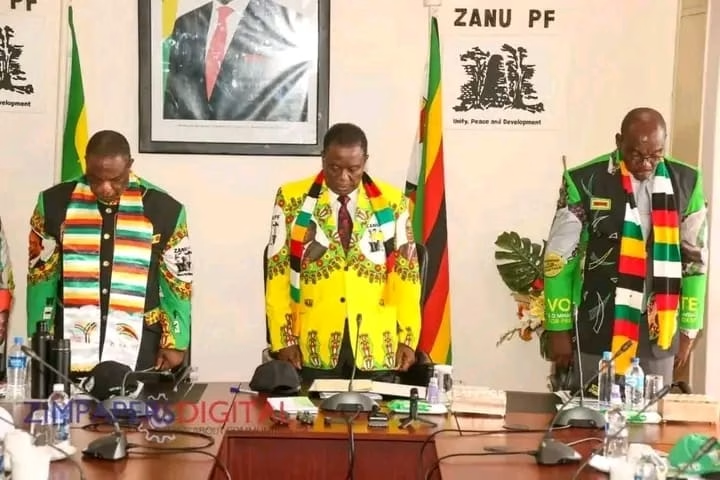
HARARE –President and ZANU PF First Secretary, His Excellency Dr. Emmerson Dambudzo Mnangagwa, has called for accelerated implementation of people-centred development programmes, declaring that Zimbabwe’s improving macroeconomic stability must translate into tangible benefits for communities through inclusive growth, industrialisation and expanded economic opportunities.
Addressing the 395th Ordinary Session of the ZANU PF Politburo, President Mnangagwa said the country’s positive economic trajectory, supported by prudent fiscal management, strategic international engagement and value addition, provides a platform for delivering transformative development that reaches every province, district and village.
The President’s address highlights the Second Republic’s evolving development philosophy, where macroeconomic stability is increasingly viewed as a foundation rather than an end in itself. Stable economic fundamentals are expected to stimulate investment, expand productive sectors and create the fiscal space necessary for Government to finance infrastructure, education, healthcare and community development programmes.
Central to the President’s message was the need to align national policy with local realities. By urging leaders to embrace the Whole-of-Government and Society Approach, he underscored that sustainable development requires coordinated implementation across Government institutions, the private sector, communities and development partners.
This approach reflects an important shift from centrally driven development towards place-based economic transformation. Different regions possess distinct natural resources, skills and economic potential, making locally designed interventions more effective in unlocking growth and improving livelihoods.
President Mnangagwa also reaffirmed that mineral value addition and beneficiation remain strategic pillars of Zimbabwe’s industrialisation agenda. Processing minerals locally rather than exporting raw resources enables the country to increase manufacturing output, create skilled employment, generate export earnings and strengthen domestic industrial capacity.
His emphasis on expanding engagement with BRICS further illustrates Zimbabwe’s strategy of diversifying international economic partnerships. Greater cooperation with emerging global economies is expected to facilitate investment, technology transfer, infrastructure financing and access to larger markets, all of which are essential for sustaining long-term economic transformation.
The President’s challenge to Party structures to strengthen implementation also reflects the growing importance of delivery-focused governance. As Zimbabwe advances the National Development Strategy 2, emphasis is increasingly shifting from policy formulation to measurable outcomes that improve household incomes, expand employment opportunities and enhance the quality of public services.
Ultimately, the address reaffirmed that Vision 2030 is anchored on inclusive development that leaves no community behind. By linking sound economic management with grassroots empowerment, productive investment and responsive leadership, President Mnangagwa outlined a development pathway that seeks to ensure national economic progress is reflected in improved living standards for all Zimbabweans.