By Aldridge Dzvene
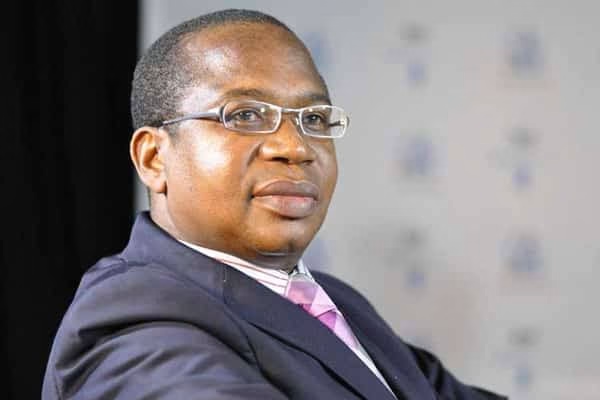
HARARE – Zimbabwe’s Treasury is expected to reaffirm its commitment to macroeconomic stability when the Minister of Finance, Economic Development and Investment Promotion, Professor Mthuli Ncube, presents the 2026 Mid-Term Budget Review this week. The presentation will signal that policy consistency, rather than sweeping fiscal or monetary reforms, will remain the Government’s overriding economic strategy.
The Mid-Term Budget Review comes at a time when Zimbabwe is consolidating gains made under a disciplined fiscal and monetary policy framework that has delivered greater exchange rate stability, declining inflation, and improving investor confidence. Against a backdrop of global economic uncertainty, Treasury is expected to reinforce confidence by maintaining its current policy direction while fine-tuning measures to support growth in the second half of the year.
Professor Ncube indicated that the Government sees no justification for altering its current policy framework, arguing that macroeconomic stability has become one of Zimbabwe’s strongest economic assets.
“The ship is sailing, it’s steady. The economy seems to be very stable; there is stability, and we have no reason to disturb or change course. Economic agents should not expect us to change our course during these announcements. For 2026, we are projecting economic growth of 5 percent, slightly down from last year’s 8.3 percent.
“We expect this 5 percent rate of growth to be achieved. In the first quarter of this year, the quarter-on-quarter annualized growth rate was 6.8 percent. If I look at the same quarter last year, 2025, that growth was just above 4 percent. Given this strong start to the year, together with last year’s performance, we believe a 5 percent growth rate for the full year is achievable,” he said.
Although the projected 5 percent expansion represents a moderation from last year’s exceptional 8.3 percent growth, economists generally view it as evidence of sustained economic resilience rather than a slowdown. Maintaining positive growth after a high base is often regarded as a stronger indicator of economic stability than short-lived periods of rapid expansion.Treasury expects growth to continue being driven by productive sectors of the economy, with agriculture, mining, manufacturing, tourism, and infrastructure development remaining the principal engines of expansion.Professor Ncube said improved electricity supply has enhanced industrial productivity by reducing production disruptions, while firm international gold prices and the recovery of base metal markets continue to support mining output and export earnings.
He added that ongoing public infrastructure investment, together with the continued expansion of manufacturing, which now contributes 17 percent of Gross Domestic Product (GDP), is laying the foundation for industrialization, employment creation, and increased value addition across the economy.
The Mid-Term Budget Review is also expected to reinforce the Government’s commitment to fiscal discipline, which has become the cornerstone of Zimbabwe’s broader macroeconomic stabilization program.
Professor Ncube said exchange rate stability, subdued inflation, and foreign currency reserves of approximately US$1.6 billion — equivalent to about one-and-a-half months of import cover — have significantly strengthened Zimbabwe’s economic position and provided critical support for the ZiG.”The objective of achieving macroeconomic stability has been met, and we want to maintain that macroeconomic stability. It’s a key objective of Government. It gives the whole economy a sense of certainty and predictability. Companies can plan when the exchange rate is stable and inflation is also stable.”We will carry on with this policy. It has arisen from ensuring that we have a prudent fiscal policy, an equally prudent and tight monetary policy, and strong coordination between the two. The growth of our reserves, now at one-and-a-half months of import cover, US$1.6 billion worth of foreign reserves, is bolstering our domestic currency, the ZiG,” he said.
Economic analysts say policy consistency is particularly important at a time when businesses are making long-term investment decisions. Stable exchange rates, predictable inflation, and disciplined public spending reduce uncertainty, lower business costs, and encourage both domestic and foreign investment.
Professor Ncube said prudent fiscal management, including limiting budget deficits and avoiding deficit monetization, has played a central role in stabilizing the domestic currency while keeping inflation in single digits.
He noted that the exchange rate has remained relatively stable at around ZiG26 to the United States dollar, while average inflation between January and June remained below 5 percent, reinforcing confidence in the country’s macroeconomic fundamentals.
Despite these gains, the Minister cautioned that Zimbabwe remains exposed to external risks beyond its control. Geopolitical tensions continue to pose risks to global energy prices, while the possibility of El Niño conditions later this year could affect agricultural production, food security, and inflation.
To cushion households and productive sectors from external shocks, the Government will continue deploying targeted tax measures where necessary to minimize the impact of rising international commodity prices.
The Mid-Term Budget Review is therefore expected to send a clear message to financial markets, investors, and the business community that the Government’s immediate priority is not policy experimentation but safeguarding the macroeconomic stability achieved over the past two years.
For Zimbabwe’s productive sectors, the emphasis on continuity provides greater certainty for investment planning, while reinforcing Treasury’s broader objective of sustaining economic growth, protecting the ZiG, strengthening fiscal discipline, and advancing the country’s industrialization and economic transformation agenda.