By Aldridge Dzvene
HARARE – Zimbabwe’s industrialisation agenda has entered a decisive phase, with President Emmerson Dambudzo Mnangagwa challenging industry leaders, investors and policymakers to accelerate value addition, expand manufacturing and reduce dependence on imported goods, a strategy economists say could fundamentally reshape the country’s economic structure if fully implemented.
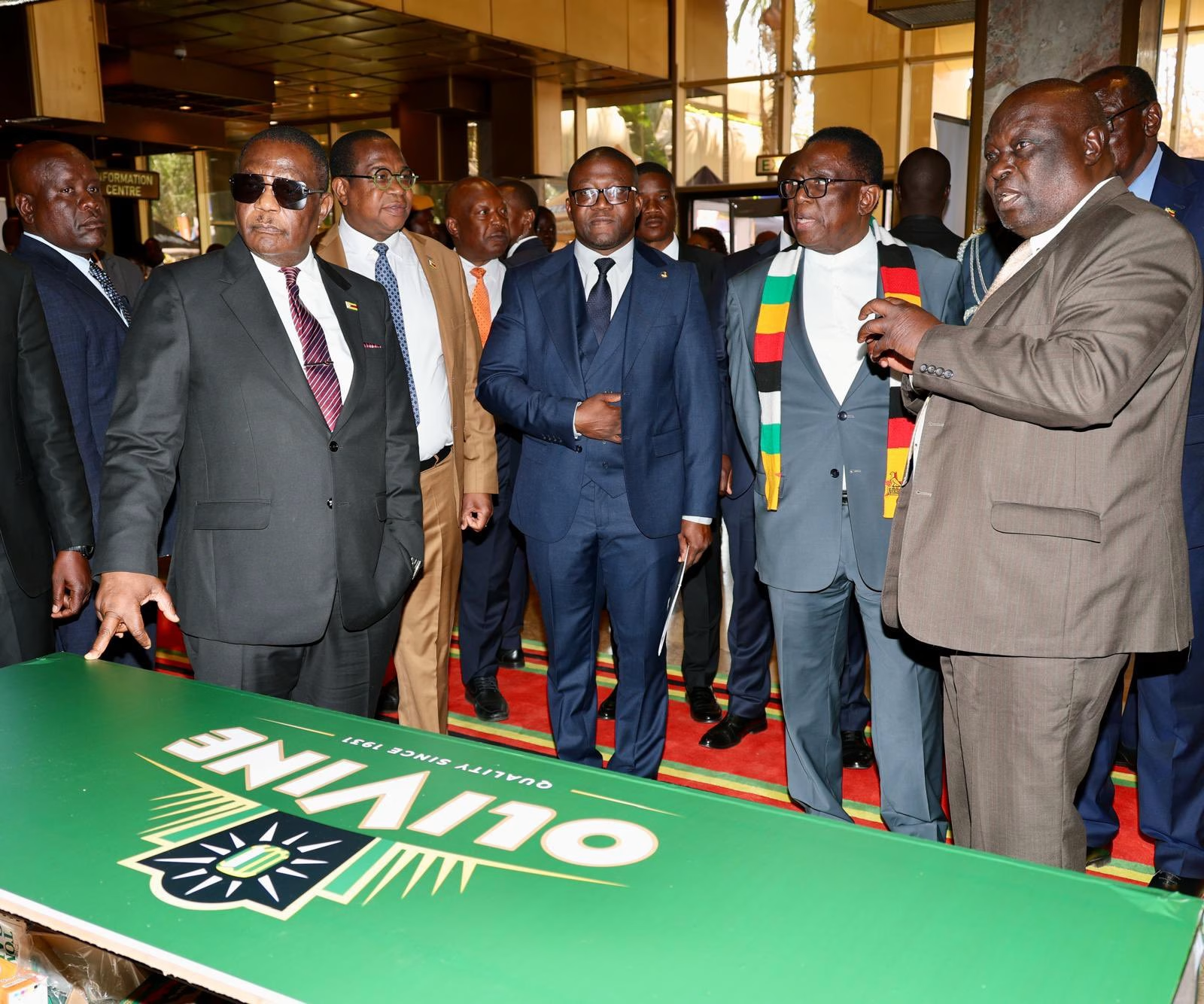
Officially opening the inaugural Zimbabwe Industrialisation Conference and Expo 2026 in Harare on Thursday, the President outlined an industrial development framework centred on regional value chains, innovation, beneficiation and export-led manufacturing. The conference, held under the theme, “Accelerating Industrialisation Through Regional Value Chains, Innovation and Trade,” comes at a time when Zimbabwe is seeking to position itself as a competitive manufacturing hub within Southern Africa and the African Continental Free Trade Area.
Beyond the policy pronouncements, the address reflected a broader economic transition. For decades, Zimbabwe’s economy has largely relied on exporting raw minerals and agricultural commodities while importing finished products. Such a model exports jobs, technology and industrial value to foreign markets, leaving limited domestic economic benefits.
The President argued that Zimbabwe must now reverse this trend by processing its own minerals, agricultural produce and industrial raw materials before export. Such an approach has long been recognised by economists as one of the most effective pathways for increasing national income, creating skilled employment and strengthening industrial competitiveness.
The country’s latest industrial performance provides evidence that this transition is already gathering momentum. According to the State of Industry and 2027 Prospects Study cited by the President, industrial capacity utilisation has risen to 61.2 percent during the first quarter of 2026, compared to 35 percent in 2019. Manufactured exports have also increased from US$360 million in 2019 to US$584 million, while manufacturing now contributes 17 percent of Zimbabwe’s Gross Domestic Product (GDP).
From an economic perspective, these indicators suggest that Zimbabwe’s productive sector is gradually recovering after years of constrained industrial activity. Higher factory utilisation generally signals improved production, increased investment confidence and stronger domestic demand.
However, the President made it clear that the current performance remains below Zimbabwe’s full industrial potential.
One of the most striking observations from the address was that Zimbabwe continues to import approximately US$2.5 billion worth of manufactured products that could be produced locally. Economists argue that such imports represent significant capital outflows which could instead support domestic industries, create thousands of jobs and stimulate local supply chains if redirected towards Zimbabwean manufacturers.
This reality places renewed importance on import substitution, not as an end in itself, but as a stepping stone towards export competitiveness. While replacing imports conserves foreign currency, sustainable industrialisation ultimately depends on producing goods capable of competing in regional and international markets.
The President therefore challenged the Minister of Industry and Commerce and the private sector to move beyond simply reducing imports by expanding production for export, particularly within the Southern African Development Community (SADC), the Common Market for Eastern and Southern Africa (COMESA) and the African Continental Free Trade Area.
This regional approach reflects changing patterns in African trade. Rather than relying solely on overseas markets, African economies are increasingly seeking to strengthen intra-African trade through integrated value chains where neighbouring countries supply components, intermediate goods and finished products to one another.
Zimbabwe’s strategic geographical location places it in a favourable position to become a regional manufacturing and logistics hub, provided investments continue in transport infrastructure, energy, digital connectivity and industrial financing.
The President also identified strategic sectors capable of driving the country’s next phase of industrial expansion. These include iron and steel, lithium processing, pharmaceuticals, fertiliser production, tobacco, leather, cotton, dairy, oilseed processing, sugar, grain processing, logistics and packaging. Collectively, these industries possess significant potential to generate value-added exports while reducing dependence on imported finished goods.
For economists, beneficiation remains one of the most critical components of this strategy. Countries that process their mineral resources domestically typically capture greater economic value through downstream industries, technological development and skilled employment than those exporting raw materials.
The President reaffirmed Government’s position that Zimbabwe’s natural resources should no longer leave the country in raw form, emphasising that investment partnerships must support domestic processing and industrial growth rather than perpetuating extractive economic models.
Equally significant was the recognition of innovation, research and technology as central pillars of industrial transformation. The President acknowledged the growing adoption of advanced technologies, including artificial intelligence, by local industries to improve productivity and operational efficiency. Such technological upgrades are increasingly becoming essential for manufacturers seeking to compete in global value chains.
The address also highlighted the role of Small and Medium Enterprises (SMEs), describing them as essential pillars of Zimbabwe’s Industrial Transformation Roadmap. Integrating SMEs into formal industrial value chains broadens industrial participation, strengthens domestic supplier networks and promotes inclusive economic growth.
Industrialisation, however, extends beyond factory construction. Sustainable industrial growth depends on affordable financing, reliable electricity, efficient transport systems, secure water supplies, digital infrastructure and a predictable investment climate. The President said Government would continue implementing reforms aimed at improving these fundamentals to enhance Zimbabwe’s competitiveness.
Another emerging dimension of Zimbabwe’s industrial strategy is green industrialisation. The President called for industries to embrace energy-efficient technologies and environmentally responsible production systems, recognising that future global markets increasingly favour sustainable manufacturing practices.
Ultimately, Zimbabwe’s industrialisation agenda represents more than an economic policy. It is an attempt to reposition the country from being primarily an exporter of raw materials to becoming a producer of high-value manufactured goods capable of competing across African and global markets.
Whether this transformation succeeds will depend on sustained investment, policy consistency, innovation, infrastructure development and stronger collaboration between Government, industry, financial institutions, academia and development partners.
If these pillars remain aligned, economists believe Zimbabwe could gradually strengthen its industrial base, expand employment opportunities, increase export earnings and accelerate progress towards becoming an upper middle-income economy under Vision 2030.