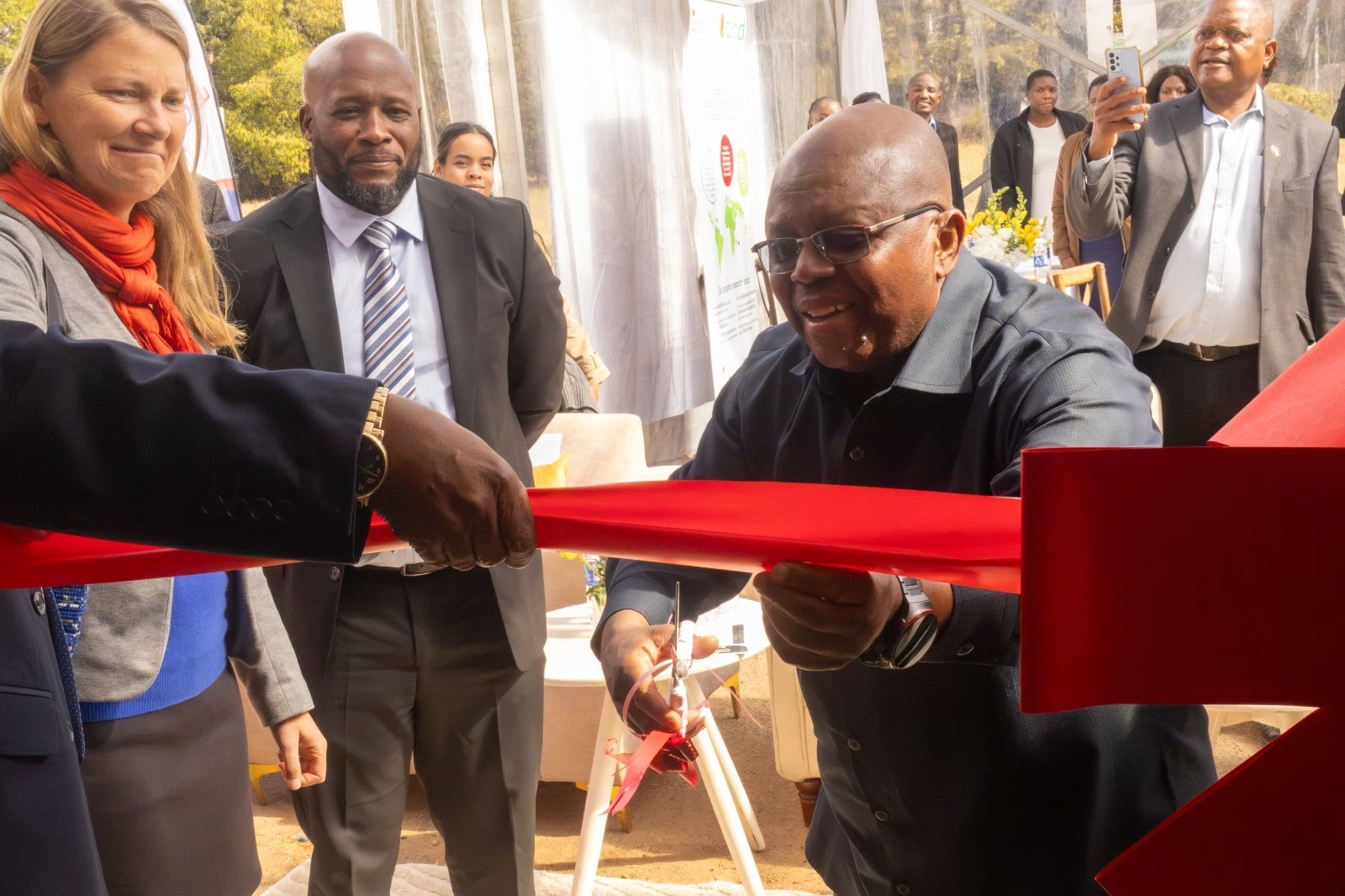
Zimbabwe has commissioned a specialised Honey Testing and Profiling Laboratory, a move expected to unlock European and other high-value export markets for local beekeepers while advancing the country’s National Development Strategy 2 agenda for export-led industrialisation and rural empowerment.
The facility, handed over on 1 July 2026, represents the culmination of an 18-month partnership between government, development partners, and rural producers.
The journey began in June 2023, when the Ministry of Foreign Affairs and International Trade led a delegation to France. During that mission, ZimTrade and MOFAIT agreed with the Agence Française de Développement [AFD] to partner on strengthening Zimbabwe’s honey value chain.
That agreement materialised on 3 March 2025 with the launch of the Zimbabwe Bee for Economic Empowerment [Zim-BEE] Project in Harare. The EUR 1.5 million initiative is funded under AFD’s Trade Capacity-Building Program [PRCC] and implemented by Expertise France in partnership with ZimTrade.
Since launch, ZimBEE has moved quickly on three fronts, namely producer capacity building, quality infrastructure, and policy and systems support.
More than 650 beekeepers across clusters in Matabeleland North, Mashonaland East, and Manicaland have received training in modern apiculture, business management, and climate-smart production. Clusters in Chikomba, Lupane, and Nyanyadzi have been key beneficiaries, with improved beehives also being distributed to raise output.
Working with the Department of Veterinary Services [DVS], the project established the new laboratory. DVS will manage it as the national competent authority.
The project is also supporting development of a National Residue Monitoring Plan [NRMP], a prerequisite for export compliance.
The lab itself now offers pesticide residue analysis, adulteration detection, botanical and geographical origin verification, and full quality profiling aligned to Codex Alimentarius standards. In short, it provides the “passport” Zimbabwean honey needs for international trade, according to ZimTrade Chief Executive Officer (CEO) Mr Allan Majuru.
“Until now, one of the key missing links has been the quality infrastructure required to verify, certify, and position our honey for premium international markets,” Majuru said at the handover.
“This was part of the gap, part of the missing link, the bridge that is required to bring our local producers closer to the global market,” he stated.
Majuru noted that honey is no small commodity. The global industry is worth US$10 billion per annum, with Europe alone consuming ∼1.2 million kgs daily. Africa accounts for about 12% of global production, yet Zimbabwe’s share has remained limited due largely to gaps in testing and certification.
“This laboratory is a gateway to international markets, to improved product credibility, to better prices for producers, and to stronger confidence among buyers,” Majuru said.
Most importantly, it is a gateway for Zimbabwean honey to tell its story scientifically, clearly, and convincingly.
The next steps are international accreditation for the lab and formalising standard operating procedures. That work will underpin Zimbabwe’s whitelisting process — the technical clearance needed to export honey to the EU and other stringent markets.Alignment with NDS2: Export-Led Growth, Value Addition, Rural Industrialisation
The commissioning directly supports several NDS2 2021-2025 pillars. NDS2 prioritises increasing non-traditional exports and reducing reliance on raw commodity exports. By enabling compliance with EU standards, the lab creates a pathway for honey and by-products to move from informal cross-border trade to formal, high-value export channels.
The facility allows Zimbabwe to capture more value domestically through testing, certification, and profiling, rather than exporting untested bulk honey at discounted prices. The lab is a seed for something bigger, with potential future upgrades to test other export foods like horticulture.
Over 650 smallholder beekeepers have already been capacitated. With market access improved, incomes and livelihoods in rural clusters are expected to rise.
By housing the lab within DVS as the competent authority, Zimbabwe is strengthening its national quality infrastructure to meet WTO and SPS requirements.
Development partners framed the project as a model for sustainable trade. “AFD is proud to support the Zimbabwean honey sector that has a strong capacity to be a lever for economic resilience and development,” said Lou Cambarrat-Roux, AFD’s Project Manager for Zimbabwe.
The Zim-BEE project highlights the importance of building a sustainable value chain for both people and the planet.