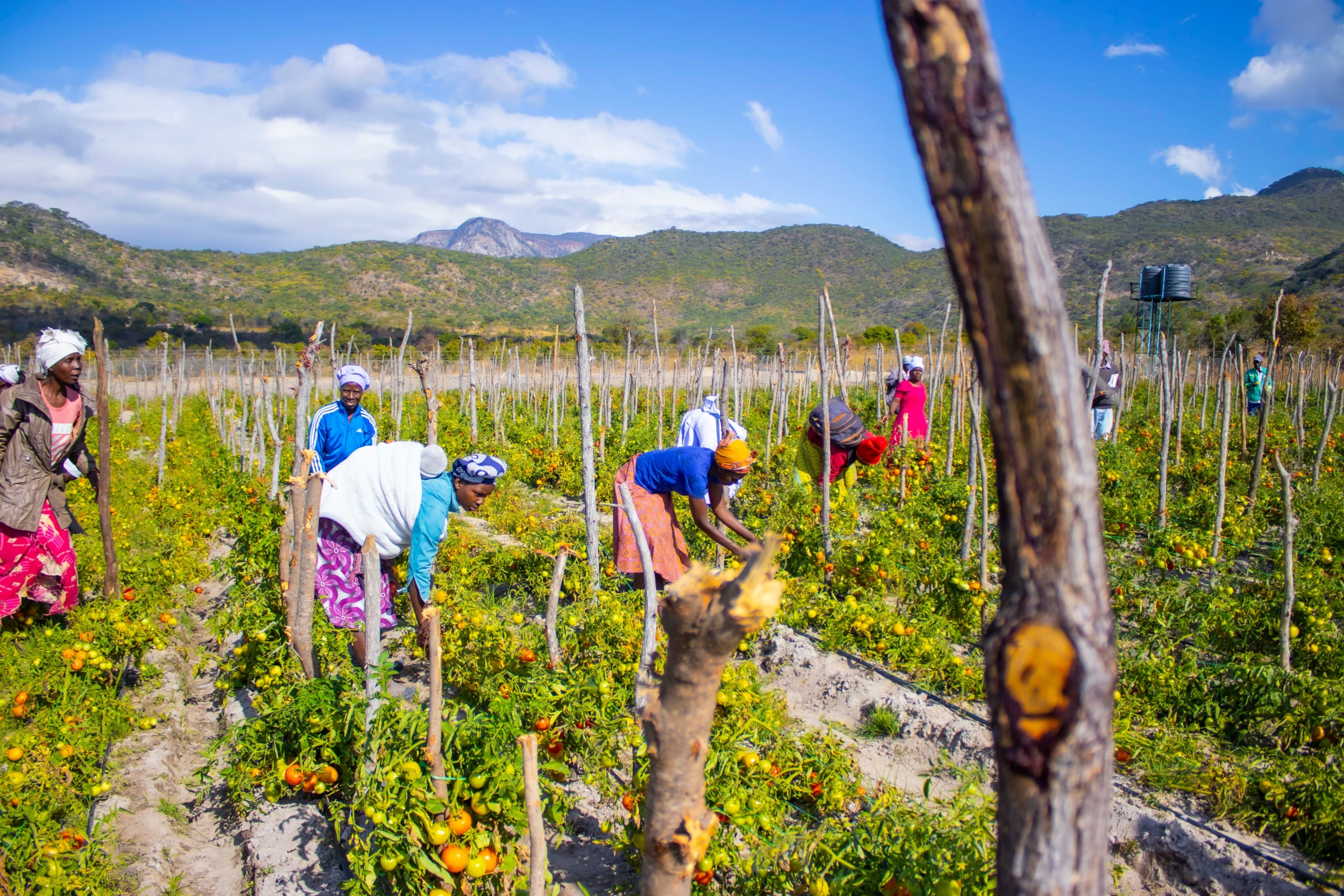
For decades, development interventions across Africa have largely been measured by how quickly communities recover from crises. However, as climate change, environmental degradation and economic shocks become more frequent and complex, a new development paradigm is emerging, one that focuses less on recovery and more on resilience. In Zimbabwe, the Zimbabwe Resilience Building Fund Phase 2 (ZRBF 2) is becoming one of the most compelling examples of this transition, transforming resilience from a humanitarian concept into an economic development strategy.
The programme arrives at a crucial moment in Zimbabwe’s development journey. Rural communities continue to face recurring droughts, erratic rainfall patterns, environmental pressures and market vulnerabilities that threaten livelihoods and food production systems. Yet the challenge confronting policymakers and development practitioners is no longer simply how to respond to these shocks, but how to build communities that can thrive despite them.
This is where ZRBF 2 represents a significant departure from traditional development models.
Rather than concentrating resources on emergency relief after disasters occur, the programme focuses on strengthening the productive capacities of communities before crises emerge. It seeks to build resilience as an economic asset, enabling households, farmers and local enterprises to adapt, innovate and generate sustainable livelihoods under changing climatic conditions.
In many respects, ZRBF 2 is helping to redefine resilience itself. The concept is no longer limited to surviving droughts or recovering from crop failures. Instead, resilience is increasingly understood as the ability of communities to maintain productivity, preserve assets, access markets and sustain economic activity even during periods of environmental stress.
This shift has profound implications for Zimbabwe’s broader development agenda.
The programme recognises that climate resilience, food security and economic growth are inseparable. Communities that can reliably produce food, manage natural resources sustainably and participate in local markets are not merely less vulnerable; they become active contributors to national economic development.
The first phase of the Zimbabwe Resilience Building Fund demonstrated the effectiveness of this approach. Reaching more than 1.1 million people, the programme delivered measurable improvements in climate adaptation, livelihoods, financial inclusion and food security. Importantly, women and young people became central beneficiaries, reflecting the programme’s commitment to inclusive development and community empowerment.
ZRBF 2 now seeks to deepen these gains by expanding interventions across selected districts while introducing stronger linkages between resilience building and local economic transformation.
What distinguishes the programme is its integrated approach. Water management, climate-smart agriculture, financial literacy, value addition, natural resource conservation, market access and enterprise development are treated not as isolated interventions but as interconnected components of a broader resilience ecosystem.
The establishment of irrigation infrastructure, agro-processing facilities and livelihood diversification initiatives reflects an understanding that resilience ultimately depends on productive economic systems. Communities become resilient when they possess the tools, knowledge and infrastructure necessary to generate income, manage risk and create opportunities.
Equally significant is the programme’s contribution to food sovereignty. Across Africa, governments are increasingly recognising that sustainable food systems are essential for economic stability, national security and social development. By promoting climate-smart agricultural practices and strengthening local production capacities, ZRBF 2 contributes directly towards reducing vulnerability to external shocks while enhancing domestic food security.
The programme also illustrates the growing importance of partnership-driven development. The collaboration between the Government of Zimbabwe, the European Union, Ireland, the United Nations Development Programme and the Food and Agriculture Organization demonstrates how international cooperation can support nationally owned development priorities.
Such partnerships are becoming increasingly important as countries seek innovative solutions to complex challenges that transcend traditional sectoral boundaries. Climate change, food security and rural development require coordinated responses that combine technical expertise, financial resources and local knowledge.
From a policy perspective, ZRBF 2 aligns strongly with Zimbabwe’s Vision 2030 aspirations and broader efforts to modernise agriculture, strengthen rural economies and promote inclusive growth. By investing in resilience at community level, the programme contributes towards building the foundations of a more adaptive and productive economy.
Perhaps the most important lesson emerging from ZRBF 2 is that resilience should not be viewed as a defensive strategy. It is increasingly becoming a pathway towards opportunity, productivity and transformation. Communities that can withstand shocks are also better positioned to innovate, invest and participate in economic growth.
As Zimbabwe continues to confront the realities of climate change while pursuing ambitious development goals, the Zimbabwe Resilience Building Fund Phase 2 stands as a model of how resilience can move beyond crisis management and become a catalyst for sustainable development.
The programme’s true legacy may therefore not be measured solely by the number of beneficiaries reached or projects completed, but by its contribution to building a resilience economy, one in which communities possess the capacity not merely to endure adversity, but to prosper despite it.