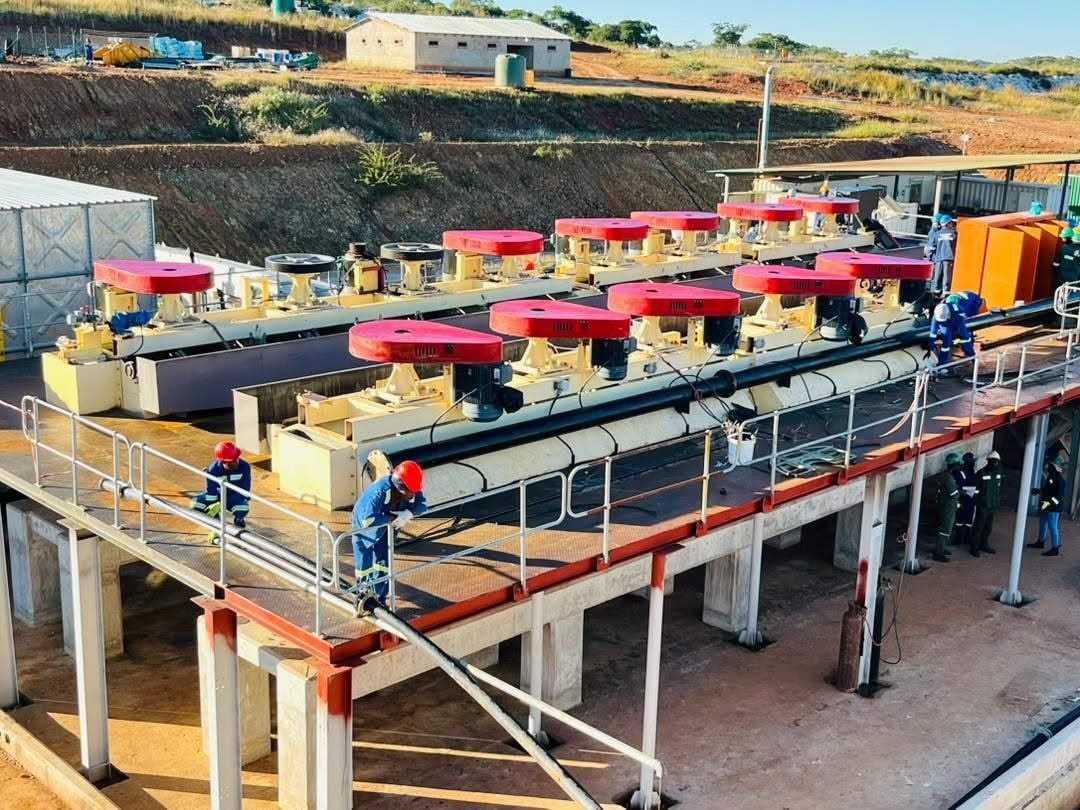
Zimbabwe’s lithium industrialisation ambitions are entering a potentially defining phase as the Zulu Lithium Project, operated by Premier African Minerals, moves closer toward stable commercial production, signalling another major step in the country’s broader beneficiation and value-addition agenda under the National Development Strategy framework.
The project’s progression toward export-grade spodumene concentrate production is increasingly being viewed as a critical milestone not only for the company itself, but also for Zimbabwe’s evolving position within the rapidly expanding global lithium economy.
Analytically, the most important indicator now is the project’s ability to consistently produce export-quality spodumene concentrate at commercial scale. This stage effectively represents the transition point where the operation moves from technical commissioning into a revenue-generating industrial producer.
In lithium processing operations, commissioning a plant is only the initial phase. The more technically demanding challenge often lies in stabilising flotation chemistry, maintaining recovery efficiencies and achieving consistent concentrate grades suitable for downstream refining markets.
For the Zulu project, market attention is likely to focus heavily on whether the plant can consistently produce spodumene concentrate within the globally accepted range of approximately 5.5 to 6 percent lithium oxide (Li₂O), the benchmark generally required for battery and refining supply chains.
The significance of the first successful export parcels extends beyond immediate revenues. Such shipments effectively validate the project’s entire processing flowsheet while simultaneously strengthening confidence among financiers, off-takers, investors and potential strategic expansion partners.
From an industrial perspective, successful stabilisation of concentrate quality could significantly improve Zimbabwe’s credibility as a reliable supplier within the increasingly competitive international battery minerals market.
The project also highlights a broader structural transition occurring within Zimbabwe’s mining sector, where the focus is gradually shifting away from simple raw mineral extraction toward integrated beneficiation and domestic processing.
This transition aligns closely with Government policy objectives centred on value addition, industrialisation and economic transformation under both the National Development Strategy 1 and the evolving National Development Strategy 2 framework.
Zimbabwe has in recent years intensified efforts to discourage the export of unprocessed lithium ore while encouraging in-country concentration, refining and downstream industrial development.
The Zulu project therefore carries strategic significance beyond the company level because it directly tests the practical viability of Zimbabwe’s beneficiation-driven mining model.
However, analysts note that the long-term success of the operation will depend heavily on infrastructure resilience and operational continuity.
Stable grid electricity, reliable water supply systems, uninterrupted reagent procurement and efficient transport logistics remain critical determinants of whether Zimbabwe’s lithium beneficiation ambitions can be sustained competitively.
Infrastructure reliability is particularly important in lithium processing because plant downtime can severely affect recovery efficiencies, production consistency and commercial viability.
Transport logistics also remain central to competitiveness, especially given the need to move concentrate efficiently through regional export corridors toward international refining markets.
The infrastructure question becomes even more significant within the context of Southern Africa’s rapidly intensifying lithium sector competition.
Zimbabwe is increasingly emerging as one of Africa’s most strategically important lithium jurisdictions, with projects such as Prospect Lithium Zimbabwe and Bikita Minerals also accelerating production and beneficiation activities.
As global demand for battery minerals continues to rise, competition among producers is likely to depend less on resource availability alone and more on operational reliability, processing consistency, infrastructure efficiency and long-term supply chain stability.
Producers capable of maintaining continuous plant uptime and delivering consistent concentrate quality are expected to secure stronger long-term supply agreements with international battery manufacturers and refining companies.
Globally, lithium has become one of the most strategically significant minerals due to its central role in electric vehicle batteries, energy storage technologies and the broader global energy transition.
This has elevated countries with large lithium deposits into increasingly important geopolitical and industrial positions within future manufacturing supply chains.
For Zimbabwe, the Zulu project represents part of a broader attempt to position the country not merely as a raw resource exporter, but as a developing midstream processing hub within the regional battery minerals value chain.
If the spodumene plant reaches stable commercial production in the near term, it would strengthen the argument that Zimbabwe possesses the technical and industrial capacity to support beneficiation-led mineral development.
More importantly, it would reinforce Government efforts to build a diversified mineral economy capable of generating higher export earnings, industrial growth, employment creation and broader economic multipliers beyond primary extraction.
As Zimbabwe advances its industrialisation agenda under Vision 2030, lithium beneficiation projects such as Zulu are increasingly becoming important indicators of whether the country can successfully transition from resource extraction toward higher-value industrial participation in the global energy transition economy.