By Aldridge Dzvene
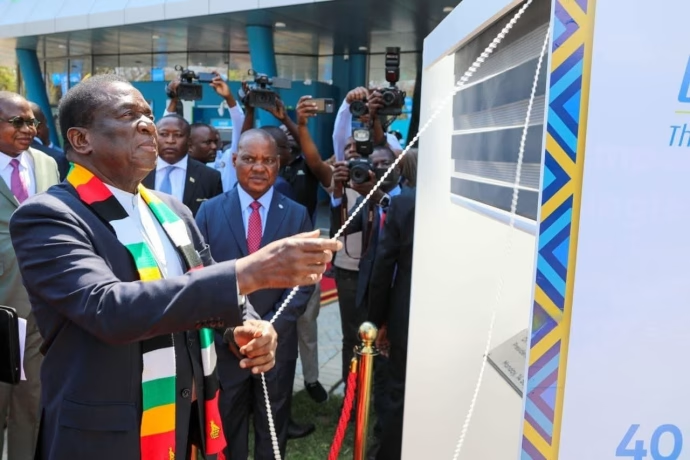
The rehabilitation of Morton Jaffray Waterworks marks a pivotal moment in Harare’s efforts to resolve its long standing water crisis, with authorities moving to double production capacity under the National Development Strategy 2.
The project, structured under a public private partnership model, is expected to increase output from the current average of 300 megalitres per day to between 520 and 600 megalitres, a significant gain for a city whose daily demand exceeds 1,200 megalitres.
While the upgrade will not fully close the supply gap, its impact is expected to be immediate and spatially significant, particularly for western suburbs and high density areas that have experienced chronic water shortages for years.
At a structural level, the intervention reflects a broader shift from temporary mitigation measures toward long term infrastructure renewal, targeting both production and distribution inefficiencies that have historically undermined service delivery.
Central to the upgrade is the replacement of aging pump systems at the main treatment plant and the Warren Control Pump Station, a move aimed at improving water pressure and stabilising supply across the network. These mechanical upgrades are critical, given that pumping inefficiencies have been a major contributor to uneven distribution, even when treated water is available.
Equally important is the refurbishment of clarifiers, which play a key role in treating raw water drawn from Lake Chivero. The lake’s high pollution load has long strained treatment processes, increasing chemical costs and reducing overall efficiency. Improving this stage of treatment is expected to enhance water quality while lowering operational costs over time.
Beyond the plant itself, the synchronisation of the upgrade with distribution reforms signals a more integrated approach to urban water management. The planned replacement of approximately 500 kilometres of aging asbestos pipes with modern alternatives is expected to significantly reduce non revenue water, which has been eroding supply through leaks and system losses.
The introduction of over 100,000 smart water meters in 2026 further reinforces this transition, shifting the system toward data driven management. Accurate consumption tracking and billing are expected to improve revenue collection while promoting more efficient water use among consumers.
Analytically, the project addresses a critical mismatch that has defined Harare’s water challenges, where production constraints, distribution losses and weak revenue systems have interacted to create a cycle of underperformance.
By simultaneously targeting these three pillars, production, transmission and financial sustainability, the upgrade begins to reposition water supply as a managed utility rather than a constrained public service.
The timing of the intervention is also strategic. With new water sources such as Kunzvi Dam under development, strengthening existing treatment and distribution infrastructure ensures that future supply gains can be effectively absorbed into the system.
Without such rehabilitation, additional raw water capacity would risk being underutilised, as existing bottlenecks in treatment and delivery would persist.
However, the scale of the challenge remains significant. Even at peak upgraded capacity, the city will still operate below total demand, meaning that supply rationing and prioritisation will continue in the medium term.
The long term success of the intervention will therefore depend on sustained investment, not only in infrastructure but also in institutional capacity, maintenance systems and governance frameworks that ensure consistent performance.
From a public health and urban development perspective, the implications are substantial. Improved water availability is directly linked to sanitation outcomes, disease prevention and overall quality of life, particularly in densely populated areas.
The Morton Jaffray upgrade, therefore, represents more than a technical intervention, it is a foundational step in restoring urban functionality and supporting Harare’s broader economic recovery.
If effectively implemented and complemented by future supply projects, the initiative could mark the beginning of a gradual but decisive turnaround in the capital’s water security trajectory.