A community-driven irrigation project in Chipinge is emerging as a powerful model of climate resilience and rural enterprise, transforming livelihoods in one of Zimbabwe’s most drought-prone regions through a partnership between the Government of Zimbabwe, United Nations Development Programme Zimbabwe, and the UK Government.
The Hakwata Drip Irrigation Garden, established under the Climate Adaptation Water and Energy Programme (CAWEP), is redefining how vulnerable communities respond to climate shocks, combining climate-smart agriculture with business training to build sustainable income streams and food security.
Located in a semi-arid zone receiving between 450mm and 650mm of rainfall annually, the project leverages drip irrigation technology to maximise water efficiency while ensuring consistent crop production despite erratic weather patterns. However, beyond infrastructure, the success of the garden has been anchored on strong business management and community ownership.
The project’s first crop cycle presented initial challenges, with participants investing approximately US$600 in seeds and pest control and generating US$1,260 in returns. Instead of consuming the profits, members reinvested all earnings into subsequent production cycles, reflecting the impact of targeted business training.
This strategy paid off significantly in the second cycle, where 15,000 tomato plants and 15,000 cabbage plants were cultivated, yielding 9.8 tonnes of tomatoes valued at US$2,724 and 17 tonnes of cabbage worth US$2,302 between June and August. Production continued into a third cycle, generating an additional US$1,929 from tomatoes and green mealies.
With 113 members, the garden has evolved into a fully market-driven enterprise, independently selling 98 percent of its produce to local markets, including Checheche growth point, neighbouring Mozambique, and surrounding communities. This level of market self-sufficiency underscores the project’s transition from aid dependency to sustainable commercial agriculture.
Beyond income generation, the garden has strengthened household nutrition, with each participating household receiving approximately 20 kilograms of tomatoes during the second cropping cycle. This dual role as both a commercial venture and a food security pillar highlights its broader socio-economic impact.
Institutional discipline has further reinforced sustainability. Members have established formal financial systems, including a bank account at AFC Bank, and adopted governance structures that prioritise reinvestment over short-term gains, with dividends deferred until after three production cycles.
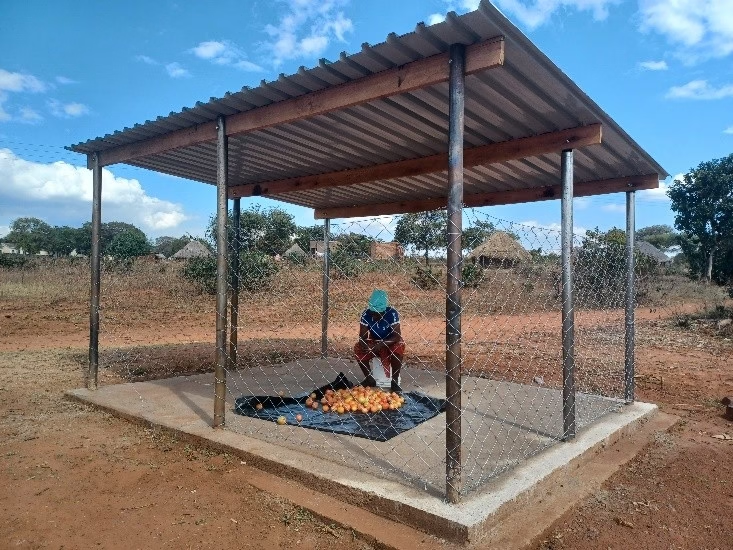
The project has also stimulated local economic activity, with the garden committee investing US$285 from generated income to construct a dedicated sales shed, replacing previously unsafe selling conditions. This investment not only improved operational efficiency but also created employment opportunities through the use of local labour.
Looking ahead, the community has set its sights on expansion, with plans to increase production land to boost output and income. The anticipated dividends are expected to support critical household needs such as school fees and food purchases, providing a vital safety net in a region where rain-fed agriculture is increasingly unreliable.
Farmers have demonstrated adaptability by aligning production with market demand, replacing less viable crops such as okra with higher-demand produce like tomatoes. Integrated pest management practices and efficient water use have further enhanced productivity and resilience.
As garden chairlady Ndaizivei Makhuyana noted, irrigation has become the community’s lifeline in an environment where rainfall is insufficient to sustain traditional farming.
The Hakwata initiative stands as a compelling example of how strategic partnerships, innovation, and community commitment can transform climate vulnerability into opportunity, advancing rural industrialisation and inclusive growth in line with national development priorities.